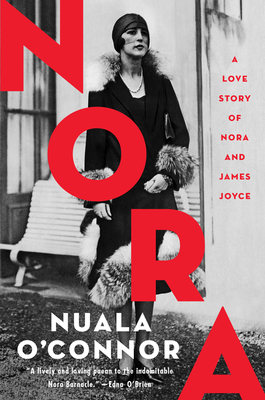
Review 2203: Nora

Nora is based on the movements of Nora Barnacle and James Joyce and on their letters, many of which, apparently, were quite explicit.

On an acquaintance of only a few, heated months, Nora Barnacle goes off with James Joyce to live in Europe despite his not believing in marriage. In 1904, she is 20 and has been working in a Dublin hotel after fleeing her family in Galway.

The life she takes on is difficult. Not only are they very poor and have no permanent abode after the job Joyce was promised at the Berlitz school in Zürich turns out to be a scam, but Joyce himself is difficult. He is a drinker and a spendthrift who buys gifts with the rent money. He is a jealous man who may not be faithful himself and likes to hear about the men Nora knew before him. He is selfish and superstitious, usually certain of his own abilities but not always.

As their life continues, Joyce gets work but never stays satisfied with it. He quits gainful employment to pursue fanciful projects. They have to borrow from his friends and family and move from place to place. Although he is gaining literary fame, he has trouble getting his books published without censorship. He leaves Nora home alone with the children to go drinking with friends and sycophants. Then there is the war, and his failing eyesight.

This is a fascinating depiction of a complex relationship. Aside from the difficulties of living with Joyce and a peripatetic life, Nora has to deal with family pressures and a mentally ill child. Yet her relationship with Joyce is one of fierce passion and love. Although I am not comfortable with explicit sex, I was otherwise wrapped up in this story.

Related Posts

Miss Emily

A Country Road, A Tree

Ghost Light

Day 774: Miss Emily

Cover for Miss EmilyLast year, I read the novel Amherst, which was mostly about Emily Dickinson’s brother Austin but depicted Emily hazily. The excellent biography White Heat, about Emily’s relationship with Thomas Wentworth Higginson, portrayed her more fully but she still seemed hard to grasp. The Irish poet Nuala O’Connor presents a more fully realized character—Emily in her middle age*—through her relationship to a (fictional) Irish maid.

Ada Concannon is a good worker but a bit too much of a free spirit for her Irish employer. She arrives at work one too many times smelling of the River Liffey, in which she has bathed on the way to work. She is demoted to scullery maid, and her mother decides there is nothing to be done but send her to America to find better opportunities.

Ada has good luck at first. She finds a pleasant home with her aunt and uncle in Amherst, and they soon learn that the Dickinsons need a new maid.

Emily Dickinson has insisted that her parents get a new maid after the old one left, because she is spending all her time on housework and none on writing. Although she loves baking, she is not really interested in most of the other chores. Other than poetry, her main interest is in her warm relationship with her sister-in-law, Sue, but Sue is busy with her family. When Ada arrives, Emily becomes fascinated by the small, neat maid.

Ada soon finds she is being courted. Daniel Byrne shows he likes her right away, and she is attracted to him. His boss’s son, Patrick Crohan, is also trying to get her attention, but she dislikes him.

When Ada finds she needs help, she has only Emily to turn to. Emily, in her turn, goes to her brother Austin.

link to NetgalleyThis novel is beautifully written, sometimes poetically, with delightfully old-fashioned chapter titles. It explores the relationship between two women across a class divide. The two main characters are interesting and convincingly developed. Austin is also developed more fully than the others, but is not as likable.

I enjoyed this novel, which made me feel as if I understood O’Connor’s fictional Dickinson as a person. Although Dickinson at 16 was just beginning to develop some of the quirks she becomes well known for, O’Conner her thinking believable.

*I originally said that Emily was 16, but Caroline of Rosemary and Reading Glasses pointed out that I was mistaken. I thought I saw a reference to her age, but perhaps I got the age reference mixed up with one about Ada. My e-copy is expired, so I couldn’t go back and look it up.

Related Posts

Amherst

White Heat: The Friendship of Emily Dickinson and Thomas Wentworth Higginson

The Invention of Wings