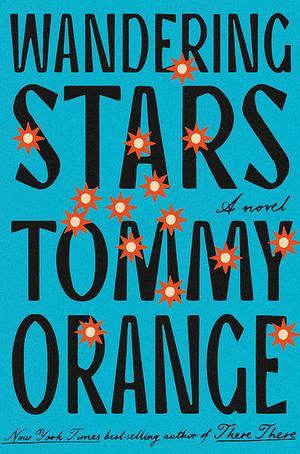
Review 2758: Wandering Stars

Wandering Stars is both a prequel and a sequel to Tommy Orange’s previous novel, There There. The novel begins in 1864 with the massacre at Sand Creek. A young boy, Star, escapes the massacre but is sent to school to eradicate all traces of his culture. He becomes the great grandfather of Opal and Jacquie Red Feather, characters from There There.

The novel follows Jude Star and his descendants as they suffer childhood mistreatment and cultural annihilation, many of them ending up as substance abusers.

About halfway through, we get to the Red Feather family that we already know, and particularly the grandsons of Opal and Jacquie: Loother, Orvil, and Lony. Slight spoiler—in There There Orvil ended up accidentally shot while dancing at a Powwow, the robbing of which provided the tension. As a result, Orvil, just beginning high school, ends up addicted to pain killers.

The family has been through one tragedy after another. Jacquie, the boys’ genetic grandmother, has just left a life of substance abuse and moved in with her sister Opal, who raised the boys after their mother died. The family was just beginning to be in a good place when the shooting occurred.

Much of the book deals with the characters’ struggles but also with their reflections about what it means to be an indigenous person, especially if you’ve been robbed of your traditions.

Orange’s writing style is unusual. At times, he likes his sentences to be very long. That didn’t bother me so much as the feeling that I felt closer to these characters in the previous book, except for Lony, who although very young is super intelligent but tends toward magical thinking. Yet, it turns out, he sees his family very well.

Related Posts

There There

The Sentence

The Mighty Red

Review 1353: There There

Cover for There ThereThere There is about the life of urban Native Americans. Set in Oakland, it follows numerous characters who plan to attend a powwow. However, we know from the beginning of the novel that some men are planning to rob the powwow.

The novel begins with a Prologue about depictions of Native Americans in popular culture. Then we meet Tony Loneman, a low-level drug dealer who is being compelled by his contacts to help them rob the powwow. Tony was born with fetal alcohol syndrome, so his thinking processes are not great, but when he puts on his regalia to attend the powwow, he sees a dancer in the mirror.

Dene Oxendene makes a presentation to a grant committee to get funding for a project to record the stories of Oakland Native Americans. The powwow is a good place to find them, and it’s not hard to image that Dene is Orange himself.

Next, we meet Opal Viola Victoria Bear Shield as a child in the late sixties, taken by her mother to occupy Alcatraz. With her is her sister Jacquie Red Feather, who is raped by a boy named Harvey. In the present day, Opal doesn’t plan to attend the powwow until she learns that her great nephew, Orvil Red Feather, plans to dance. Ultimately, Opal’s entire family, including Jacquie and Jacquie’s children, ends up at the powwow.

Another important character is Edwin Black, a young man who has spent his time since college trolling the internet and gaining weight. When he finds out that his father, Harvey, is a powwow emcee, he gets a job helping organize the powwow.

Although this novel is an angry one, it at least has a hopeful ending. However, it was marred for me by the promise of violence. Of course, that was the way to lend it suspense, but I had the same reaction to it as I did as soon as I saw the gun in Thelma and Louise. Although these people have a tough life, there isn’t any gun violence in it (although there is domestic violence) except for this plot device. I wish Orange had found a different way to hold his stories together.

Related Posts

A Brief History of Seven Killings

Telegraph Avenue

LaRose

Day 786: Telegraph Avenue

Cover of Telegraph AvenueArchy Stallings and Nat Jaffe own a vinyl record shop on the dilapidated Telegraph Avenue in Oakland. It makes a modest income but mainly provides a hang-out for the locals. Now Archy and Nat are worried because ex-NFL pro Gibson Goode is planning on opening a huge media outlet two blocks away that will include a department for vinyl. Archy and Nat thought that city councilman Chan Flowers was blocking the permits, but now he seems to have changed sides. Curiously, he has also begun asking Archy about the whereabouts of his father, whom Archy has not seen in years.

Luther Stallings and Chan Flowers were involved in a crime years ago before Chan became respectable. Luther went on to star in several Blaxploitation karate films in the 70’s, but for years he has been a has-been and a drug addict. Now, Luther is trying to shake down Chan for the money to make a third film in his famous series.

Archy isn’t altogether certain how he feels about losing his business, but he has other problems. His very pregnant wife Gwen has caught him cheating on her, and his 14-year-old son Titus from a previous relationship, ignored until now, has turned up and made friends with Nat’s son Julie. Furthermore, Gwen, who is in partnership with Nat’s wife Aviva as midwives, has lost her temper with a doctor at the only hospital that allows them admitting privileges, and a hearing is scheduled.

I had a harder time getting involved in this novel than I usually do with Chabon because I found Archy’s behavior reprehensible on many fronts. Of course, Chabon sometimes seems to specialize in the adolescent behavior of grown men, but I have less patience with it. However, Chabon gets in some digs at the lifestyles of Gwen and Aviva’s white middleclass clients, which is fun, and skewers the noir genre in general with the subplot involving Chan Flowers and Luther Stallings.

It takes awhile, but Archy is finally forced to consider his relationships with both his wife and his son. The energy of Chabon’s writing kept me engaged well enough, but the ending of this novel seems overly optimistic, given its web of difficulties.

Related Posts

Gentlemen of the Road

The Child in Time

That Old Cape Magic