Review 2327: Chenneville

John Chenneville, a Union officer, awakens in a field hospital in Virginia to find that the Civil War is over and he has been lying in a coma for months. He has a healing wound on his head where a chain hit him after an explosion. The war is over, but it takes him months to be well enough for the journey home to Bonnemaison in Missouri on the Mississippi.

Once home, he can tell something bad has happened, but he has to wait for his Uncle Basile to arrive from New Orleans to learn what it is. In the meantime, he occupies himself with trying to restore his ravaged estates. Finally, his uncle tells him that on another one of the family estates further south, his sister, her husband and baby have been murdered. His mother has gone to live with Uncle Basile and has not spoken since the event. After waiting longer to improve his strength and coordination, Chenneville sets off to avenge them.

He finds it is an open secret that they were murdered by a man named Dodd. Dodd was a deputy, and it’s clear that the sheriff is going to do nothing about it but has warned Dodd that someone is after him. After going on a wild goose chase, Chenneville learns that Dodd has fled southwest to Texas. He is killing people on the way, and Chenneville eventually finds himself a suspect for one of the murders.

Jiles seems to like writing about people on journeys, and she likes the setting of post-Civil War Texas. Chenneville finds in East Texas an area once more populous and prosperous, now wild and desolate. This novel is involving and eventful as you wonder how Chenneville can avenge his family without destroying his own life.
Related Posts

The Color of Lightning

Simon the Fiddler

News of the World

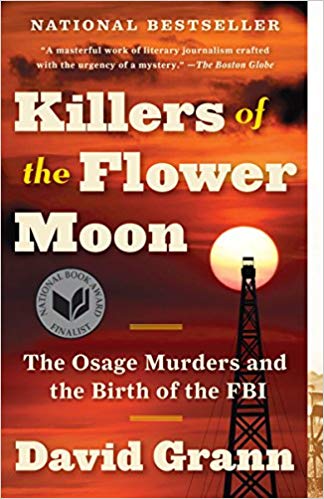
Review 1335: Killers of the Flower Moon: The Osage Murders and the Birth of the FBI

Cover for Killers of the Flower MoonDavid Grann’s book Killers of the Flower Moon details a past that was once infamous but now almost forgotten except in Osage country. In the 1920’s, the Osage nation in Oklahoma was the richest population per capita in the United States. This phenomena was a result of wise decisions by the tribal leaders during the 19th century land grab by the whites. They voluntarily moved from their homelands, purchasing land in Oklahoma that they thought white men would deem worthless. Then oil was discovered on their property. Because the nation had purchased the property, it couldn’t be taken back.

However, the federal government, in its infinite wisdom, deemed the Osage unfit to handle their own money. So, they appointed white guardians for them. As you can imagine, there were many eager to cheat these people out of their headrights, as were called their shares of the tribal fortune.

The Osage began dying. Grann centers much of his book on Mollie Burkhart, the Osage wife of Ernest Burkhart. One by one, her family started dying. First, her sister, Annie, was found shot in the head. Then her mother, Lizzie, died of a mysterious illness, believed by many to be poison. When her sister Rita’s husband, Bill Smith, tried to investigate, he and his wife and servant girl were killed one night when their house exploded. Other Osage were dying, too, and investigators either came up with nothing or were themselves murdered.

As the FBI was in its infancy and trying to figure out its own jurisdictional powers, new director J. Edgar Hoover decided that the Osage murders, which were becoming infamous as indicators of failure and corruption, would be good ones to solve. So, he sent out a former Texas Ranger, Tom White, to investigate.

Grann follows their investigation, and it is a fascinating one. This is a shameful period in our history that should not be forgotten. Grann goes further than the FBI, though, by looking into other deaths that were not investigated.

This book tells a mesmerizing story about a shocking time not so far in the past.

Related Posts

The Lost City of Z: A Tale of Deadly Obsession in the Amazon

The Midnight Assassin: Panic, Scandal, and the Hunt for America’s First Serial Killer

The Wicked Boy: The Mystery of a Victorian Child Murderer

Day 965: Strange Company

Cover for Strange CompanyI read about half of Strange Company but decided not to finish it. It just wasn’t the book for me. I thought it might be interesting because it is about Native Americans during the Civil War.

Roderick “Dhu” Walker is a member of a group of the Cherokee Nation called the Pins, for pins they wear under their lapels. They are traditional Cherokees on the side of the Union who begged the government to protect them from the Confederates under the terms of their treaty. The government did nothing, though, and the Confederacy has forced the Pins to fight on its side.

Before a battle in Missouri, some of the Pins decide not to fight but instead to kill Confederate soldiers during the battle. Dhu kills a couple men but mostly because they get in his way while he’s trying to escape. Later, though, he is captured by the Confederates as a deserter.

As a prisoner, Dhu is teamed up with a Union soldier and forced to fight him at the instigation of Captain Gordon Early. This amusement is only stopped by the intervention of the Colonel. When the Union soldier, Ben Lacey, tells Dhu that Early is off to escort a load of gold from Mexico, Dhu talks Ben into escaping with the idea that, along with some other Cherokees, they’ll intercept the shipment.

The novel moves along fast enough but does little else. There seems to be no idea of characterization. Sentences are short and choppy. Although the writing is grammatical, it is not polished by any means. Any metaphors are clichés. In short, the novel is not very good. If you are interested in reading a Western, you’ll be much better off with one of the “Related Posts” at the bottom of this post.

Disclosure: This eBook was sent to me by the publisher in exchange for an honest review.

Related Posts

The Son

Appaloosa

The Sisters Brothers