Review 2275: The Books of Jacob

The Swedish Academy that awarded Olga Tokarczuk the Nobel Prize for Literature called The Books of Jacob her magnum opus. It is certainly a stupendous novel at almost 1000 pages, carefully researched, minute in detail, taking on such subjects as the nature of religion, forgiveness, the interconnectedness of things. It is a dense historical novel about a real figure in history, Jacob Frank, the head of an odd religion, a Jewish heresy.

Frank emerges from another Jewish heresy, a group called the Shabbatians, who believe the Messiah has already come and therefore according to teachings, the Mosaic law is broken. The new law, according to Frank, is whatever he says to do. This story is told from multiple perspectives, notably that of Nahman, one of his earlier followers, who attempts to document his life and beliefs.

The movement, which begins in the mid-18th century, is formed mostly of Shabbatians, some of whom are merchants but others of whom are very poor. Frank’s teachings seem to consist mostly of story telling, but as with other cult leaders, one big feature is the sexual exploitation of women, first by all of them sucking a woman’s breast and later by Jacob assigning men partners even from the unmarried girls. You can guess that Frank is charismatic.

This fantastic story follows this group of people, which gets larger and larger, first from southeastern Poland down to Turkey, where Jacob briefly converts to Islam, then back to Lwow in Poland. There, they are attacked by the Talmudic Jews until from revenge they tell the authorities that it’s true that Jews use Christian blood in their rites, a lie that ends in the execution of 14 Jews, including rabbis.

After fleeing Poland again, Jacob decides that their route lies with conversion to Christianity, an act that he can justify with teachings but that also has the end goal of the members being allowed to own land and gain other honors denied them as Jews. Although the path is not always smooth and a lot more traveling ensues, the upward mobility of the group after that decision is phenomenal. Ultimately, Jacob becomes an intimate of the King of the Habsburg Empire.

The research that this novel reflects is phenomenal. As a reader, I was often enthralled but reluctantly had to put up with some deep philosophical discussions, including deeply confusing ones about numbers, since some of the members are kabbalists. The most difficult part of it, though, was the sheer number of characters, especially Frank’s followers. I was keeping up okay until they converted and all changed their names. Then I was usually lost.

I wouldn’t recommend this book as the first you read by Tokarczuk, and it’s certainly not an easy read, but it’s a fascinating story.

Related Posts

Drive Your Plow over the Bones of the Dead

Flights

Zealot: The Life and Times of Jesus of Nazareth

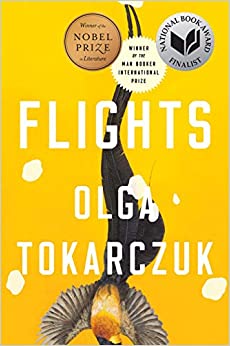
Review 1611: Flights

Olga Tokarczuk’s Drive Your Plow over the Bones of the Dead was unusual, but Flights is in another category altogether. It is an attempt to escape the boundaries of the conventional, linear novel.

It is written in snippets. Some of them are stories, some little vignettes or descriptions, some philosophical discursions, some lectures. Some of the snippets are observations from the narrator, an unnamed Polish woman who likes to be constantly traveling, often to visit museums of curiosities, particularly those that show the workings of the human body. Others are stories about people she meets on her journeys or just stories about people. Some of the threads recur in the novel; most do not.

Anchoring all this is the theme of movement. Most of the stories are about people on their way somewhere else, occasionally to another stage of being.

This novel was widely acclaimed by reviewers and won the Man International Prize. How it will strike ordinary readers is hard to guess. It’s not easy. I found parts of it interesting and other parts, particularly the lectures on travel psychology, which I doubt anyone would ever listen to, incomprehensible, as if someone were reading from a dense professional manual.

Related Posts

Drive Your Plow over the Bones of the Dead

Outline

Ducks, Newburyport

Review 1524: Drive Your Plow over the Bones of the Dead

Mrs. Dusczejko lives in a tiny Polish village near the Czech Republic, so remote that they get Polish or Czech police depending upon where in town they call from. In the early morning, her neighbor, whom she calls Oddball, comes to get her, telling her he has found their other neighbor’s body. Although she hates this other neighbor, whom she calls Big Foot, because he’s a hunter and she believes it’s a crime to kill animals, she helps him make the body decent before the police arrive. Later, it’s determined that he died from choking on a deer bone.

Mrs. Duszejko is an eccentric old lady who spends her time doing astrological charts, helping an ex-student translate William Blake’s writings into Polish, and writing letters to the police complaining about poaching. After a few months, though, her life is disturbed when men in the area begin dying in a series of bizarre killings.

This is an unusual crime story that’s not so concerned about the criminal case as it is about the activities of its characters. It is sometimes funny and always atmospheric. I really enjoyed it.

Related Posts

The Secret in Their Eyes

My Darling Detective

With Fire and Sword