 Best Book of the Week!
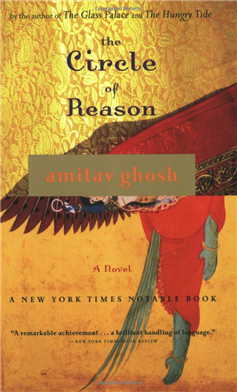
Although magical realism is often mentioned in reference to The Circle of Reason, as Amitav Ghosh said himself in an interview for the New York Times review, there is nothing fantastical that happens in the book. Still, it continues to be compared to the works of magical realists such as Gabriel García Márquez or Salman Rushdie.
These comparisons may be because of the book’s rambling narrative style or its peculiar characters. The main character is Alu Bose, but we get to him only slowly through his uncle Balaram, a scholar turned teacher in a small village in India who develops a mania for the pseudo-science phrenology and worships Louis Pasteur. As Alu’s head is covered with odd-looking bumps, like a potato, he provides a subject of endless study for his eccentric relative.
Later, Balaram becomes obsessed with cleansing the village and begins a campaign to convince the villagers to coat every object with carbolic acid. His feud with the local politician combined with his obsession results in disaster, and Alu ends up fleeing India because of being mistaken for a terrorist. He is pursued by a policeman named Jyoti Das, who would rather be an ornithologist.
Thus begin Alu’s adventures, first in the Middle Eastern port of al-Ghazira, where he develops his own obsession for cleanliness, and then moving farther west, ending up in Algeria. On the way, readers encounter a myriad of other characters and stop to hear the stories of their lives or learn a little bit about weaving, say, or the history of al-Ghazira.
I was less reminded of magical realism than of One Thousand and One Nights, the tales of Scheherazade in which, in the middle of one tale, another begins. I attempted to read them at one time but despaired that I would ever get to the end of a tale or keep the various stories straight. Luckily, Ghosh’s narrative is a little more coherent, although not much. It is purposefully rambling, running off in delight to tell one fabulous story after another.
The novel is wonderfully well written, beautifully written, but sometimes I wondered where it was going or what the plot actually was. The feeling was only momentary, however, because I was always compelled onward. The ending is actually satisfying and less chaotic than I expected.
When I read that Ghosh wanted to write something like Moby Dick, that explained a lot about the novel’s narrative style. Fortunately for us, Ghosh’s style is a lot more accessible than Melville’s. Still, I prefer some of his more recent novels, particularly Sea of Poppies and River of Smoke. The Circle of Reason is Ghosh’s first novel, and he keeps getting better and better.


 What? Me Read?