Day 827: Flood of Fire

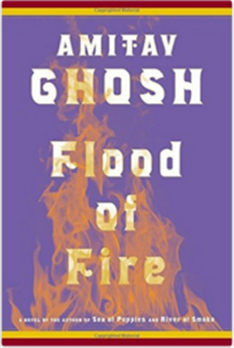
Cover for Flood of FireBest book of the week!
In the third book of his Ibis trilogy, Flood of Fire, Amitav Ghosh slowly draws most of his characters to China during a momentous period in history. The only major character missing from the first book is Deeti, making a home on Mauritius. And of course Bahram Modi, who died at the end of River of Smoke.

It is with the absent characters that we start, in a way, for at the beginning of the novel, Kesri Singh, Deeti’s brother, is unaware of what has happened to her. It is through Kesri that Deeti’s family met her husband, for he was brother to Subedar Nirbhay Singh, the highest-ranking sepoy in the battalion to which Kesri belongs. Kesri is a new character, and we go back in time to learn how Deeti helped him join the battalion and how Kesri, although wary of the character of Deeti’s proposed husband, encouraged the match to further his own ambitions. As those who have been following the series know, that did not turn out well.

Shireem Modi, Bahram’s wife, is finding her life uncomfortable since her husband died. Because his opium was confiscated by the Chinese government, she is left with nothing, dependent upon her own family. But soon her husband’s friend Jadig Karabedian arrives and tries to talk her into traveling to China to represent herself in the opium sellers’ claims against the Chinese government; otherwise, her claim may be disregarded. He also finds it necessary to tell her about Ah Fat, her husband’s illegitimate son.

Zachary Reid has finally been acquitted of blame for the incident on the Ibis but finds himself assessed fees that he cannot pay because his mate’s license has been suspended. He goes to work for the mysterious Mr. Burnham (who, although barely present, seems to affect all the events in the series) restoring a boat. There he is led into a dangerous relationship with Mrs. Burnham.

Neel, the rajah who ended up in prison for his father’s debts because of Mr. Burnham’s desire for his property, is still in China working at an English-language press. As the British Empire draws together a force to invade China, bringing most of the other characters there, Neel begins working for the Chinese government as a translator.

This trilogy clearly depicts Britain, driven by the greed of the opium growers and sellers, as the bully of Asia. Sea of Poppies shows how the Indian farmers were forced to abandon food crops to grow opium poppies, and how then the price of opium was manipulated to make them subsistence farmers. River of Smoke shows British efforts to force the Chinese to import opium, including the lies conveyed back to the British public about the behavior of the emperor. Flood of Fire draws all of our friends back to China to culminate in the First Opium War, when the British stuff opium down the throats of the Chinese.

Overall, I was very satisfied with this series. Ghosh is able to get you completely involved with his characters and is playful and inventive with language. Although I was not happy with the evolution of the character of Zachary Reid from a naive young man to the person he becomes, this is a great series.

Related Posts

Sea of Poppies

River of Smoke

The Siege of Krishnapur

Day 262: River of Smoke

Cover for River of SmokeA month or two ago I reviewed Sea of Poppies, Amitav Ghosh’s riveting first book in his Ibis trilogy. I have been waiting since then for a good opportunity to post my review of River of Smoke, the second book in the trilogy.

The various passengers and crew members of the Ibis have been separated and now several of them travel toward China on three different ships. Paulette Lambert has been taken on the Redruth by Filcher Penrose, a nursery man for a major botanical garden who hopes to exchange New World plants for those of China. He has hired Paulette, whose father was a renowned botanist, to help take care of the plants.

En route to China with a shipment of opium, the merchant Bahram Moddie, Ah Fat’s father, takes on the disgraced Raja Neel as a munshi, or clerk. Neel travels on the Anahita to Canton in Bahram’s entourage under the name of Anil Kumar.

The Ibis, now containing the owner Benjamin Burnham, is also on the way to Canton.

In Macao, Paulette meets a friend from her childhood, Robin Chinnery, the unacknowledged illegitimate son of a famous painter. As a woman, Paulette is not allowed into Canton. She can only go as far as Hong Kong, then a desolate, almost uninhabited island, where she searches for plants. But Robin goes on to Canton with a mission to try to find out for her and Penrose who painted a picture of a golden camellia and possibly to trade for such a plant.

Robin is in town during the unsettled days before the beginning of the Opium Wars, when the Chinese Emperor is trying to halt the opium trade into China, while the opium traders are purposefully trying to instigate war so that they can call for the intervention of the British navy. Robin’s entertaining letters to Paulette keep us informed about the political debate as he is befriended by Charles King, the only merchant of stature who believes China is in the right.

Bahram Moddie, a well-meaning man who loves Canton on sight, has unfortunately invested his entire fortune in this shipment of opium. He is caught between his conscience and his need to be successful as the Chinese government tries to keep the foreign ships at bay.

As rich in language and storytelling as the first book, this novel is completely engrossing, showing the American and British opium dealers as the venal, hypocritical men they are, with their self-serving arguments about Free Trade and their arrogant disdain for their Chinese hosts. I’m afraid it may be two or three years of waiting before I can read the final book in the trilogy.

Day 218: Sea of Poppies

Cover for Sea of PoppiesSea of Poppies is an absolutely enthralling historical novel, the first of a trilogy. Set in India in the 1830’s, it is centered around the opium trade, which the British East India Company forced upon both India and China. The novel is an ensemble piece, following the fates of several characters who all find themselves by the end of the book on the Ibis, an old slave ship bound for Mauritius.

The novel begins with Deeti. Like the other Indian farmers in her area of eastern India north of Calcutta, she has been forced to replace her food crops with poppies, destined for the Ghazipur Opium Factory. Now she can barely grow enough to feed her family, while the price for poppies sinks. As a girl, she was tricked by her husband’s family into marrying a hopeless opium addict. Soon fate will cause her to leave her home and flee down the Ganges.

Zachary Reid is a mulatto sailor who ships out from Baltimore on the Ibis as an ordinary seaman. A series of misfortunes onboard leave him without officers to sail the ship to Calcutta from Africa with only the help of Serang Ali and his fellow lascars. Once in Calcutta, his employer Benjamin Burnham hires him to help refit the ship and take the third mate position for the voyage to Mauritius.

Raja Neel Rattan Halder, the zemindar of Rashkali, is deeply in debt because of poorly timed investments in the opium trade. Although Neel is careful of the welfare of his hundreds of dependents, he is careless of business and expects to go on in his pleasure-loving ways. But the self-righteous Burnham wants the Raja’s estates for himself.

Paulette Lambert, the daughter of an eccentric French naturalist, has been left destitute by his death. Burnham has taken her into his family out of charity, but she is having a hard time adapting to his household. She is expected to behave like a proper young English lady, but she was primarily raised by an Indian woman, treats her son Jodu like a brother, and prefers to dress in a sari. Jodu has recently returned to Calcutta after his mother’s death and wants to be taken on as a hand on a sailing ship.

The fates of all these characters, and others, converge aboard the Ibis, which is scheduled to journey across the Indian Ocean to Mauritius with a load of indentured workers and then to sail to China to participate in the impending Opium Wars.

The novel is filled with entertaining characters and the colors, smells, and languages of India. It is beautifully written and crammed full of unusual words–Bengali words, sailor and lascar jargon, ornate oriental English, and various patois. The book has a glossary, but it is ironically intended. Comic, cruel, vivid, and deeply engrossing, the novel is rich and teeming with life. Amitav Ghosh’s novel, which was shortlisted for the Man Booker Prize, is wonderful.