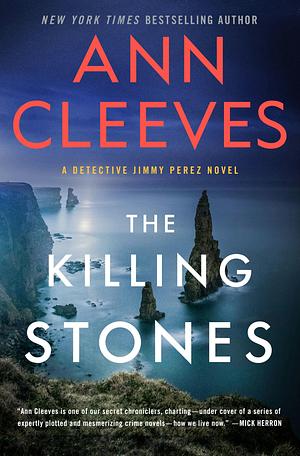
Review 2662: The Killing Stones

Ann Cleeves retired the Jimmy Perez series a while back, so I was delighted to hear she had brought him back. He has moved from the Shetland Islands to the Orkneys—with a milder climate and more pastoral scenery—and lives with his partner and boss, Willow, and their three-year-old son, James. Oh, and it’s the Christmas season. What better time for a mystery than Christmas?

Willow is away from their home on the mainland island when Jimmy gets an urgent call to Westray Island. His good friend Archie Stout, whom he was raised with, is missing. Archie’s wife Vaila says he was on his way to meet pals at the pub but never got there, a concern with Jimmy as there was a big storm that night. Jimmy finds Archie at an old archaeological dig, where his head has been mashed by one of the Westray story stones—two Neolithic stones with Viking inscriptions that Archie’s father helped discover and interpret. Unfortunately, because of the storm, evidence is thin.

Willow takes Jimmy off the lead because he’s too close to the victim and leads the case herself, even though she is on maternity leave and a few weeks out from having their baby. Jimmy returns home to follow up leads on the mainland. They find that Archie was upset because, since his father Magnus’s death, he has found his notebooks showing that Magnus, a self-educated farmer, did most of the work on the Westray stones even though Tony Johnson, a professor who visited occasionally, had taken all the credit, a discovery which launched Tony’s career. Tony and his wife were on the island the day of the murder. But there are other leads, including Archie’s possible affair with his wife’s ex-friend Rosalie Gruman.

Jimmy, following up on the mainland with anyone who had been on Westray the night Archie was killed, has been trying to talk to George Riley, a schoolteacher. But before he can meet him, George is also found dead, killed with the second stone. Jimmy finds out that George was writing a children’s book about the discovery of the stones that alleges Johnson stole Magnus Stout’s work.

If I have any criticism of this book, which moves right along and is certainly perplexing, it’s that Cleeves provides almost no information that could lead readers to the killer until the very end. However, she does a great job at misdirection. I’m not really sure what I think of Willow, who does a lot of the investigating in this one. She appeared in several previous books, but I still don’t have much sense of her.

Related Posts

Wild Fire

Cold Earth

Too Good to Be True

Review 1897: The Metal Heart

On the Orkney Islands in 1942, a German U-boat attack on Scapa Flow leads the British to fortify the seaway’s defenses using Italian prisoners of war as labor. The Italians are located on the small island of Selkie Holm, one avoided by the islanders because of its evil reputation. However, twin young women, Con and Dot, also live there, having moved to a ruined bothy after events on Kirkwell that are not at first explained. Con is afraid, though, of Angus MacLeod.

When the Italians arrive, one falls overboard, and Dot dives in to save him. His name is Cesare, and he begins working in the camp commander’s office and trying to find ways to help the girls. However, he is stopped by the brutality of guard Angus MacLeod.

I liked Lea’s The Glass Woman, and I also like her apparent preference for placing novels in remote northern locations. However, I just wasn’t feeling it here. I felt as if the characters were being put through their paces, not as if the story evolved naturally. I also felt a certain sense of manipulation. Although I was interested to find out why the girls’ parents had vanished, I wasn’t very interested in the love story. I read about half the book, then stopped.

Related Posts

The Glass Woman

The Tolstoy Estate

The Girl from the Channel Islands

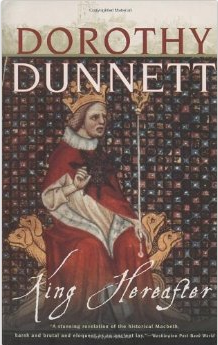
Day 526: King Hereafter

Cover for King HereafterBest Book of the Week!
What most of us know of Macbeth, King of Scots, is taken from Shakespeare, from a play he wrote in honor of King James I of England. It is perhaps no coincidence that James I was a descendant of one of Macbeth’s enemies. King Hereafter presents an interpretation of Macbeth’s life from the master of historical fiction, Dorothy Dunnett, herself a Scot. You may well imagine that the Scots have a different version of the story than did the English and Shakespeare.

For some way into this novel, you may wonder when Macbeth will even appear, for it begins in Norway with a Viking and his foster son. Thorkel Admundason has left his foster son Thorfinn in Moray with his stepfather Findlaech for a few months while Thorkel attends the Norwegian court. Thorfinn is one of what had been three earls of Orkney—Thorkel recently killed one of them and is at court to learn his punishment. But Thorkel soon hears that Brusi, the other earl, has arrived to complain to the throne that Thorfinn has demanded half of the islands from him.

Thorkel is angry at the behavior of his 13-year-old foster son, who may have gained what he wanted if it was approached another way. In the end, not only does Thorfinn not receive more of Orkney, but he is forced to pledge himself as King Olaf’s vassal.

Thorkel has almost broken with Thorfinn entirely when he learns why Thorfinn fled to Norway. While Thorfinn was in Moray with his stepfather, Findlaech was burned to death in his hall by his two nephews. Thorfinn ends their conflict by begging Thorkel to teach him to think like a man.

Of course, Thorfinn is the young Macbeth, or rather Macbeth is the Christian name he takes later. In Thorfinn’s time of the 11th century, Christianity was not widespread in northern Scotland.

Thorfinn straddles cultures and religions. He is mostly of Celtic descent and was raised partly in his Celtic stepfather’s house, but as an Orkney man he is a Viking. He eventually comes to rule an area incorporating Scots, Norse, Irish, and Saxon subjects. He must speak Gaelic, Norse, and Saxon to rule them.

By the time his grandfather Malcolm, King of Alba, dies, Thorfinn is ruler of part of Orkney and of Moray. He has avenged his stepfather’s death by burning his enemies and has consolidated Moray by marrying Groa, the wife of one of his victims.

However, only when his cousin Duncan, by that time King of Alba, attacks Moray in an attempt to take it from Thorfinn does Thorfinn fight and kill him. With Alba part of Thorfinn’s dominion, he realizes he must learn to rule differently, to try to make of the entire territory of Scotia something resembling a nation instead of a collection of settlements with no towns or roads.

Fans of Dorothy Dunnett’s other novels will not be surprised at the meticulous research that went into this novel. Nor will they be surprised to find that Thorfinn is immensely capable and intelligent but frequently misjudged. This novel is wide ranging in scope, as Thorfinn masters the politics of Europe and struggles with the various intrigues between the Irish and Latin churches. For he must decide which religion will unify his people and serve them best.

Since Dunnett is a master of characterization as well as historical detail, the novel is full of vibrant characters. Thorfinn at first merits the respect and eventually the love of his followers. He has a handful of friends who are important characters. Although they misunderstand each other at first, he eventually enters into a deep love and partnership with his wife Groa.

No witches are part of this novel, but there is Luloecen, his stepson with second sight. He tells Thorfinn his fate very soon upon meeting him.

Yes, the woods of Dunsinane play a pivotal part in the plot. If you enjoy historical novels that are rich in detail and steeped in their time period, you will like this book. Like all of Dunnett’s novels, it is complex, yet full of excitement and adventure. King Hereafter is a clever, romantic, and intricately plotted novel.