Day 1278: The Forty Days of Musa Dagh

Cover for The Forty Days of Musa DaghBest Book of Five!
In 1915, the Ottoman Empire decided to make a scapegoat of its Armenian subjects. It declared all Armenians to be subversive and began “relocating” them to the deserts of Syria. Those who did not die on the way from starvation or mistreatment starved to death upon arrival. In this way, the Turks rid themselves of 1.5 million Armenians, a fact the Turkish government still denies.

In the shadow of the mountain named Musa Dagh, the inhabitants of seven villages decided not to go. After the villages received the news that they would soon be relocated, they sneaked supplies and livestock up into the mountain. Then, the day before the evacuation, they walked up onto Musa Dagh. There, for forty days, they managed to defeat the Turkish army’s attacks until they were rescued by the French navy. Although there were casualties, more than five thousand people were rescued.

The Forty Days of Musa Dagh is considered Franz Werfel’s masterpiece—his fictional account of the event. The main character is Gabriel Bagradian, a wealthy man raised in Europe who has recently returned to this family home after the death of his older brother. He is a reserve army officer, and when he reports to the regional capital to find out why he hasn’t been called up, he hears disquieting rumors.

Back home, he consults with village leaders until the arrival of Aram Tomasian, a Protestant pastor who was relocated with his family from another village. He and his family have been allowed to travel to his father’s village, the authorities thinking it will not affect his fate. But he is able to tell the villagers what is happening during the relocations.

Gabriel has been trying to save his French wife, Juliette, and his son, Stephan. But now he proposes that the villagers ascend Musa Dagh and defend themselves. Only the followers of one church decide to cooperate with the Turks.

At 800+ pages, this novel is very long, but completely absorbing. Werfel’s characters are not heroes but complex people. The novel is suspenseful because even though we know the result for the village as a whole, we don’t know what will happen to the individual characters. The villagers have deserters, loss of their livestock, a fire in their grainery, and other hazards to navigate. I don’t know any other way to explain it but to say this. This novel is fantastic. It is absolutely what I look for in a good novel, where I can immerse myself in another world for a short while.

P. S. If you are interested in reading more about the Armenian genocide, another touching novel is Birds Without Wings by Louis de Bernières.
Related Posts

The Bastard of Istanbul

In the Shadow of 10,000 Hills

A God in Every Stone

Day 482: The Map of Love

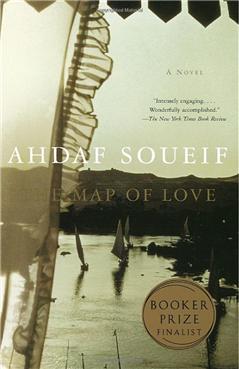
Cover for The Map of LoveBest Book of the Week!
The Map of Love is an absorbing novel to read now, just after the Arab Spring and during the troubled times that have continued on. It is a love story certainly, its title tells you that, but it also explores the roots of the political turmoil in present-day Egypt and some of the other countries that used to be a part of the Ottoman Empire.

The novel follows the course of two cross-cultural love affairs 90 years apart. In 1900 Anna Winterbourne travels to Egypt in an attempt to overcome her grief. She is the widow of a man who recently served in the Soudan, and even though their marriage was not a happy one, she is sorrowful that she could not help him overcome his despair at participating in an unjust war. Almost accidentally, she meets Sharif al-Barroudi, a Cairo lawyer and activist, and falls in love with him.

Anna’s diary and letters are discovered by her great-granddaughter, Isabel Cabot. Isabel herself has fallen in love with ‘Omar al-Ghamwari, a famous Egyptian-American orchestra conductor who is rumored to work with the Palestinians. ‘Omar feels that their age difference is too great for a relationship, but he suggests that Isabel take her find to his sister Aman in Cairo so that she might help Isabel translate some of the materials.

Aman becomes absorbed in reading Anna’s diaries and letters and realizes very soon that she and Isabel are related, for Anna’s beloved sister-in-law Layla is Aman’s own grandmother. With Layla’s diaries of the same time period, she begins to reconstruct Anna’s story and that of Egypt’s history during a turbulent period. Aman has returned from life abroad to live in Cairo in another turbulent time.

Anna’s courtship is fraught with difficulties, but once she and Sharif are married, she is caught up in his work for Egyptian independence from the Ottoman Empire and from British oversight. As the years go by, his efforts extend to attempts to keep Palestinian land, once owned by his family and by his neighbors and occupied by hundreds of thousands of Muslims, from being bought up by Zionists who would expel them.

The blurb for this novel stresses the similarities between the two love stories, and there are many points of similarity, but the focus of the story in the current time is more with Aman than with Isabel and ‘Omar. Aman is at first at loose ends in Cairo, but she becomes involved with trying to help the fellaheen who occupy her family’s land, as they are treated unjustly by a corrupt and paranoid government. I was frankly more interested in Aman and in Anna and Sharif than I was in Isabel and ‘Omar, who are much less present in the novel.

For me, not very politically aware in regard to problems in this part of the world, this was a fascinating and revealing reading experience. It points up the complex history of the area from a point of view we westerners seldom hear. It is affectingly told in the context of a great love affair between two lovingly created characters. The characters of the two sisters, Layla and Aman, are also vivid. This novel is beautifully written and evokes for us a vibrant culture.

Day 334: Pawn in Frankincense

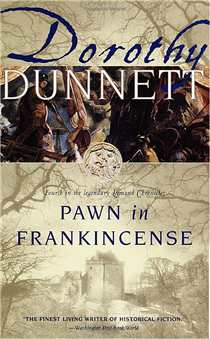
Cover for Pawn in FrankincenseBest Book of the Week!

In the fourth exciting book of the Lymond Chronicles, Francis Crawford of Lymond sets out to find his two-year-old child by Oonagh O’Dwyer, hidden somewhere in the vast Ottoman Empire. He disguises his personal mission with the official one of delivering an elaborately decorated piano from the King of France to the Sultan in Constantinople. Another goal is to find and kill the traitor Graham Mallet Reid, who has the child in his power. The problem of the child is complicated because Lymond doesn’t know which of two boys, one Reid’s by his sister Joleta, is his own. Another complication is that if any harm comes to Reid, the boys, under the protection of Sulieman, will both be murdered.

Accompanying him and his household are a couple of merchants, including the mysterious Marthe. Raised in the household of the Dame de Doubtance, Marthe, except for her sex, could be Lymond’s identical twin.

After some disastrous adventures, Lymond believes he has sent home the redoubtable fifteen-year-old Philippa Somerville, who foisted herself upon him thinking he would need her help to care for the child. However, she is actually on her way to join the seraglio to find one of the boys, Kuzum, while Lymond searches in the stews of the city for the other one, Khaireddin. Philippa’s role in this novel is a major one, with her character and her opinion of Lymond changing and maturing as their adventures continue.

Aside from the intrigues taking place in an empire that is Byzantine in its complexity (not to make a pun), Lymond is hampered in his activities because of sabotage by a member of his own household staff. He also suffers from his usual problem of failing to explain his actions to his adherents, such as Jerrott Blyth, so that they become angry and occasionally work against him.

In action that moves from Marseilles across Europe to North Africa and finally to Constantinople, Lymond’s concerns grow to involve the fate of nations.