Day 966: Last Post

Cover for Last PostBest Book of the Week!
This last volume of Ford Madox Ford’s modernist work Parade’s End is unique in that its main character, Christopher Tietjens, barely appears, even though the book continues to be about him. It may be my imagination, but it seems as if he has been less of a presence with each book.

This volume is narrated from the point of view of four characters during a single day. Mark Tietjens, Christopher’s older brother, begins and ends it. Mark has been overcome by a stroke and is not speaking. He and his wife, Marie-Léonie, are living in a country cottage with Christopher and Valentine Wannop. They have built Mark a hut with no walls from which he watches and listens to the events of the countryside.

It is some time after the events of volume 3, but Mark remembers Armistice Day and the days following that brought them to the cottage. The peace of the cottage is about to be disturbed, though, because the vengeance of Christopher’s wife, Sylvia Tietjens, has provoked a number of people to descend upon it.

Sylvia has incited the eccentric tenant of Groby, the Tietjen’s ancestral home, to fell the great tree of Groby, and it has taken part of the house with it. Mrs. de Bray Pape has been egged on by Sylvia to belatedly ask permission from Mark. Accompanied by Christopher’s son, Mark, who keeps trying to draw her away, Mrs. de Bray Pape subjects the older Mark to an inaccurate lecture on history. Since Sylvia has hinted to everyone that Mark is ill from syphilis, they can’t understand why he won’t speak to them.

Subsequent sections of the volume are from the points of view of Marie-Léonie, Valentine, and Sylvia. As the cottage environment descends into chaos with the arrival of more visitors urged on by Sylvia, Sylvia makes a momentous decision.

Although I have not read much about Ford’s life, some of the notes in my annotated edition by Carcanet lead me to believe the novels are at least partially autobiographical, both in the portrayal of the war and in the personal relationships. I have really enjoyed this novel about a man who is completely misunderstood because his name has been blackened by his ex-wife and the wife of a woman whose husband owed him money. Some of the novel deals with the idiocy behind World War I, but it is mainly about the end of an era. Christopher thinks of himself as a man who belongs in the 18th century, and he is a symbol for the destruction of a way of life, with of a kind of outlook that others think must be dragged into modern times. I will be looking for more by Ford.

Related Posts

Some Do Not

No More Parades

A Man Could Stand Up

Day 939: A Man Could Stand Up

Cover for A Man Could Stand UpBest Book of the Week!
At the beginning and end of A Man Could Stand Up, the third book of Ford Madox Ford’s Parade’s End, it is Armistice Day. In between, the book returns in time several months to the front.

Valentine Wannop is at her job as a schoolmistress in a London school when classes are dismissed because of the Armistice. But in the midst of all the confusion, Valentine receives a spiteful phone call from Lady MacMaster about Christopher Tietjens. Since Lady MacMaster has been spilling her poisonous lies to the headmistress, Valentine finds herself having to make plain to her what she barely understands herself.

Months earlier, Tietjens has been ordered to take second in command of a unit at the front. He was in a much safer position in charge of moving men, but General Campion has, as usual, miscontrued the events in the second book between Tietjens and his faithless wife and has transferred Tietjens to a position of more danger. Unfortunately, his commanding officer has been drinking too much, and Tietjens has to remove him from duty. The novel depicts the events of a chaotic night during a bombardment.

This novel has been considered one of the best books about World War I. Certainly I have enjoyed every minute reading about the principled Tietjens, whose every action has been misinterpreted, and his so far unfulfilled affair with Valentine Wannop.

Related Posts

Some Do Not

No More Parades

Goodbye to All That

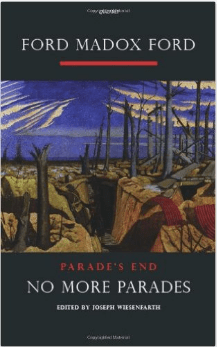
Day 926: No More Parades

Cover for No More ParadesBest Book of the Week!
The second book in Ford Madox Ford’s tetrology about World War I, No More Parades, begins as Christopher Tietjens is busy preparing a draft of men for the front in an atmosphere of almost total chaos. The discussion between Captain Tietjens and his fellow officers reveals the difficulties of this task, with shortages, supplies withheld from his troops because they are Canadian, and contradictory orders.

During this night, Tietjens is not able to retire to bed because of his duties. And one of his men is killed because of the lack of a helmet during a bombardment, helmets having been refused them. Since Tietjens recently refused the man leave because of fears he would go home and get himself killed over an unfaithful wife, he blames himself for the death.

Tietjens is already feeling rocky when Colonel Levin comes to tell him that his wife Sylvia has arrived. Levin has been sent by General Campion to advise him of this extremely compromising situation, women not being allowed there and Sylvia having come without papers.

Tietjens was under the impression that Sylvia had left him, after an evening where she acccused him of infidelity with Miss Wannop just before he returned to the front. He is in love with Miss Wannop, certainly, but he has never acted on it. In fact, it is Sylvia who has been consistently unfaithful.

Sylvia, though, is torn between the need to get some sort of reaction from Tietjens and the realization that she wants him back, that in fact, no man seems adult after him. However, she continues to try to injure him with his family, his commanding officer General Campion, and society.

This volume is a fascinating portrait of two unusual characters—Tietjens with his old-fashioned morality and Sylvia with none at all. This story is an indictment of the conduct of war but also a tale about a disappearing kind of man.

Related Posts

Some Do Not

Goodbye to All That

The Happy Foreigner

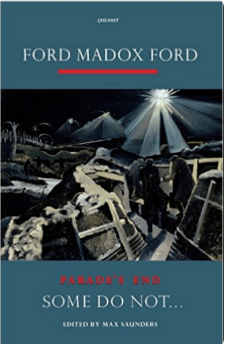
Day 903: Some Do Not

Cover for Some Do NotBest Book of the Week!
Some Do Not is the first volume of Ford Madox Ford’s tetrology “Parade’s End,” which is considered one of the great novels about World War I. For those who are interested, an excellent TV series came out a few years ago starring Benedict Cumberbatch (or maybe for those who are interested in Benedict Cumberbatch).

When we first meet Christopher Tietjens in 1912 or so, he is separated from his wife Sylvia and on a golfing trip with MacMaster, his coworker and friend from school days. We eventually learn that Sylvia was having an affair with a married man when she met Tietjens, and the paternity of their son is in question. Sylvia has run off to Europe with a lover, but Christopher has just received a letter from her asking to come back.

Christopher Tietjens is a big clumsy man who is a sort of genius with facts and figures and works for the government. (That was the one weakness of the casting of Cumberbatch, who is neither big nor clumsy, in the part, as several times he is forced to refer to himself that way, which struck me as odd before I read the book.) He is also absolutely principled and honest. He agrees to take Sylvia back because that is how a gentleman behaves.

On this golfing trip, though, complications begin that are to affect the rest of his life. A member of the golfing party is General Campion, an idiotic but well-meaning man who likes Sylvia and so thinks that any problems in the marriage must be Christopher’s fault. When Christopher helps a couple of suffragettes escape from the police, the General immediately concludes that one of them, Valentine Wannop, must be Christopher’s mistress, even though Christopher has never met her before. Later on, similar misunderstandings contrive to blacken his reputation.

Egging everyone on is Sylvia, who takes a long time to understand the character of her husband. She believes he and Valentine must be lovers and even spreads the rumor that he is sharing a mistress with MacMaster. Mrs. Duchemin, whose husband is an academic with mental issues, is indeed having an affair with MacMaster, but Christopher’s only crime is to help MacMaster financially. Some of Sylvia’s ex-lovers or would-be lovers are also eager to harm him.

Christopher does fall in love with Valentine, but he doesn’t act on it because he is incapable of treating her dishonorably. With social ruin threatening him, he goes to war.

I tried out this first volume to see if I would like it after having watched the TV series. As soon as I finished it, I ordered the other three volumes. This is a great novel, about how a completely honorable but reticent man is misunderstood and dishonored by almost everyone around him.

Related Posts

Goodbye to All That

The Summer Before the War

The Happy Foreigner