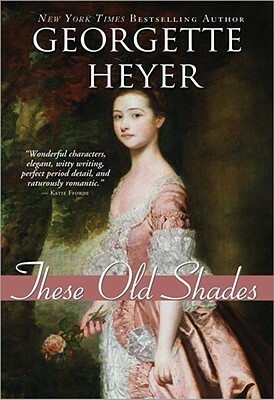
Review 2482: These Old Shades

In trying to fill some of the holes in my Century of Books project, I noticed that These Old Shades, which I haven’t read for many years, would help. This novel is Heyer’s first, and it is also the first of four about the Alastair/Audley family. (The others are The Devil’s Cub, Regency Buck, and An Infamous Army.)

Late on a mid-18th century night, His Grace of Avon Justin Alastair is walking through a Paris slum when a boy collides with him. The boy is fleeing his brutish brother. On impulse, the Duke buys the boy, but it is clear he is up to something. He takes the boy home and makes him his page.

The boy, Léon, has fiery red hair and dark eyebrows. The Duke has noticed this resemblance to his enemy, the Comte Saint-Vire, and takes Léon around to embarrass him. However, he begins to have other thoughts about the resemblance because of Saint-Vire’s reaction.

Soon, though, it is revealed that Léon is really Léonie, disguised as a boy since she was 12. The Duke takes her to England and leaves her with his sister while he arranges a chaperone, announcing that he intends to adopt her as his ward. Léonie is starting to enjoy being a girl when she is kidnapped by Saint-Vire.

This is an adventurous, amusing romantic novel. The Duke is enigmatic and Léonie is charming and feisty. Although the Duke has a bad reputation and is known as Satanas, as his relationship with Léonie develops, he becomes more human. Some of the interviews between Saint-Vire and Avon struck me this time as a little unsubtle, but overall, it is a great start to Heyer’s career and I enjoyed it very much.

Related Posts

Regency Buck

An Infamous Army

The Nonesuch

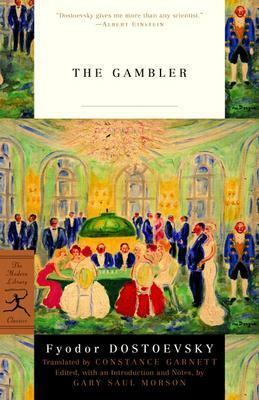
Review 2472: 2024 Dostoevsky Read-A-Thon: The Gambler

The Gambler is known as Dostoevsky’s most autobiographical novel, written in 26 days to foil the claims of an unscrupulous publisher. For Dostoevsky himself was a gambling addict and made a fool of himself over a girl called Polina when he was much older than his fictional alter ego. I read The Gambler for the 2024 Dostoevsky Readathon hosted by Russophile Reads. You can read his much more thorough evaluation of The Gambler here.

Alexey is a tutor for a Russian family returning at the opening of the story from two weeks’ leave to a German spa and gambling town. He works for the General tutoring his young niece and nephew and he is madly in love with Polina, the General’s older niece.

The General is broke, although he is madly pretending not to be. In fact, during his leave, Alexey has been pawning things for Polina. The General is in love with a Frenchwoman named Blanche, who is clearly after the money he expects to get when his aunt dies. Also hanging around are a Frenchman named des Grieux, whom the General has been borrowing money from and who has his eyes on Polina, and a rich Englishman whom Alexey likes named Mr. Astley.

As usual with Dostoevsky’s main characters, Alexey is in a sort of frenzy, this one of love for Polina. In attempts to gain some kind of equality with the other characters, he instead repeatedly shows his immaturity.

I have read most of Dostoevsky’s novels but I didn’t realize he could be funny until this one. The General hears that his aunt is ill and may be dying, so he keeps sending telegrams asking if she is dead in his desperation to seal the deal with Blanche. Suddenly, his aunt, called Grandmother in the novel because she is Polina’s grandmother, appears in town. And does she appear. She takes over the novel until she departs, making Alexey her escort to the casino, where she at first wins a lot of money.

Then loses it, but has the sense to go home. In the meantime, she disinherits the General. She is the most truly Russian character in the novel, with the other Russians trying to pretend they are cosmopolitan.

Eventually, we learn from Alexey’s experience what it’s like to be a gambling addict. For Alexey goes to the casino to try to win enough money to help Polina.

This is a short, sometimes funny, sometimes sad but always lively story about Alexey’s inability to understand what is going on, and about greed in its various forms. Note that the story contains lots of stereotypes in depicting people from countries other than Russia.

Related Posts

The Brothers Karamazov

The Idiot

The Kreutzer Sonata Variations

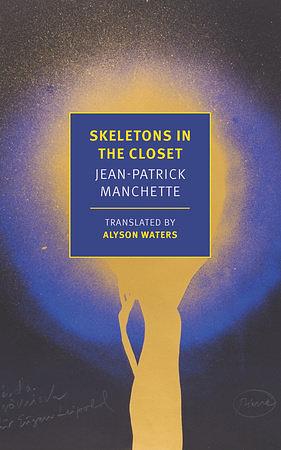
Review 2331: Skeletons in the Closet

A quote by Frederick Méziès on the cover of my edition of Skeletons in the Closet says, “Writing so dark it gives a new meaning to the word noir.” The novel was written in 1976, a bit after the height of French film noir, and it is certainly violent, although probably not as shocking to modern readers.

Eugene Tarpon is a private detective whose office is next to his bedroom. He only has one client when one of his contacts in the police department sends him an old lady, Mrs. Pigot. Her daughter, Philippine Pigot, has disappeared. She left for work one day and never arrived. Further, she is blind.

Tarpon’s contact, Coccioli, has strongly hinted that he shouldn’t actually look for Philippine, but he does. The next day, Mrs. Pigot arranges to meet him in a public square, and she is shot to death before his eyes. Soon, people are trying to kill him.

This novel is dark; nevertheless, there is a certain lightness and humor about it. Manchette is credited with redefining the noir genre for social criticism, but although there is certainly corruption going on, that theme is not so stressed in this novel.

I received this book from the publishers in exchange for a free and fair review.

Related Posts

The Disappearance of Adèle Bedeau

The Blank Wall

The Blunderer

Review 2158: Half-Blown Rose

Vincent (a woman named after Vincent Van Gogh) is living in Paris, separated from Cillian, her husband, after his latest book revealed that when he left Ireland at 15, he left behind a pregnant girlfriend. Vincent and Cillian have been married for more than 20 years, but he had never told her about this.

While Vincent is teaching writing and creativity classes in Paris and considering having an affair with Loup, who is half her age, Cillian calls constantly trying to reconcile.

I don’t usually do this, but very soon after starting this novel I tried to figure out how old Cross-Smith is. This was because at about page 2, Vincent wonders if Loup is still looking at her and thinks, if he isn’t I’ll die. I thought, is this woman 12 years old? The character is 44, by the way.

Nevertheless, I continued reading, because the situation started to come out and it seemed intriguing, even though I was dreading the hot affair that I could see coming.

Then, at about page 75 begins a series of emails between Vincent and her husband’s illegitimate son and his mother. They are unbelievably juvenile, including lots of exclamation points.

Vincent is hanging around with artists and academics, and their conversation is absolutely unconvincing. And don’t get me started on the playlists (really?) and the number of references to Vincent’s menstrual blood. This was a DNF for me.

Related Posts

The Other Daughter

The Light of Paris

Alien Hearts

Review 2113: The Clockwork Girl

I liked Mazzola’s The Story Keeper well enough to try another book by her. This one looked interesting.

In 18th century Paris, Madeleine was forced into prostitution at a young age by her mother and so badly scarred by a customer that she now works in the brothel as a maid. She is determined to escape with her nephew, which is one reason she reluctantly agrees to spy for the police on the household of Dr. Reinhart. She is supposed to find out what he is working on, but once installed there, she finds it difficult to learn anything. Something about Reinhart seems off, but he locks up his secrets. However, his interest is in anatomy and he makes elaborate wind-up animals.

A second narrator, Véronique, is Reinhart’s daughter, newly returned from being raised in a convent. Her father has promised to train her in his work, but time passes and he works only with Doctor LeFevre on some project for the King.

Madeleine hears rumors that children are disappearing off the streets and worries about her nephew.

A third narrator is Madame de Pompadour, who is afraid she is losing the King’s affection and worried about what he is up to.

This novel is fast-paced and eventually gets very creepy, but there are some unlikely aspects about it, especially how neatly everything is resolved. Still, it certainly kept my attention.

Related Posts

The Story Keeper

Little

Pure

Review 2108: The Paris Apartment

Jess needs to leave London quickly, so she calls her brother Ben in Paris and announces she is coming for a visit. He tells her it’s not a good time but ends up giving her instructions to his apartment.

All doesn’t go well for her travel plans, and she ends up arriving late. However, she can’t get Ben to buzz her in or raise him on her phone. She ends up following someone in and picking the lock to his apartment.

When Ben doesn’t appear the next morning, Jess begins asking about him. The neighbors, though, are hostile and unhelpful. The building itself is old and unusual, surrounding a courtyard with each apartment occupying a single floor. It seems much more expensive than Ben, a journalist, can afford. Moreover, in the apartment Jess has found a spot smelling strongly of bleach and a cat with blood on its fur.

I think I’ve read enough Lucy Foley. Her plots are puzzling enough, but her style gets old. All the books I’ve read by her are narrated the same way—in short chapters moving back and forth in time and changing narrators. Her style seemed unusual at first but it doesn’t change from book to book.

Related Posts

The Guest List

The Hunting Party

In a Dark, Dark Wood

Review 2065: The Invisible Bridge

One of the reasons I learned to love reading was that I got swept up into another time or place or even world. As I got older and more discriminating, this experience happened less often. It happened most recently within a few pages of starting The Invisible Bridge, which I read for my James Tait Black project.

Andras Lévi, a young Hungarian Jew, arrives in Paris in 1937 to study architecture. He has brought with him a letter that an acquaintance asked him to mail once he was in Paris. He mails the letter but notices the address.

Soon he is involved in the technicalities of art school, made more difficult because he almost immediately loses his scholarship, a first act of the anti-Semitisim that is perceptibly increasing, although not as bad in Paris as it was in Budapest. He seeks a job at a theater from Zoltán Novak, a man he met on the train from Hungary. When he begins a friendship there with an older actress, she sends him to lunch with friends at the address on the envelope he mailed, and that’s how he meets Klara, an older woman with whom he falls madly in love.

This novel, which starts out seeming very particular, about a love affair between two people, grows into a novel of great breadth, covering events of World War II, the Hungarian Holocaust, life in work camps, the siege of Budapest. All of it is centered in the importance of family.

I absolutely loved this novel. It is sweeping, wonderfully well written, touching, harrowing. And what a story, based on the lives of Orringer’s grandparents. I can’t recommend this book enough.

Related Posts

Great House

A Town Like Alice

Between the Woods and the Water: On Foot to Constantinople: From the Middle Danube to the Iron Gates

Review 2039: Alien Hearts

It’s hard for me to start this review without a swear word. A lot of discussion goes on in this novel about the nature of love and the difference between men and women, but to my mind, neither Maupassant nor his characters have a clue. But maybe that’s what I should expect from a man who died of syphilis at 43.

André Mariolle is a young, rich dilettante who is introduced into the salon of Madame de Burne, who is known for her flirtations that only go so far. Her salon is peopled with artists and musicians, and Mariolle is an outlier, but she embarks on a flirtation as she would with any new man in her circle. However, this time the two fall in love and begin an affaire.

Mariolle isn’t happy for long, though, because he wants her to be as madly in love with him as he is with her. We get lots of descriptions of heart rendings.

The Introduction to the novel includes a quote about it from Tolstoy: “In this last novel the author does not know who is to be loved and who is to be hated, nor does the reader know it, consequently he does not believe in the events described and is not interested in them.” Yes.

Related Posts

Chéri

The Last of Chéri

The Parisian

Review 1799: Summer Will Show

I have enjoyed the two other books I read by Sylvia Townsend Warner, but I am not as sure how I feel about Summer Will Show. According to the Introduction by Claire Harman, the two main characters bear a strong resemblance to Warner’s real-life companion, Valentine Ackland (Sophia) and herself (Minna). This may be the problem I have with this novel, because, as with Vita Sackville-West’s Challenge, depicting a semblance of her own true-life relationship, I think perhaps the closeness of the relationship inhibits the writing. In this case, I didn’t really get the attraction between the two women. It didn’t seem convincing.

in 1848, Sophia Willoughby has been running her estate and raising her children on her own for some time. She has long tolerated her husband’s affairs, but when she hears of one with Minna Lemuel, she is enraged. Minna is famous as a sort of actress/prostitute/mountebank, and she is not only unattractive but older than Sophia. Sophia tells her husband Frederick he can stay in Paris.

Although Sophia is an extremely competent manager, she is impatient in many ways with her woman’s role. She wants to live a free life. She is not happy in society and has no friends. Although an attentive mother, she thinks her children are too soft and doesn’t coddle them. Then a mistaken attempt to toughen them up ends in their deaths.

With no one to care for, Sophia decides to go Paris and talk her husband into having another child with her. She arrives there as the Parisians are preparing for another revolution.

In searching for Frederick, Sophia meets Minna and is immediately captivated. In a short time, she is caring for her instead of a new child. Minna is a revolutionary, however, and although Sophia is skeptical of the movement, whose advocates seem to hang around Minna’s flat and do little, she is slowly drawn to Communism. In the meantime, Paris is starving.

Aside from what I felt was an unconvincing love affair, I wasn’t really interested in the revolutionary setting or the turn to Communism, which wasn’t very coherently explained. I was also appalled by Sophia’s treatment of Caspar, her husband’s illegitimate half-caste son. So, not so excited about this one.

Lolly Willowes

The True Heart

Challenge

Review 1653: The Parisian

Midhat Kamal is the son of a wealthy textile merchant from Nablus in Palestine. His father more or less deserted him with his second marriage after his mother’s death and lives in Cairo, visiting a few times a year. When Midhat is 19, in 1914, his father decides he should study medicine in France and arranges for him to stay with a French professor of anthropology, Frédéric Molineu, in Montpellier.

Unfortunately, Midhat falls in love with Molineu’s daughter, Jeanette. Although his feelings seem to be returned, Midhat discovers a betrayal that makes him flee Montpellier for Paris. In Paris, he works on developing a reputation as a bon vivant and womanizer, only peripherally involved in his friends’ discussions about Arab nationalism.

Nonetheless, returning to Nablus, he almost immediately adopts the life his father demands, learning how to run the Nablus store in preparation for moving to Cairo and finding a wife. Events, however, will turn the course of his life again.

Although the novel covers the beginning of the fight for Arab nationalism against the British and French, which sounds interesting, as well as the time period of World War I, Hammad is hampered by her choice of main character, for Midhat is so self-absorbed through most of this book that he hardly seems to know what’s going on around him. This detachment affects the readers’ relationship to the novel, making me feel detached from its actions. Further, although there is a weak link between the first part of the book and the rest, there seemed to be little connection except that Midhat’s self-absorption is related to this character he has created for himself, the Parisian. I found the love affair unconvincing in any case.

For a historical novel set in an interesting time and place, there is very little sense of that time or place. So, not a big recommendation from me for this novel, which I read for my Walter Scott project. It is well written, but although important things happen in the novel, the action is at such a remove that it feels as if nothing is happening, if that makes any sense.

Related Posts

Palace Walk

The Map of Love

The Forty Days of Musa Dagh