Day 558: La Reine Margot

Cover for La Reine MargotIf you’ve been following my reviews of Maurice Druon’s Accursed Kings series about medieval France, you’ve probably seen me use the phrase “nest of vipers.” La Reine Margot, set a couple of centuries later, is just as full of intrigues, infidelities, betrayals, and even poisonings.

It is 1572, and the French court is celebrating the inexplicable marriage of Marguerite of Valois (Margot) to Henry of Navarre. France is at the height of the wars between Catholic and Huguenot, and Charles IX has proposed the union between his sister and the leader of the Huguenots purportedly to further peace.

Soon, though, we find out that the wedding is a trap for the leading Huguenots planned by Charles and his evil mother Catherine de Medicis. (Note that throughout I spell names as they were in the book.) For that evening of St. Bartholomew’s Day, troops are sent out all over Paris to massacre the Huguenots, who are in town for the wedding.

Thinking to rid himself of an enemy in Henry of Navarre, Charles has not considered his sister. Even though she and Henry are not romantically attached, the two have sworn to support each other. When Henry is trapped in the Louvre with the royal family, a combination of Margot’s support and his recanting saves his life. Margot has also rescued a young wounded Huguenot, La Mole, from the slaughter, providing a romantic subplot for the novel.

So begins the novel about how Henry of Navarre, aided by Margot, survives the machinations of the Valois family. The rumor is that Catherine recently murdered Henry’s mother by poisoning her, and Catherine also works in charms and horoscopes. Charles IX is unstable, first mistrusting Henry and then treating him like a brother. Henry d’Anjou, Charles’ brother, detests Henry of Navarre and thinks he is a threat to d’Anjou’s own right to the throne after his brother. François d’Alençon, the other brother, wavers in his decision to ally with Navarre.

Dumas was a writer of the Romantic movement, which de-emphasized rationality and emphasized emotion. The romantic plot involves the love affair between Margot and the naive and gallant La Mole, who is drawn into danger because of his love and religion.

My Oxford World Classics edition was fortified with copious notes, including information about which events were true and which were invented. Dumas is prone to using real people in his historical romances, and it was just a little off-putting to discover, for example, that the real La Mole was not a gallant Huguenot but a fundamentalist Catholic who was responsible for many murders during the massacre. Still, I found the real stories as fascinating as the novel.

If you like a fast-moving adventure that also involves political maneuvering, this is a good book for you. I was more interested in the nerve and political agility of Navarre than I was in the romance, but I still enjoyed the novel.

One caution—an abbreviated version of this novel is available as Marguerite of Valois. I have not read it, but if you want the more complete novel, look for La Reine Margot. (Yes, it is in English but also in French, so be careful if you order it online.)

Just a side note. I have written much about Dorothy Dunnett’s excellent historical novels. One of her Crawford of Lymond novels, Queen’s Play, is also partially concerned with the massacre.

Day 528: A Tale of Two Cities

Cover for A Tale of Two CitiesIt has been a long time since I read A Tale of Two Cities, and I did not remember anything except its broadest outlines. The novel is unusual for Dickens in two respects. It is his only historical novel, and it is probably the grimmest. Although he handles some weighty subjects in other novels—the poor laws, the civil justice system, mistreatment of children, abusive schools—this novel about the French revolution shows little of his celebrated sense of humor.

The novel centers around a much smaller cast of characters than usual for Dickens. It begins with Dr. Alexandre Manette, long a resident in a French prison for reasons we do not learn until the end of the novel. When the book begins, he is free but severely disturbed from trauma. His daughter Lucie travels with his banker Jarvis Lorry from England to bring him back to London.

Five years later, he is living contentedly with his daughter in England. Their friend French émigré Charles Darnay is tried for treason on bogus charges, but he is released when his defense proves that the principal witness cannot tell him apart from Sidney Carton, a barrister. These characters will soon become well acquainted.

When the novel returns to France, it shows us the extreme poverty of the poor as well as grim depictions of their mistreatment by aristocrats. Darnay returns to France to meet his uncle, the Marquis St. Evrémonde, and renounce his inheritance. St. Evrémonde’s careless slaughter of a young child when he runs over him in his carriage and his disdainful treatment of his nephew are all we see of him before his murder.

Secretly, a revolutionary society is growing and taking note of atrocities such as those committed by Evrémonde. Wine shop owners Monsieur and Madame Defarge are involved, and at first we have sympathy with their cause.

Charles Darnay marries Lucie Manette in London, but Sidney Carton has fallen in love with her as well. Although he considers himself unworthy of her, he pledges to do anything he can for her or for anyone she loves.

Meanwhile, France falls into revolution and brutal chaos. It becomes a place where revenge is more important than justice.

The fates of the main characters reach a climax when Charles returns to Paris to help an old retainer and is denounced by the revolution. Although he has committed no crime, his relationship to St. Evrémonde puts him in peril. Dr. Manette’s sanity is also threatened when he, Lucie, and Jarvis Lorry travel to Paris to try to help Charles.

The novel is a little more melodramatic than I prefer, unleavened as it is by Dickens’ usual antics. Only a couple of major characters provide momentary relief, and Madame Defarge is like a heavy dark cloud hovering over everything. The novel is also a bit disjointed through moving back and forth between the two cities. Still, Dickens always manages to bring tears to my eyes.

Day 419: The Bones of Paris

Cover for The Bones of ParisHappy Halloween! I tried to select a book that was appropriate for the occasion, although I didn’t have a ghost story lined up.

Laurie R. King’s series about Mary Russell and Sherlock Holmes is very popular, but I prefer her Kate Martinelli series or, even better, some of her dark psychological stand-alone novels. Folly is my favorite. With The Bones of Paris, she brings some of that darker sensibility to what looks like the beginning of a new mystery series.

Harris Stuyvesant is an ex-FBI agent who has been scraping a living in Europe by taking private investigation work. Among the hordes of American expatriates in 1929 Paris, he is searching for a young woman, Pip Crosby, whose relatives have not heard from her in months. A cause for possible embarrassment or worse is that Harris met Pip in Nice the year before and had a brief fling with her. Ever since a disastrous incident that ended his career and cost him his fiancée, he has been living an aimless and bohemian existence.

Two of Harris’ first stops in his search for Pip are Pip’s flatmate, Nancy Berger, and the Paris Missing Persons Bureau. Nancy seems to have a hangover but is actually suffering the effects of travel. She just returned from an archaeological dig in Greece and has not seen Pip for months. Harris finds the police officer, Doucet, concerned about what may be a series of killings.

Harris’ attentions soon narrow on three men connected with the art world whose names keep surfacing in connection with Pip and who all have a fascination with the macabre. The artist Man Ray‘s photographs of Pip focus on a gruesome scar from an accident in her youth. Count Dominic de Charmentier is a wealthy patron of the arts who owns a theatre that alternates grotesque and frightening scenes with comic ones. He also hosts parties that feature macabre decorations and terrifying staged events. Didi Moreau is a creepy, disturbing artist who makes displays of found objects, including human bones. Pip has a few of these displays in her room, as well as some of Man Ray’s photographs. When Harris begins investigating these men more closely, he finds to his alarm that his ex-fiancée, Sarah Grey, is working as de Charmentier’s assistant.

King evokes the time and place with mastery, introducing us to a dissolute café culture populated with famous figures such as Cole Porter and Josephine Baker. She also cleverly raises the creep factor by interjecting short chapters about the bones that underlie parts of Paris, foreboding snippets of conversation, and other indications that something monstrous is going on behind the scenes of glittering nightlife.

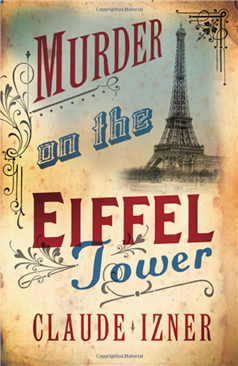
Day 313: Murder on the Eiffel Tower

Cover for Murder on the Eiffel TowerThis mystery set at the opening of the Eiffel Tower has a nice sense of history and is well written, but like mysteries written early in the genre (which it is not), it depends almost entirely upon determining opportunity. There is no indication of motive until the lengthy written confession at the end of the novel–standard early detective fiction nonsense–that is, charming in earlier fiction, but not so much now. This novel was published in 2009.

People begin being killed by “bee stings” on or near the Eiffel Tower the day before Buffalo Bill arrives in Paris for the opening of the 1889 World Exposition. Bookseller Victor Legris starts looking into these incidents after he notices that Kenji Mori, his father figure and business partner, met with more than one of the victims near the time they were killed. He also begins to fear that the woman to whom he is attracted, Russian illustrator Tasha Kherson, could be involved.

I found Victor to be silly, not very good at investigating, and prone to overlooking clues. Many secondary characters are only sketchily drawn and therefore difficult to keep straight. So for me, despite all its promise and its setting in an exciting period of time, Murder on the Eiffel Tower was not a success.