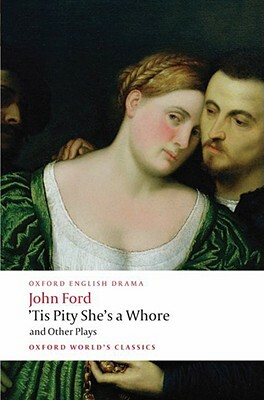
Review 2666: Classics Club Spin Result! ‘Tis Pity She’s a Whore

I have to admit I picked this play for my Classics Club list because knowledge of the plot was a major clue in the first Midsomer book, The Killings at Badger’s Drift. A clue that I missed.

John Ford was a playwright in the Jacobean and Caroline eras. Really nothing is known about him, and although I took a graduate course in drama that started with Christopher Marlowe and included Jonson, Kidd, Webster, and Tourneur, he was never mentioned. He was a famous playwright during the reign of Charles I, and his plays usually deal with the tension between passion and the laws of society. ‘Tis Pity She’s a Whore is his best-known play, and despite its subject matter, it is regarded as a classic of English literature.

And this is truly a gruesome play, with few redeeming characters. The drama is around a situation that evolves immediately in Act I. Arabella is a beauty of Parma who is courted by several noblemen. But it is Giovanni, her own brother, who wins her, and their relationship is consummated at the end of Act I. Spicy stuff!

Arabella is being courted by Soranto, but he has his own drama. He once seduced Hippolyta with promises of marriage if her husband died. Her husband now lost and believed to be dead, her reputation is ruined for nothing, because Soranto has dropped her. When she confronts him, he calls her a few bad names. She wants her revenge, and Vasquez, Soranto’s Iago-like servant, pretends to be sympathetic only to learn her plans.

As could be expected but apparently isn’t, Arabella finds herself in a situation where she has to get married. She reluctantly agrees to marry Soranto.

Interestingly, we seem to be expected to sympathize with Arabella and Giovanni. Certainly, there aren’t any other nicer characters. The Cardinal favors a Roman nobleman after he murders a man, and the Priest, who has been Giovanni’s confidante, runs away when things get dicey. Arabella’s governess apparently sees nothing wrong in her having an affair with her brother.

No one goes unpunished, but the fate of the women is much more gruesome than that of the men.

I thought the play was surprisingly readable and went very quickly. It doesn’t have beautiful speeches like Shakespeare, but it is partially in verse. I am sure its audiences found it very exciting.

Related Posts

The Duchess of Malfi

Titus Andronicus

Edward II

Review 1459: The Charterhouse of Parma

I found a nice hardcopy edition of The Charterhouse of Parma a while back and finally decided to read it. I have to conclude that I am not a fan of Stendahl. I read The Red and the Black a few years ago and deeply disliked its hero, who is essentially a sociopath.

The Charterhouse of Parma is about the life of a young Italian nobleman, Fabrizio, the second son of the Marchese and Marchesa del Dongo. When Fabrizio is a boy, the region where he lives, near Lake Como, goes back and forth between occupation by the French and rule by Austria. Although Fabrizio’s father is a conservative devoted to the Austrian king, Fabrizio grows up with romantic stories about Napoleon’s exploits. When he is a young man, extremely naïve and stupid, he runs off to fight for Napoleon just in time for Waterloo. He doesn’t even know how to join the army so ends up being mistaken for a spy and having so many ridiculous exploits that I thought I was reading a comedy. I wasn’t. In any case, this adventure results in his being accused by his elder brother of being a spy for the French so that he can no longer reside in Austria, which includes portions of Italy.

Meanwhile, his beloved aunt, the Countess Pietranara, is widowed. She eventually meets Count Mosca, a powerful person in the government of Parma, who falls in love with her. He offers to quit his position and move to Milan to be her impoverished lover (he is married) or to have her marry Duke Sanseverina in name only so that she can respectably move to Parma and be at court—and also be his mistress. She chooses the latter plan.

After Fabrizio’s return from the front, Duchess Sanseverina and Count Mosca try to help Fabrizio gain some position worthy of his birth. They choose the church and advise him how to behave. But Fabrizio is struggling between his instincts and his conscience and consistently falls into one mishap after another.

When I tell you that Tolstoy modelled his description of Waterloo—the least interesting part of War and Peace, which I consistently skipped over—after Stendahl’s, and when I say further that Waterloo, to me, was one of the most interesting parts of this book, you will guess how much I enjoyed it. Actually, I should say the first half of the book, because I finally stopped reading. I did not find Fabrizio interesting and didn’t really care what happened to him.

Related Posts

Vanity Fair

Don Quijote

The Kreutzer Sonata Variations