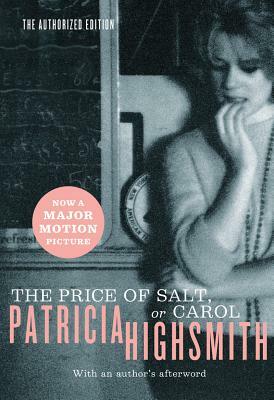
Review 2571: #1952 Club! The Price of Salt

Here we go with my last entry this year for the 1952 Club!

If you’re accustomed to Patricia Highsmith’s suspense novels, like the Ripley novels or Strangers on a Train, The Price of Salt may be a big change of pace. The W. W. Norton and Company edition I read tries to slant it more in that direction by using phrases like “sexual obsession” and “stalking” on the cover, but it’s not like that.

Therese Belivet is unhappy in her life. She is a set designer who can’t find a job, so she has taken a temporary Christmas-season job with a large department store. She hates that job. She dates a man who wants to marry her—Richard—but she doesn’t want to marry him, even though she likes him.

Then one day at work she sees a beautiful blonde woman about 10 or 15 years older than herself. She is immediately struck by her. After she sells her a doll, she puts a little thank you note into the package to be delivered, not signing it but using her employee number. To her surprise, the woman, Carol Aird, calls her at the store.

They begin a hesitant friendship, with Carol often picking her up to spend the night at her house. She lives alone because she is divorcing her husband, who is trying to get custody of their daughter. Therese, who is madly in love with Carol, can’t figure out how Carol feels, as she is cold at times.

Professionally, things are looking up a little for Therese. She gets a short-term job doing sets for an off-Broadway play and has the attention of a major director. Things are getting rocky with Richard, though, and she can’t figure out the situation with Carol. Then Carol invites her to accompany her on a cross-country driving trip.

If this book wasn’t written in 1952 or was about a man and woman, it would more or less be a standard romance with the entanglement of a 50s divorce. However, because of when it was published, it was a daring novel, especially for the United States. (I have read other similar books from English writers, published earlier.) Like many of Highsmith’s books, I wasn’t drawn to any of her characters, but I have never thought Highsmith cared about that kind of thing, in fact, may have preferred protagonists that readers don’t like.

I don’t know what I feel about it. I guess I admire Highsmith’s courage in writing it but otherwise felt sort of meh about it.

Related Posts

After Sappho

Nightwood

LOTE

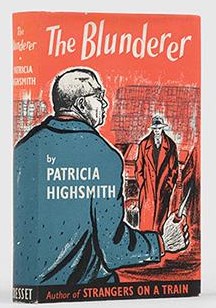
Day 1255: The Blunderer

Women Crime Writers coverPatricia Highsmith can be very dark, and The Blunderer is about the darkest of her works that I have read. It appears in the 1950’s volume of my Women Crime Writers set.

The novel begins with a murder that at first seems to have little to do with the main action. After establishing an alibi for himself by making sure people at the movies see him, Mr. Kimmel follows his wife’s bus out of town until it stops for a break. Then he calls her out of the way to talk to him and strangles her.

Walter Stackhouse notices an article about the murder and figures out that Kimmel could have murdered his wife. He places a clipping about the murder in a scrapbook where he keeps notes and articles about different personality types, and he even goes so far as to visit Kimmel’s bookstore to take a look at him.

Walter is unhappily married to Clara, who criticizes him constantly and tries to drive away his friends. Lately, she’s been accusing him of having an affair with Ellie, a woman he has only met twice socially. Walter isn’t thinking of murder, however, but of divorce. When he asks Clara for a divorce, she attempts suicide.

The Stackhouses give their marriage another try, but soon Clara is behaving the same way. Walter does begin an affair with Ellie and makes plans to get a divorce in Reno.

Cover for The BlundererYou guessed it, of course. Clara gets on a bus to take care of her mother’s affairs after her death. Walter stupidly follows the bus to do he knows not what but cannot find her at the bus stop and assumes she has gotten off. Later, her body is found dead at the bottom of a cliff. Detective Corby sees the similarities to the Kimmel case and decides Walter has murdered his wife.

The suspense derives from Walter’s dilemma as he does just about everything wrong, raising suspicion in everyone he knows. Then Corby decides he can solve both cases by playing Stackhouse and Kimmel off one another.

This novel is certainly suspenseful. It may have been a little dark, though, even for me.

Related Posts

The Talented Mr. Ripley

Ripley Under Ground

The Talented Miss Highsmith

Day 601: The Talented Miss Highsmith

Cover for The Talented Miss HighsmithI became interested in reading this biography after hearing about interviews with Schenkar, who called Patricia Highsmith a sociopath. Patricia Highsmith is, of course, the author of many mid-20th century thrillers, the most famous being Strangers on a Train and The Talented Mr. Ripley. After reading the biography, I don’t really think Highsmith was a sociopath. I think she was fascinated with certain dark themes, but she strikes me as more of a social inept, perhaps partially on the autistic spectrum.

Highsmith was certainly a complex person of many contradictions. She was a lesbian misogynist, as contradictory as that sounds, who was a great womanizer in her younger years and was seldom faithful to any of her lovers. She was an outspoken anti-Semite who had Jewish lovers and a lot of Jewish friends. Known in later years as a recluse, she visited her neighbors every evening and corresponded with many people, as well as making an appearance whenever invited.

She certainly was a damaged person. She had a love-hate relationship with her mother for her entire life, blaming her for abandoning her briefly when she was young and for not divorcing her stepfather. She was a woman who always thought she should actually have been a man. A heavy drinker and smoker, she barely ate any food for years and was probably anorexic.

Her life was an interesting one. She did not seem to be a likable person and frequently behaved very badly. Yet, she had many sincerely devoted friends.

I was interested in this book but had some issues with its structure. Schenkar explains at the beginning that a chronological approach wouldn’t do Highsmith justice, so she approaches Highsmith’s life sort of organically. The problem I found with this approach was that after awhile I could not figure out what organizing principle is holding some of the chapters together. Sometimes they just seem to follow a stream of consciousness approach. It makes the information conveyed very repetitive and chronologically impossible to follow. Schenkar helpfully provides a chronology at the back of the book, along with about 100 pages of supplementary material, but by then I was exhausted and had no interest in exploring any of it.

Finally—this is a small quibble—I got irritated by Schenkar’s chapter naming. The table of contents shows only nine chapters in this very long book, but there are really forty-nine. That is because she actually names them Les Girls Part 1, Les Girls Part 2, and so on. Perhaps I’m being unfair, but I could just imagine Schenkar’s editor telling her she couldn’t have a 150-page chapter, which is the length of Les Girls, Parts 1–14. Such an approach does not strike me as being very imaginative.

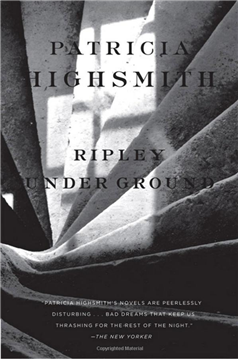
Day 454: Ripley Under Ground

Cover for Ripley Under GroundIn the second novel of Highsmith’s Ripley series, Tom Ripley seems much more of a bumbler than in The Talented Mr. Ripley and the plot unnecessarily convoluted. In the first book, Highsmith succeeded in making us care about Ripley’s fate almost despite ourselves, but in Ripley Under Ground, Ripley’s troubles seem to be caused by hubris.

Ripley is living in France in his beautiful house with his wealthy wife Heloise at the beginning of the novel. He has done well from the death of Dicky Greenleaf but occasionally finds ways to raise a little extra cash.

One recurring source of money has been some businesses built around the work of a famous artist named Derwatt. The businesses are completely fraudulent, however, because Derwatt has been dead for five years. He committed suicide in Greece, and Buckmaster Gallery was originally opened to sell his paintings as an homage by his friends. His paintings were soon all sold, however, and it was Tom’s idea to “resurrect” him, as a recluse living in Mexico. Derwatt’s devoted friend Bernard Tufts has been painting forgeries ever since, to be sold by the gallery with a small token going to Ripley.

Gallery owner Jeff Constant contacts Ripley in a panic. Thomas Murchison, the American owner of a Derwatt, thinks his painting is a fake, and he is coming to the next Derwatt opening to speak to the gallery owners. In an attempt to bamboozle Murchison, who is planning on meeting with an art expert, Tom masquerades as Derwatt at the opening and assures Murchison that the painting in question is his. Murchison has some theory about the use of color in the painting, though, and is unconvinced, even ridiculously suggesting that Derwatt may not remember his own painting.

As himself, Tom meets Murchison in the lobby of his hotel and invites him to France to see his own Derwatts. Tom’s intention is simply to try to convince Murchison he is wrong about the painting, but of course he ends up having to murder him.

This starts us on a complicated series of events, where Tom buries the body then digs it up, confesses his murder to no less than four people, travels all over Europe looking for an errant Bernard, and is, of course, the number one suspect in Murchison’s disappearance. If this isn’t enough, while Tom is trying to cope with all these problems, people continually arrive on his doorstep and the phone rings at every inopportune moment. Ripley’s return is not an unqualified success from my point of view, as everything is over-complicated and the pace of the novel is too frenetic.

Day 441: The Talented Mr. Ripley

Cover for The Talented Mr. RipleyThe first Ripley novel, The Talented Mr. Ripley, is a re-read for me after I recently bought a set of three Ripley novels. If you are familiar with Tom Ripley only through the terrific movie starring Matt Damon, prepare to find the original Ripley a lot less likeable.

We first meet young Tom Ripley just eking out an existence in New York, but he is already engaged in a con—inept because he can’t even collect the proceeds of his mail fraud. Nevertheless, when a middle-aged man seems to be tailing him one night, he is afraid it is the police.

The man turns out to be a wealthy businessman named Herbert Greenleaf. He has been trying to get his son Dickie to come home from Italy and take up his responsibilities, but Dickie has shown no interest in returning. Apparently, some of Mr. Greenleaf’s friends have misunderstood the depth of Tom’s friendship with Dickie, whom he has only met once or twice, and have recommended he send Tom to Italy to try to convince Dickie to come home. Tom sees in this project a free trip to Europe, getting out of New York at a very good time, but he also intends to do his best for Mr. Greenleaf.

Tom is a man with a troubled past and a will to succeed with the right people. Except for his fastidiousness, he seems almost a blank slate, so eager to please that he constantly lies about himself, his work, his education. He wants to be liked but finds people shying away from him after awhile. He is a talented mimic. Tellingly, he only feels guilty when he tells the truth about himself.

Tom travels out to the small seaside village of Mongibello to find Dickie, who does not remember him. In an attempt to ingratiate himself, Tom confesses why he is there and how much Dickie’s father is paying him. Dickie is amused by this and invites him to stay, encouraging Tom to spend the money from Dickie’s father on the two of them even though Dickie has plenty of his own money.

Tom becomes enamored—it is unclear whether of Dickie or Dickie’s lifestyle—for Dickie is free to go wherever he wants, and his only serious endeavor is to try to paint, which he does badly. Dickie’s close friend Marge Sherwood poses a problem to their friendship, though. She is immediately jealous and suspicious of Tom, telling Dickie he is probably gay. Since Tom’s sadistic aunt, who raised him, used to taunt him with being a sissy, Tom has sought to deny this, even to himself.

None of these characters is particularly likable. Dickie is a spoiled rich kid who uses Tom but believes himself used, who thinks only of himself, and strings Marge along so he’ll have some company in the long winter months. Marge, although seen only through Tom’s eyes, is clinging and jealous. Tom is, of course, Tom, whom we only begin to understand slowly.

The situation is ripe for disaster, and Tom eventually commits a much more serious crime than mail fraud. This event happens only a third of the way through the book, and the fascination of the novel is in watching how Tom Ripley hides his crime, how he manages to profit by it, and what he is forced to do to avoid suspicion. He is surprised to find within himself an ability to coldly and analytically carry through his crimes with little notice—actually commit them almost without planning—although he is somewhat bumbling when it comes to the cover-up.

But Ripley learns, and we watch with fascination as he slowly develops his inner sociopath. This is an absolutely spellbinding novel by an author who was depicted in a recent biography as a sociopath herself. Another goal for my personal reading—pick up that biography!