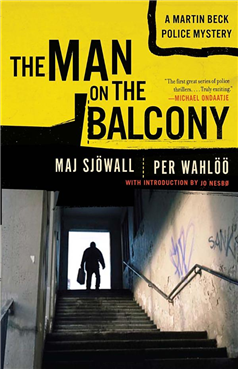
Day 390: The Man on the Balcony

Cover for The Man on the BalconyAlthough it is the third in the Martin Beck series, The Man on the Balcony is considered a breakthrough novel, one of the first realistic police procedurals. Written in 1967, it is based on an actual case from 1963.

The novel begins with a description of a man watching the activity of a Stockholm summer day from his balcony. The scene seems very ordinary, but we know it is important because of the title of the novel. Later, a detective in Martin Beck’s division takes a phone call from a woman who complains that a neighbor is standing all day long watching children from his balcony, but the detective dismisses the woman as a crank. Such activities are obviously not illegal. Although a call like this might send chills down our spines these days, this novel takes place in a more innocent time and place.

The police have actually been working hard on the case of a mugger who attacks people in the parks and robs them. But almost under their noses the body of a nine-year-old girl is found in the park. She has been raped and strangled and her panties stolen. This case becomes the priority, but it is not long before the police suspect that the mugger may very well have seen the murderer in the park.

After a second girl is murdered, Beck realizes he has another potential witness–a three-year-old boy who went off to play with the victim and came back alone. The boy can barely talk, however. Although the book is notable for its realism, this was the only point that I found unrealistic, as usually three-year-olds can speak quite well with some occasional interpretation from their parents.

As Martin and his coworkers doggedly follow every lead and wait impatiently for forensics results, they become more and more stressed and depressed, hoping they can catch a break before the killer strikes again.

These novels are extremely well written. Although the pace is much more leisurely than you would find in an American mystery novel, the novel still builds up a fair amount of suspense. Sjöwall and Wahlöö, the husband and wife writing team, set the standard for this type of mystery to come. Ever since I picked up the first Martin Beck novel, Roseanna, I have been impressed with this series.
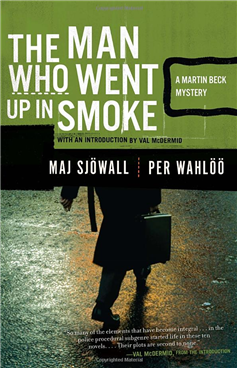
Day 350: The Man Who Went Up in Smoke

Cover for The Man Who Went Up in SmokeAt first, I thought this novel, written in 1966, was a little more dated than Roseanna, by the same authors. However, except for the formality in the characters’ dress, it stopped feeling dated after awhile.

Inspector Martin Beck has been on vacation with his family less than a day when he is called back to take charge of an unusual case. A Swedish journalist named Alf Mattson has been reported missing by his editor. The difficulty is that he disappeared in Budapest. There can be no official investigation because the Hungarian police have not received an official request for assistance, so Beck must travel to Budapest unofficially.

In Budapest Beck is able to retrace Mattson’s movements right up until he disappeared, one day after arriving. He visits a youth hostel where Mattson spent the first night and hears through his colleagues back in Sweden that Mattson claimed to have a girlfriend there. But when Beck finds her, she denies knowing Mattson.

Beck feels himself at a loss. His discussions with the Budapest police have not gone very far. The police can’t conduct a full-blown investigation until Mattson’s visa expires, but they have made some inquiries. It is not until Beck is viciously attacked that he understands he is getting somewhere.

Sjöwall and Wahlöö are known for having reinvented the police procedural, and many of its present-day conventions were first used in their novels. The novels are well written and deal with common people more often than with career criminals or gangsters.

Day 212: Roseanna

Cover for RoseannaApparently Roseanna is a classic of Swedish crime fiction. Written in 1965 by the team of Maj Sjöwall and Per Wahlöö, it is a compelling police procedural that has sent me to the book stores looking for more.

Lake Vattern is being dredged on a July afternoon when up comes the naked body of a young woman. Autopsy results find she has been violently sexually assaulted and strangled. Detective Inspector Martin Beck and his colleagues Ahlberg, Kollberg, and Melander at first have difficulty even identifying the body.

After months of inquiries, they learn she is a librarian from Nebraska named Roseanna McGraw.  Once they know that, it takes awhile longer to deduce that she must have been killed on a canal boat named the Diana, during a trip when engine trouble delayed her passage through the lake until midnight.

As with other Scandinavian mysteries I have read, the pace is slower and probably more realistic than American procedurals until the police finally identify a suspect. Then, in that time when forensic evidence is so much more limited than at present, they find no evidence linking him to the murder except some hazy snapshots of the two together on the boat. Martin and his team must find some other way to prove he is the murderer.

It’s hard to define why I found this novel so much more enjoyable than some of the more recent Swedish mysteries. It is written in a spare, tight prose. The solution is plausible instead of too convoluted. The characters seem fully defined. The book drew me in, and I was not disappointed.