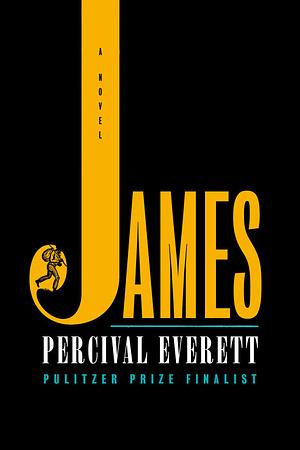
Review 2617: James

I read James for both my Booker Prize project and my Pulitzer Prize project, which it won. As most people know by now, it is a retelling of Twain’s Huckleberry Finn from the point of view of the slave Jim.

Aside from generally following the plot of the original novel about halfway, James lives in a world that is much more violent than Huck Finn ever had a clue about. Everett has taken a liberty and placed the novel in the 1860s instead of the 1830s or 40s, when the original is set. He also uses a striking conceit: when among themselves the black characters speak more correctly—and sometimes with erudition—than most of the white characters.

Jim—or James, as he prefers to be called—hears that Judge Thatcher is going to sell him away from his wife and daughter, so he escapes and hides on a small island on the Mississippi. Unfortunately for him, Huck Finn has heard that his dreaded father is in town, so he fakes his own death and runs away, ending up on the same island. James realizes right away that he will be blamed for Huck’s “death.”

The two stick together and encounter what Huck thinks of as adventures and James knows to be deadly peril. After all, a slave is lynched later in the book for being suspected of stealing the nub of a pencil from his master. That he did steal it to give to James is beside the point.

The book follows the same basic outlines as Huckleberry Finn until James gets away from the Duke and the Dauphin, but all of the situations are much more deadly. Eventually, James’s inner anger is set aflame.

Everett’s books are witty, but they are also very angry. And he has some surprises for us.

This novel is fast moving and really interesting. It shows facets of the “institution” of slavery in all its ugliness.
Related Posts

The Trees

Erasure

Incidents in the Life of a Slave Girl

Review 2541: Erasure

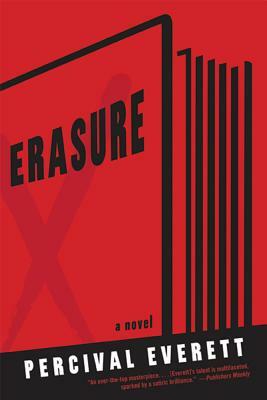
If you’ve seen the movie American Fiction, you already know the plot of Erasure. I haven’t seen it yet, and I read this book for my A Century of Books project.

Thelonius (Monksie) Ellison is a writer of high intelligence whose dense, uncompromising novels have failed to make a hit with the general public. He has just put out his latest book, but his agent, Yul, is having difficulty placing it and has been told that Ellison is too far from his ethnic origins as a Black man.

Ellison lives in California, where he is a university professor, but on a visit to Washington, D. C., for a conference, he finds that his mother isn’t doing well. Eventually, he is forced to move back to D. C. to take care of her. That means taking a leave of absence, but he hasn’t sold his book. His mother’s affairs are in poor shape, so he finds he needs money.

He is infuriated by a recent book that is making a splash, We’s Lives in Da Ghetto. It’s written by a middle-class midwestern Black woman based on one week that she spent with relatives in New York, and it employs every known cliché about the lives of Black people.

On a whim, Ellison sits down and writes a parody of this kind of novel, which he titles My Pafology. He submits it to Yul, who is horrified, and asks him to submit it to publishers under the name of Stagg Leigh. Shockingly, Random House takes it as straight and offers him lots of money.

This novel produces spoof upon spoof. Even Everett’s character Ellison takes himself so seriously that I think he’s being mocked. Certainly, he starts out mocking academia with the learned talk he gives at the beginning of the novel. This talk is incomprehensible, and yet it makes another academic leap up and shout, “Bastard!” at him. He also hits the publishing industry, the reading awards organizations, and television interview programs.

The novel is presented as Ellison’s diary, so it includes learned jokes (most of which I didn’t understand), imagined conversations between various dead people in the arts, recollections from his past, especially about his father, and the entire text—about 50 pages—of My Pafology.

As My Pafology gains attention, Ellison begins to lament that he ever compromised his standards. Forced occasionally to masquerade as Stagg Leigh, he feels as if his own persona as a cultured Black man is being erased. Maybe he feels that that whole culture is being erased.

Parts of this novel were above my head, particularly some of the little scribbles in the diary. Also, when I say Everett is heaping on the satire, I’m not saying that the novel is funny (although some of it is). Most of the time I felt sorry for Monksie, who is too unyielding for his own good and knows it, but cannot stop.

Percival Everett is having a moment lately, which has resulted in four of his books being in my pile, of which this is the second. I’m not sure if I like his work, but it is at least interesting.

Related Posts

The Trees

Flights

Ferdydurke

Review 2536: The Trees

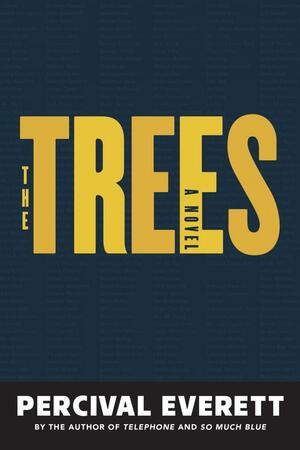
The Trees is not a book for everyone. It is black satire, very dark, and it covers shameful events in American history that took place over centuries.

In Money, Mississippi, a dismal small town, a brutal murder occurs, or maybe two. A White man is found bound in barbed wire, his testicles removed. With him is the body of a Black man unknown to anyone in town, his hand wrapped around the testicles.

Shortly, the Black man’s body is stolen from the morgue and ends up at the scene of another murder, holding another White man’s testicles. Both White men are descendants of Granny C, an old lady who turns out to be the woman who claimed Emmett Till disrespected her, resulting in the famous lynching. Then Granny C is found dead.

And this is what the novel is about, in its sly, sometimes stereotyped (at least in the case of the White redneck characters), brutal way. It’s about the history of lynchings that continued in this country up until not that long ago (Wikipedia says, shockingly, 1981), thousands of them, mostly Black males, but also some women, as well as Chinese, Native Americans, and even one Japanese man.

The novel has a strange, sort of overdone anti-Southern humor that leads to additional gruesome scenes as two Black detectives from the Mississippi Bureau of Investigation come to investigate.

I read this novel for my Booker Prize project.

Related Posts

Chenneville

The Tilted World

The Warmth of Other Suns: The Epic Story of America’s Great Migration