Day 1285: Miss Buncle’s Book

Cover for Miss Buncle's BookMiss Buncle’s investments have not been providing her an income, so she realizes she must do something. She decides to write a book. She submits it to a publisher, Mr. Abbott, who can’t decide whether it is a sly satire or a story written by a rather simple person. Nevertheless, he likes it and decides to publish it. In particular, he is impressed by the lifelike characters.

Miss Buncle always says she has no imagination and has simply described the people she knows. When the book comes out, all of her neighbors begin to recognize themselves, and many of them are not pleased. But no one knows who the author, John Smith, is. Some of the less likable people in the village decide to find out. The topper is that Miss Buncle has imagined futures for some of her characters, and they start to behave as she predicted.

This is a delightful novel, a fun, light read. It’s the perfect thing to go with a cup of tea on a rainy afternoon. I can see why so many people have loved it. I read it for my Classics Club list.

Related Posts

Vittoria Cottage

The Baker’s Daughter

Sylvester, or the Wicked Uncle

Day 1279: Harriet

Cover for HarrietHarriet is a novel written in 1934 based on a true crime that occurred in 1875. As such, it is suitable for the season as well as for the R. I. P. Challenge and the Classics Club Dare.

Harriet is a woman in her 30’s who has her own fortune of £3,000 with prospects of 2,000 more. She is a “natural,” which I take to mean having some sort of mental incapacity. Although her mother, Mrs. Ogilvie, cares about her, she boards her periodically with poorer relatives, allowing them to make a little money and giving herself and her husband a little break from Harriet, who can be difficult.

Mrs. Ogilvy sends Harriet to stay with her cousin, Mrs. Hoppner. Mrs. Hoppner lives with her spoiled daughter, Alice. Visiting her are her older daughter, Elizabeth, and Elizabeth’s husband, Patrick Oman, an artist. Also visiting is Patrick’s brother, Lewis, a clerk. Patrick and Elizabeth are devoted to Lewis.

Although the charismatic Lewis is courting the delicate and beautiful Alice, he turns his attention to Harriet. He is soon engaged to her and marries her despite Mrs. Ogilvie’s objections. In fact, Mrs. Ogilvie tries to get Harriet made a ward of the court to block the marriage, but this backfires when Lewis finds out and tells Harriet she wants to have her committed. Once they are married, Lewis proceeds to strip Harriet of her money and possessions.

After Harriet has a child, he boards her at his brother’s house and moves into a nearby house with Alice. Up until then, Lewis’s actions are marginally legal if morally repellent. It is after this that the behavior of the two brothers and two sisters becomes criminal.

This novel is chilling in its psychological depictions of the two sisters and brothers. Jenkins was fascinated by the case and uses people’s actual Christian names, imaging the thoughts and activities of the characters. This novel was one of the first fictionalizations of a true crime.

Related Posts

The Wicked Boy: The Mystery of a Victorian Child Murderer

The Invention of Murder: How the Victorians Reveled in Death and Detection and Created Modern Crime

The Fall of the House of Walworth: A Tale of Madness and Murder in Gilded Age America

Day 1273: The 1944 Club! They Were Sisters

Cover for They Were SistersBest Book of Five!
I was going to save my review of They Were Sisters for our February Literary Wives club, but I saw it was also published in 1944, so applied to the 1944 Club! So, for Literary Wives, I will just have to refer back to this review and then make my further comments about the depiction of wives in fiction.

I previously read another book published in 1944. Here is its link:

Friday’s Child by Georgette Heyer

* * *

Lucy’s sisters, Vera and Charlotte, are much younger than she, so much so that she was largely responsible for raising them when their mother died. Lucy never thought she would marry, but she is, happily, to William, who is a bit eccentric. She has misgivings, though, about her sisters’ choices of husbands, especially Charlotte’s.

Vera’s husband, Brian, is solid and devoted. Lucy likes him, but Vera, who is a stunning beauty, seems to be bored with him. She has a constant entourage of male followers and loves to entertain. They have two daughters, Meriel and Sarah. Meriel is close to her father and paternal grandmother, who hates Vera and is always trying to make trouble. Sarah is closer to her mother, but she is the volatile one, who has trouble making friends.

Charlotte married Geoffrey. As a young man, he was constantly pulling pranks, and Lucy couldn’t see what Charlotte saw in him. As a husband, he is hypercritical and verbally abusive, teaching his daughters, Margaret and Judith, to disrespect their mother.

1944 club logoThe three women have been apart for years when they get together at the beginning of the book. After that visit, Vera and Lucy vow to keep in better contact with Charlotte because they are worried about her. Only Lucy pursues this, however, and through her efforts falls completely for Judith as a child. Although Charlotte avoids Lucy as she loses herself to alcoholism, Judith becomes a regular visitor to Lucy and William’s home, where she sees a more normal home life than the one she has. She also makes unlikely friends with her cousin, Sarah.

This novel is an insightful study of the bonds of sisters, despite their differences. It is a lovely book, also about how the act of caring on Lucy’s part has ramifications beyond her own sisters’ lives. Again, Whipple gets better and better. I will be sad when I will have read all of her books.

More about this book in February for Literary Wives!

Related Posts

Because of the Lockwoods

Greenbanks

They Knew Mr. Knight


Day 1269: Greenery Street

Cover for Greenery StreetThe way I work my blog is that, as I finish a novel, I write up my notes in a book diary. Every five reviews, I pick out my next five books from those notes, and generally speaking, I run about six months behind what I have read.

Obviously, there’s room for error in this system, and I have made one with Greenery Street. I kept expecting my review to turn up, and finally, the other day, I looked the novel up on Goodreads to see when I finished reading it. More than a year ago! I looked back in my journals to see if I inadvertently skipped it, only to find that I apparently forgot to write it up. What a shame for this delightful novel!

Greenery Street is a story of ordinary life in a couple’s first home, written in 1925. It begins on a day in April when newly engaged Felicity Hamilton and Ian Foster wander into Greenery Street in search of a house and find a very small and pleasant one. Then it jumps back to cover their meeting and engagement.

The novel details the everyday life of this newly married couple. There is nothing particularly unusual about their lives (well, not for their time—not too many young wives spend their days shopping, socializing, and supervising the help anymore), but they are rendered in interesting detail and humor, small disagreements and the normal ups and downs of a new marriage. The end of the book is telegraphed from the beginning, when we’re told the house would be too small for three. However, the journey is delightful.

Related Posts

Greengates

Family Roundabout

Mrs. Dalloway

Day 1267: Alas, Poor Lady

Cover for Alas, Poor LadyBest of Five!
A Footman for the Peacock was a strange little book, so I didn’t quite know what to expect from the much longer Alas, Poor Lady. It turned out to be an astonishingly feminist novel for being published in 1937.

At the beginning of the novel, Miss Scrimgeour, an elderly woman, receives the charitable gift of a two-room flat and an annuity for life. One of the women involved in the charity realizes that Miss Scrimgeour is a gentlewoman, of the same class as herself, and that she previously had no income at all. She exclaims, “How did that happen?” This novel answers that question.

It begins in 1870, when Grace Scrimgeour is born into a wealthy family. She is the youngest of six sisters, born almost a generation behind her last sister, but she is not the youngest child. Two years later, the Scrimgeour’s only son is born.

All the girls are raised to become wives and mothers. At least the oldest girls are sent away to school, but after Charlie is born, Grace’s upbringing is neglected and she is left to be educated by a governess who is not very competent.

The two girls marry, but it becomes clear that Mary and Queenie will not. Mary attempts to be useful by offering to teach Grace and Charlie, but her attempts to find herself an occupation are rebuffed by her parents.

As biddable, affectionate Grace nears her debut, Captain Scrimgeour spends more and more of his money on Charlie, selling out of stable financial funds to do so. Grace’s unmarried sisters become a problem once she is “out,” because most hostesses don’t want to entertain six Scrimgeours, so they leave Grace off their invitation lists. Her parents are now too elderly to see she has proper opportunities to meet someone, and neither of her married sisters take her in hand.

The novel follows the downward trend of the family’s finances, especially after Mrs. Scrimgeour is left in charge, herself having never received any instruction about finances. Clearly, tough times are ahead for the three unmarried sisters.

This novel shows painfully the origins of the destitute lady spinster—how everything in her upbringing works against her ability to support herself. Painfully ironic for the reader, who can see where things are trending, is a scene in which the newly widowed Mrs. Scrimgeour, blithely pledging £500 for a bed in the hospital for children, money she cannot afford, ignores a plea to help indigent gentlewomen, thinking the women are shiftless.

This novel is touching and eye-opening. The two most sympathetic characters are Grace, even more so her valiant sister Mary. But there is also a delightful family Grace goes to work for later.

Although I found this novel sad, it was enthralling and affecting. I highly recommend it. Another great novel from Persephone Press.

Related Posts

A Footman for the Peacock

Dolly: A Love Story

Mrs. Palfrey at the Clairmont


Day 1253: Because of the Lockwoods

Best of Five!
I just have to say, Dorothy Whipple keeps getting better and better. I am so thankful to Persephone Press for reprinting her books and am sorry that I only see a few more in their catalog.

Because of the Lockwoods is about the complex relationships between two families, the Hunters and the Lockwoods. The families used to be neighbors and social equals, but Mr. Hunter died unexpectedly, leaving the Hunters in financial straits. When the novel opens, Mrs. Lockwood is preparing to patronize the Hunters by inviting them on New Year’s Eve to witness a production by her girls that she would not inflict on more important people and to dine on leftover treats from Christmas Day.

The youngest Hunter, Thea, has grown to hate the Lockwoods for the way they treat her mother—Mrs. Lockwood patronizing her and Mr. Lockwood being irritable when Mrs. Hunter turns to him for advice. The Lockwood twins are bullies who continually ridicule Thea. What the Hunters don’t know, though, is that Mr. Lockwood cheated Mrs. Hunter just days into her widowhood.

The Lockwoods are not without their good qualities, just as Thea is not without bad ones, and it is this nuanced approach that makes the novel interesting. Mr. Lockwood adores his family, and Mrs. Lockwood is one of the few old friends who continues to visit Mrs. Hunter after the family’s move to a less salubrious neighborhood. Thea, on the other hand, is difficult, stubborn, and unforgiving. While despising the Lockwoods’ middle class values, she has adopted some of them herself, and is at first snobbish when she meets a new neighbor, Oliver Reade.

This novel is a long one, but it swept me up. I watched Thea suffer one humiliation after another at the hands of the Lockwood family and was interested to see how she handles her opportunity for comeuppance.

One feature of Whipple’s novels is how readable they are. Once you start reading, you don’t want to stop.

Related Posts

They Knew Mr. Knight

The Priory

Someone at a Distance

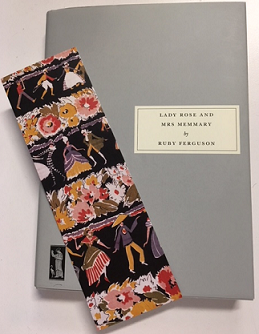
Day 1242: Lady Rose and Mrs Memmary

Cover for Lady Rose and Mrs MemmaryLady Rose and Mrs Memmary is an odd little book. It shows its naive heroine in the grip of Romanticism until she learns what the real world is like.

The novel begins in the 1930’s, when it was written. A couple and their friend are touring the area and come upon Keepsfield, a beautiful old Scottish house, which is available to let. They ask if they can tour the house and are taken around by Mrs Memmary, the old caretaker. As they tour the house, Helen Dacre gets Mrs Memmary to tell her about the life of Lady Rose, the Countess of Lochule, who owns the house.

Lady Rose has been brought up on stories of Rob Roy and Mary, Queen of Scots, and Bonnie Prince Charlie. She is an extremely romantic and enthusiastic girl from a life of privilege but not luxury, the daughter of an Earl. Her parents make no bones during her debut in 1873 that their job is to marry her to a man of equal fortune and position in society.

We see little vignettes of Lady Rose’s life from the age of six until she marries Sir Hector Galowrie when she is seventeen. Her parents don’t pay attention, however, to the idea of matching Rose in temperament.

By the time the visitors appear at the house, much has changed for the aristocracy of England and Scotland. The owners of fine mansions can no longer afford to live in them. This is the story of the attitudes of her peers once Lady Rose decides she has done her duty, but it is also the story of the fall of the aristocracy.

For such messages, the novel is written in an extremely sentimental style, with gushing descriptions of the house and landscape and chapters ending in poetry. I don’t think it is altogether successful, but it is interesting as a document of the times.

Related Posts

The Scottish Chiefs

The Remains of the Day

A Footman for the Peacock

Day 1212: Queen Eleanor and Fair Rosamund

Queen Eleanor and Fair Rosamund is the second of two novellas by Mrs. Oliphant contained in my Persephone Press edition of The Mystery of Mrs. Blencarrow. Although I was disappointed in the first novella, I found this one much more sensational and touching. Both are about the consequences of middle-aged passion.

Those who are more aware of their British legends could probably guess where this story was going right from the beginning. It took me a bit longer.

Mrs. Lycett-Landon lives a contented existence on the banks of the Mersey outside Liverpool. She has married a successful businessman and has two cheerful children. Her son Horace is just old enough to join his father’s firm and is day-dreaming about the success he’ll make of it. Her husband Robert is an affectionate father and spouse.

Robert has been speaking of sending Horace to the London office to train with young Mr. Fareham, the nephew of Robert’s partner. However, after a business trip, Robert tells Mrs. Lycett-Landon that the London office is in disarray because of Fareham’s undisciplined work habits. He will have to travel more to London and stay longer to sort out the trouble.

Robert is home less often after that and is irritable when he is home. He looks eager to leave when he returns to London and seldom writes home. If you can’t guess what is going on, I’m surprised, but his family has no notion of it.

It is actually even worse than you’re probably guessing. The question is not so much what Mrs. Lycett-Landon discovers as what she decides to do about it.

Although it’s hard to imagine a woman dealing with this problem in the way she does, I was touched by Mrs. Lycett-Landon’s solution. I found this a much more involving story than the other. In both, the person involved holds back information, but in this one, it’s to more effect.

Related Posts

The Mystery of Mrs. Blencarrow

The Perpetual Curate

Phoebe Junior

Day 1202: The Mystery of Mrs. Blencarrow

Cover for The Mystery of Mrs. BlencarrowFlighty Kitty Bircham has flown to Gretna Green to elope with her swain when she discovers in the marriage record a juicy bit of gossip. The respectable and dignified widow from her village, Mrs. Joan Blencarrow, has married someone secretly. Indeed, she has been married for three years!

Kitty is so excited about her discovery that she fails to notice the name of Mrs. Blencarrow’s husband. Instead of running off with her own new husband to London as planned, Kitty goes straight home, figuring this juicy bit of news will win her forgiveness from her mother.

Soon the neighborhood is agog. Is the rumor true or not? Mrs. Blencarrow even has a visit from her own uncles trying to find out, but she only tells the vicar the truth.

I was somewhat dissatisfied with this Victorian era sensation novella, which is a character study rather than a mystery. Part of the truth comes out fairly quickly, but it isn’t hard to guess the other part. And we get a very unfinished story. Why did the couple marry? That’s not at all clear. Are we to believe it was from passion? That’s hard to believe considering her later reaction. What is clear is that Mrs. Blencarrow thinks she will be in disgrace if the truth comes out. But that doesn’t answer the question of why they married in the first place.

Mrs. Blencarrow is an interesting person, and this is a very short work, so a qualified approval.

Related Posts

Passages in the Life of Mrs. Margaret Maitland, of Sunnyside

The Rector and the Doctor’s Family

The Perpetual Curate 

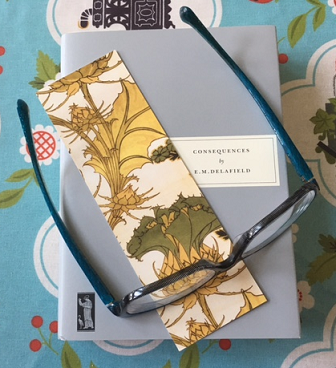
Day 1198: Consequences

Cover of ConsequencesIf you expect E. M. Delafield’s Consequences to be like her witty Diary of a Provincial Lady, you will be surprised. Although it addresses themes that Diary touched on much more lightly, it is serious, sad, and even bitter.

Alex Clare grows up in the typical environment of a Victorian child of wealthy parents. She and her brothers and sisters are raised by Nanny and only see their parents at specific times. Alex is an aggressive child with her siblings, but her desire is to have someone care about her. Since Nanny dislikes her and Cedric and Barbara band against her, she tries to please her mother.

But a childish game causes a near tragedy. Alex’s part in it is misinterpreted, and she feels too guilty to defend herself, so her parents send her away to a convent school in Belgium.

Here, Alex begins a lifelong pattern of fastening upon someone for whom she will do anything. In school, it is Queenie, for whom she breaks rules to give treats and try to hang around her. These kinds of crushes are forbidden, and Alex is constantly in trouble for breaking rules, while Queenie blithely accepts forbidden treats and gets away with it. Alex does not learn to develop standards of behavior. She just yearns for love and understanding without having the ability to evoke it from others.

This childhood does not prepare her for young womanhood, where the only expectation is that she will marry well. She does not enjoy all the parties and events she must attend and is unable to hide her discontent.

Alex is not an attractive character. She is needy, unprincipled, and depressive. But her small transgressions are magnified by her family until she feels friendless and isolated.

Consequences is Delafield’s indictment of this kind of upbringing and the expectations for women of her class and time. It is also a character study of a woman who feels lost wherever she is. It is quite the feminist statement, published in 1919. The reviews included in the appendix of the Persephone edition show that its message was not well understood or accepted by the (presumably) male literary world of its time.

Related Posts

The Diary of a Provincial Lady

The Home-Maker

A Lady and Her Husband