Day 1192: The Priory

Cover for The PrioryBest of Five!
Saunby is an old estate that belongs to Major Marwood. It was once a priory, and the ruins are still there. The major is a poor landlord and manager who cares only for cricket. Although he has hundreds of pounds of unpaid bills and the house is falling to bits, he spends a huge amount of money every year in hosting two weeks of cricket matches.

The major is most unhappy about how the house is being run. His sister, Victoria, who is supposed to be in charge of the house, pays attention to nothing but her art, producing one atrocious painting after another. His two daughters, Christine and Penelope, are happy in their isolation up in the nursery, making odd-looking dresses and ridiculing the neighbors. The servants do what they want. Everyone in the household is completely self-absorbed.

So, the major decides it is time he remarried, principally to get someone to take care of the house and keep expenses in check.  He has his eyes upon Anthea Sumpton, a woman no longer young who he is sure will be sensible.

Unfortunately, Anthea is in love with him and doesn’t understand he is making a marriage of convenience. Soon, she will have a rude awakening.

Everyone in this novel is due for a rude awakening, however, as the focus of the novel moves to Christine and what happens when she falls in love with Nicholas Ashwell. He is one of her father’s cricket players who has been raised to be as selfish as her family is.

This novel is also somewhat an Upstairs/Downstairs novel at first, when the new maid, Bessy, falls in love with Thompson, who helps with the cricket. He returns her feelings but doesn’t reckon with the rejected Bertha.

This novel is the best kind, the type in which characters develop and you change your mind about them. Beginning in the late 1930’s, it is also winding its way slowly toward the war. I found the novel beautifully written, involving, and ultimately touching, as a dysfunctional family learns to become slightly more functional. I have enjoyed all of Whipple’s novels, but I think I liked this one best, so far.

Related Posts

They Knew Mr. Knight

Someone At a Distance

Greenbanks

Day 1163: The Shuttle

Cover for The ShuttleAt first, I wasn’t sure I would like The Shuttle, despite my enjoyment of Frances Hodgson Burnett’s other novels. That is because it begins with an extended metaphor, rather cumbersome, about the shuttle of fate weaving together east and west. I wasn’t altogether sure which east and west she was talking about and had wild thoughts about China. But we weren’t leaving the Occident. By west she meant America, more precisely the United States. By east, England. But this introduction lasts only a couple of pages, and then we get into the action.

The novel begins with Rosalie Vanderpoel, the gentle, naive daughter of a New York millionaire. It is the early days of the migration of young, titled Englishmen to New York looking to marry money, and the relatively innocent New Yorkers don’t understand that most of these men are fortune hunters. Rosalie becomes engaged to Sir Nigel Anstruthers. Although Reuben Vanderpoel, Rosalie’s father, does not like Nigel, only nine-year-old Bettina sees him for the vicious bully that he is.

But Nigel hasn’t done his homework. He doesn’t realize that American girls don’t come with dowries nor that Rosalie won’t expect to hand her money over to her husband for handling, as an Englishwoman might. Once he realizes his mistake, he blames it on Rosalie.

Rosalie goes to live in dilapidated Stornham Court, where she is mistreated and bullied by her husband and his mother. Thinking that no man would take money from a woman, Rosalie doesn’t offer any, and it takes a while before she realizes that’s what he wants. But he doesn’t want money for the estate, just to support his vicious habits. He cuts her off from her family to make her miserable and keep control.

Rosalie isn’t the heroine of the novel, however. That honor belongs to Bettina, or Betty, who vows at the age of nine to go sometime and rescue Rosalie. And so she does, 15 years later.

This novel isn’t one of great surprises. When Betty finds Rosalie and her son alone and works to buck them up and get them ready to leave, the tension builds from the expectation of a showdown with Nigel. When Nigel finally arrives, he uses all his cleverness to foil Betty. We know who will win—we just don’t know how.

I don’t think Burnett’s adult novels were considered sensation fiction, but this one certainly deals with those kinds of topics and is very melodramatic. Still, it was a fun book to read. Betty is clever and determined. You know she will win at love and defeat Sir Nigel.

Related Posts

The Making of a Marchioness

That Lass o’Lowrie’s

Diana Tempest

Day 1155: Literary Wives! A Lady and Her Husband

Cover for A Lady and Her HusbandToday is another review for the Literary Wives blogging club, in which we discuss the depiction of wives in fiction. If you have read the book, please participate by leaving comments on any of our blogs. Be sure to read the reviews and comments of the other wives!

Eva of Paperback Princess
Kate of Kate Rae Davis
Lynn of Smoke and Mirrors
Naomi of Consumed By Ink
TJ of My Book Strings

My Review

A few months ago for Literary Wives, we read The Awakening, one of the first feminist novels, written in 1899. A Lady and Her Husband was written 18 years later and shows great advances in feminist thought.

As I started the novel, I thought it was going to be about Rosemary Heyham, who is just about to be married, but instead it is about the awakening of her mother, Mary, a gentle, conventional soul who has been married to James for nearly 30 years. The action of the novel stems from Rosemary’s recognition that her mother is facing empty nest syndrome but also because she thinks her mother needs outside stimulation. She goes to her father with the idea that he give Mary a job.

James decides to put Mary to work looking into the welfare of his female employees, particularly the waitresses who work in his chain of tea shops. He believes he is a stellar employer and she won’t find anything to complain about, so in a way, this job is make work.

But Mary takes her job seriously. At first she finds nothing wrong, but she is shocked when she investigates the living conditions of the girls. (Of course, this dates the work, because these days the things she looks at and has control of would not be an employer’s business.) When she finally goes to James with some ideas, she is surprised to find him reacting angrily. What she asks for first are a room in each shop where the girls can eat their lunches, shoes that are more comfortable, and permission to do the washing up sitting down. What she gets are the shoes, but the girls will have to buy their own.

As Mary pursues her work, eventually asking for raises for the girls, she begins to see James in a less rosy light. It is difficult for me to guess how a contemporary audience would view their relationship, but for me, even when it is loving at the beginning, he patronizes her shamefully. All of this eventually leads to a crisis, when Mary is forced to evaluate even her own marriage.

While I wouldn’t say I loved this novel, I found it fascinating. A lot of it follows the evolution of Mary’s ideas from total acceptance of her situation in life to more of an awareness of her duty to herself and others. It also exposes James’s self-justifications. After I read Samantha Ellis’s introduction to the Persephone edition, which provides biographical information about Amber Reeves, I felt that if I ever had a hero, she would be it. As a young women, she had an affair with the much older H. G. Wells, whose ideas about free love didn’t include the woman being equally free, but she grew out of it. He never did, apparently, grow out of her, though, but kept rewriting her into novel after novel, where he depicted her changing from a vibrant, intelligent lover to a subservient wife. She never did, though.

What does this book say about wives or the experience of being a wife?

Mary has had a conventional marriage for her time. In the beginning of the novel, she sees that her role has to do with keeping house and caring for the children. She believes that only men are capable of understanding bigger issues. She loves her husband and takes care to present him with a placid home life.

However, largely because of his reaction to how she does the job he invented for her, she begins to re-evaluate her ideas about men and their relationship to women. She sees that men care more about things—their careers, their projects—more than they do about people. She begins to question her role in her marriage and in their business—in which she owns 50%—and to feel that she has a responsibility to make sure their employees aren’t treated badly.

She also begins to understand James’s self-justifications. As an example, when Mary, having seen how some of the waitresses live, points out that they are not receiving a living wage, both James and their son Trent remark that the girls just spend their money on ribbons. And she notices how James adroitly manages to blame a more serious marital problem on Mary herself.

Within the novel, Mary awakens from a woman who has been blinded by convention to a person who is more aware of the realities of life, who is able to think through her own difficulties and come to a solution.

Related Posts

The Awakening

Fidelity

Dept. of Speculation


Day 1144: The Victorian Chaise-Longue

Cover for The Victorian Chaise LongueThe Victorian Chaise-Longue is a short little tale of the macabre in honor of the season. Its plot is simple.

Wealthy Melanie Langdon is recovering from tuberculosis, complicated by recent child birth. When she is finally recovered enough, she is carried to lie on a Victorian chaise-longue that she bought in an antique store. There she falls asleep.

When Melanie awakens, she has returned to Victorian times and is locked in a Victorian body. When she is alarmed at her situation, she is thought to be hysterical.

logo for RIPI did not find the novel terrifying, but perhaps that is my own lack of imagination. I felt I needed to care for the character more before she was put in her dilemma. I understand from the introduction that Laski moved to a remote house to induce in herself a sense of fear, just to write this novel.

This is the final book I read for the R.I.P. challenge. Happy Halloween!

Related Posts

Sleep, Pale Sister

The Solitary House

The Sleep Room

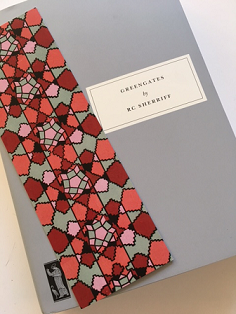
Day 1116: Greengates

Cover for GreengatesBest Biweekly Book!
I knew that Greengates was about a retired couple, but I didn’t know it would strike home with me in several ways. Although it was written in the 1930’s, it has some universal themes.

Tom Baldwin has his last day at work, retiring from an insurance company where he has worked for 30 years. On his way home, he wonders what he will do with his time, but he decides he will have another career in history and work on his garden.

So, he arrives home full of plans, but within a few days, he realizes his plans were overly optimistic. He doesn’t have the background, even, to understand the history books he has, and his plans for the garden are thwarted because of poor soil and a lack of light.

Further, his wife, Edith, had not reckoned on the disruption to her life. He may be retired, but she still has to keep the house. He continually disrupts her routines. As he begins feeling more useless, he questions her comings and goings. For the first time, they begin to argue.

One day Edith remembers how they used to enjoy a walk to the country on autumn weekends. They would take the train out and then walk to the beautiful Welden Valley. She suggests to Tom that they go, and he reluctantly agrees. Little do they know that the walk will change the rest of their lives.

Although I have not so far experienced a loss of purpose since I retired, the activities I’ve been focusing on parallel those that finally give the Baldwins a renewed set of goals. So, that is what chimed with me.

But I think almost anyone could sympathize with the plight of this couple. Even though some of the details are dated, their problems still exist. Tom has spent most of his professional life involved in activities related to work, even to the company sports team. Now he has to find something else to occupy his time, and Edith has to find a way to cope with their altered life patterns.

This was another fine novel from Persephone Press. I really enjoyed it.

Related Posts

Greenbanks

One Fine Day

Major Pettigrew’s Last Stand

Day 1039: The Home-Maker

Cover for The Home-MakerBest Book of the Week!
The Home-Maker, which was published in 1924, was certainly a radical novel for its time. It has themes that resonate even today, although in some ways it is dated.

Evangeline Knapp is one of those super housekeepers whose home is always immaculate. When we first meet her, she has spent hours scrubbing a grease stain on the floor. But she does not love her work, and her unhappiness creates an atmosphere of tension in the house. She continually picks at her children for not meeting her standards, and everyone is afraid to upset her.

Lester Knapp works as an accounting clerk at a department store and hates every minute of it. He is not earning points with the new management for his dreamy demeanor or love of poetry. Although he is a good husband and father, he is perceived by his community as ineffective and a poor provider. Early on, we learn that he did not get a promotion he was hoping for, and his family will continue to be poor.

A terrible incident forces the two Knapps to swap responsibilities after Lester is injured. Lester takes over the household and child-rearing while Evangeline gets a job in the department store. Her new employers are struck by her energy and dedication to her work, while Lester’s patience with the children makes everyone’s temper and health improve. Everyone learns to adjust to a certain level of messiness.

The idea of swapping roles was much more controversial at this time, so much so that the novel is forced into a shocking conclusion. That was the only thing I didn’t like about this novel, which is touching and compassionate in its view of its characters. However, there probably wasn’t a better way to resolve the situation at the time.

This is a fascinating novel for its time, exploring the ideas of roles for the sexes and how well they actually apply, what happens when a person has no challenging life’s work, and so on. The novel’s themes are applicable to today, even if the times would not require such a resolution.

Related Posts

Fidelity

The Squire

The Wife

Day 1021: Mariana

marianaAt the opening of Mariana, Mary hears that her husband’s ship has struck a mine and that there were many casualties. Her phone is dead and it is nighttime, so she must spend the night convinced her husband is dead. She goes back in her memory to her childhood, adolescence, and young adulthood to consider how her life began.

As a young girl, Mary lives for her summer vacations at Charbury, her grandparents’ home, and it is Charbury she first remembers. Charbury means her wonderful room at the top of the house, her pony, and lots of running around with her cousins. In particular, this means Denys, with whom she is infatuated. Dickens’s descriptions of Charbury are delightful.

In the fall, Mary reluctantly returns home to the small flat where she lives with her mother and uncle, a largely unemployed actor. Her father married beneath him, but since his death Mrs. Shannon has insisted on her independence, and the small family struggles along. Certainly, her upbringing is unusual, because her mother and her brother are on the Bohemian side, although certainly affectionate guardians.

This novel follows Mary as she grows up and through her various relationships in her youth. We are pulled along by our interest in her and our curiosity about who she marries rather than by the plot. This novel is romantic without being a romance novel as such. Monica Dickens was Charles Dickens’s great-granddaughter, and she certainly inherited his ability to tell a tale.

Related Posts

Family Roundabout

Greenbanks

One Fine Day

Day 1002: The Crowded Street

Cover for The Crowded StreetThe Crowded Street was Winifred Holtby’s second book, and like her others, one of its themes is a woman’s duty to herself and to a larger society than her local community. The novel’s main character is Muriel, who always tries to do what is right and good.

We first meet Muriel when she is nine and follow her for the next twenty years. In the first scenes of the novel, Muriel is excited to be attending a party. But her desire to enjoy the party by watching the others conflicts with the ideas of her mother, who thinks she should be dancing and socializing.

During the party, she dances with Godfrey Neale, who becomes important to her later in the novel. But in trying to escape her mother, Muriel falls into a situation where her behavior is misunderstood and the party is ruined for her.

Muriel begins a pattern of always trying to please her mother. Mrs. Hammond, though, has married beneath her and has spent her career social climbing to make up for it. Although Muriel would like to learn about astronomy and is interested in math, the only way she can please her mother is by marrying well. Unfortunately, she is shy and only moderately attractive. Still she decides fairly early on to devote herself to her mother.

Only one friend, Delia, urges her to do more. She tries to get Muriel to go to college, but Muriel is naive and for a long time believes what her mother tells her, which is that men do and women wait for them to act.

It took me a while to relate to Muriel, probably because she is so naive. But eventually I became engrossed in her story, as she learns to view her world and her mother with a more skeptical eye. Having grown up in the 50’s and 60’s, I remember my own mother coming out with some of the things implied or said in Holtby’s novel, only my own reaction was one of indignation. But that was 30 years after the setting of this novel.

I very much enjoyed this novel about Muriel and her slow turning toward a more feminist outlook.

Related Posts

The Land of Green Ginger

Anderby Wold

South Riding

Day 955: Family Roundabout

Cover for Family RoundaboutBest Book of the Week!
It is 1920, and the Fowler and Willoughby families are about to be united by marriage. The Fowlers are an old county family, now getting a little shabby, while the Willoughbys are forces in the town, wealthy but not so genteel. Up until now, the families have held apart, but in this generation there are friendships between the children. Now, Max Willoughby, good-natured and charming, will marry the determined and managing Helen Fowler.

The two families are headed by widows. Ever since she married her husband, Mrs. Fowler has hid her true self, whom she wryly refers to as Millicent, behind a façade of vagueness and stupidity that she calls Millie. Although she never seems to make a decision or take charge of anything, everything seems to get done they way she wants it.

Mrs. Willoughby is made of sterner stuff. She manages everything, including the family business and the lives of her grown children. When she tries to manage Mrs. Fowler over the wedding, though, it’s like pushing jelly around. Everything gets done, just as Mrs. Fowler wishes it to. From the beginning of the marriage, Helen is more like Mrs. Willoughby’s daughter than Mrs. Fowler’s.

Endpaper
Endpaper for the Persephone edition

Other future partnerships seem foreseeable from the wedding. Anice Fowler gets engaged to Martin Newbolt, a poor but intellectual young man who works in his uncle’s book shop. We can see trouble ahead because of Anice’s unspoken rivalry with Helen. The youngest Willoughby, Oliver, finds himself attracted to his young sister Cynthia’s best friend, Judy Fowler, who is looking beautiful and grown up at the wedding. Then there is the already married couple, Peter and Belle Fowler. They have a young daughter, Gillian, but things are not looking good for them. Peter is sensitive and mild-mannered, but Belle is a self-centered, temperamental beauty.

Family Roundabout follows the fortunes of the Fowler family and some of the Willoughbys through almost 20 years, until just before the war. Although it has many characters, I found myself deeply interested in their lives and problems. This is a compelling novel about the everyday lives of ordinary people, with an ending that eerily contrasts what we know about the coming war with what the characters don’t know. Although I don’t usually lose this perspective with fictional characters, it made me wonder what happened to them next.

Related Posts

Wild Strawberries

Greenbanks

Cheerful Weather for the Wedding

Day 873: Fidelity

Cover for FidelityBest Book of the Week!
Fidelity begins in 1913 with the return of Ruth Holland to her home town in Iowa after an absence of ten years. As a naive young woman from a privileged background, Ruth fell in love with a married man. When he was diagnosed with tuberculosis a few years later, Ruth left town to join him in Arizona.

Ruth’s good friend, Dr. Deane Franklin, would like to see Ruth’s old friends welcome her back as she returns to her father’s deathbed. He knows that Ruth’s life has been difficult, both emotionally and economically, and would like people to show some sympathy. He wants to introduce Ruth to his new wife Amy. But Amy thinks this suggestion is shocking and can’t imagine why Deane would want her to know this scandalous woman.

Eventually, the novel returns in time to show how the affair started and progressed. It is not until Ruth returns that she learns how difficult things also were for her family after she left.

The plot of Fidelity, which was written in 1915, closely mirrors a situation in Glaspell’s own life, in which she ran off with a married man and later married him. She wrote the novel to answer the question “Was it worth it?”

During Ruth’s visit back home, she meets a woman who teaches her to recognize another type of fidelity—to herself. Although we don’t know where this fidelity will take her, we know that she will keep to it.

Of course, the novel is also meant as a condemnation of the small minds in Ruth’s home town. Even though they have known her from a child, most of her former friends misinterpret her actions in terms of her new reputation. Only her youngest brother Ted and a few friends see her for the person she has always been.

I found this novel completely fascinating from beginning to end, even though I’m not sure I would answer the question the same way Ruth did. The novel is particularly insightful about its characters, making readers understand and sympathize with even some of its unlikable ones.

Related Posts

A View of the Harbour

Someone at a Distance

Greenbanks