Day 614: The Bridge of San Luis Rey

Cover for The Bridge of San Luis ReyThe Bridge of San Luis Rey is a moral fable that explores whether there is a purpose in life beyond that of a person’s own will. This theme is not one that interests me, nor do I usually enjoy fables, but I did enjoy Wilder’s rich characterizations in this short novel.

The novel begins in 1714 in Peru, when the bridge of San Luis Rey collapses, killing five people. A monk, Brother Juniper, believes that this event may be his opportunity for scientific proof of the will of God. So, for six years he collects information about the lives of each victim.

What follows is a chapter about each of the lives of the victims, in all their humanness and contradictions. The Marquesa de Montemayor is an ugly, rich old woman who is despised by many for her eccentricity. She obsessively loves her daughter, who has moved to Spain to get away from her, and she writes her rambling but marvelous letters that only her son-in-law reads. With her dies her young maid Pepita.

Esteban is a twin whose brother Manuel recently died. Esteban and Manuel were inseparable until Manuel fell in love with the actress Perichole, who used him to write her love letters. Ever since Manuel’s death, Esteban has been inconsolable.

Uncle Pio was a wanderer who eventually settled down to mentor Perichole, whom he raised from a young barroom singer to become a great actress. But Perichole begins to have ambitions beyond the theatre and eventually throws off Uncle Pio. Uncle Pio has devoted himself only to her, though, and promises to educate her son Jaime.

This novel is beautifully written and touching in its acceptance of the foibles of humanity.
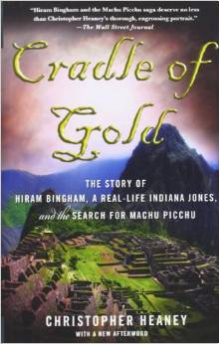
 

Day 541: Cradle of Gold

Cover for Cradle of GoldA few years ago I reviewed The Lost City of Z, which told about Percy Fawcett’s search for a fabled city in the Amazon jungle. That book alleged that Fawcett was a possible model for Indiana Jones. It is a minor point of Cradle of Gold that Hiram Bingham III is much more likely to be the model. Bingham was the man who brought the world’s attention to Machu Picchu.

At the time, Bingham was hailed by the western world as Machu Picchu’s discoverer, despite its being known about all along by the nearby farmers. Bingham’s story also has other examples of chauvinism and controversy, including his removal of artifacts without the permission of the Peruvian government. (He more or less permanently “borrowed” them.) Peru has only recently won a law suit against Yale University for the return of the collection, including many human remains. Still, Bingham is recognized even in Peru for his contributions to Peruvian history and archaeology.

The book begins in Hawaii, where Bingham was born the son of missionaries who expected him to study theology. But Bingham did not see himself taking up his father’s mantle. He was still fairly young when he took the money saved for his education and tried to embark for San Francisco. Although he was prevented from leaving and eventually ended up attending Yale University, he soon after became an explorer.

The book is named Cradle of Gold after Choqquequirau, supposedly the home of the Virgins of the Sun, which was the first site Bingham visited. He found it had been looted long before. Instead of pursuing it further, he became interested in finding Vilcabamba, the residence of Manco Inca, one of the last rulers of the Inca who was captured and slaughtered by the conquistadors. Initially attracted because no one knew what happened to Manco Inca’s great treasure, Bingham eventually became more interested in Incan history and artifacts.

This book is the engrossing story of Binghams’ origins and expeditions, his contributions to science, and the controversy that followed. Author Christopher Heaney is a Doctoral Fellow in Latin American history at the University of Texas, Austin. He has written a clear and interesting account for the general public but supported by extensive documentation. If you are interested in stories of exploration, you will like this one.