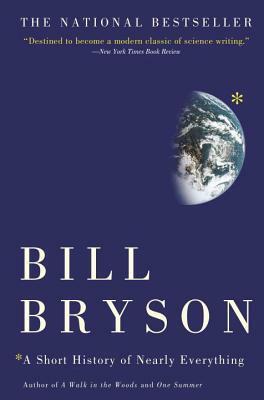
Review 2579: A Short History of Nearly Everything

I picked out A Short History of Neary Everything because it filled one of the last holes in my A Century of Books project and I generally enjoy Bill Bryson. I don’t know what I thought it was about—I think I expected it would be something like At Home, which told the histories of objects and rooms in an ordinary house. But silly me, it’s all science.

It’s not that I never read about science, but I have a limited tolerance for it.

When I first began reading it—actually for the first few chapters—I wondered who the audience for it was. It seemed to be telling about things I supposed most people know, so I wondered if it was for middle grade readers. But it certainly was never marketed that way.

It took a while before Bryson got to subjects that I wasn’t as familiar with, but in any case one of his strengths is finding out strange facts or biographical details of the scientists who made discoveries, so that he makes the material more interesting. And he writes with a lively style. However, he also really likes numbers, which are in general fairly meaningless to me (although he does make good comparisons to make them at least imaginable).

But this is a very long book, nearly 600 pages, and after a while I found myself skipping material. The first thing I skipped was the end of a chapter after it started getting too far into particle physics. Later, I skipped the entire chapter on cells. The geology chapter was interesting, but I was less than 100 pages from the end of the book when I finally pooped out. It didn’t even work to take a break and read a different book. It also didn’t help that such a book becomes rapidly out of date.

As a side note, I found the format of the library’s fancy version a little annoying. It used magazine-style callouts. That is, they didn’t provide additional information but just included quotes from the text. The purpose of such callouts in a magazine is to attract attention to the article, but in a book that you’re already reading?

Related Posts

At Home: A Short History of Private Life

The Body: A Guide for Occupants

Annals of the Former World: Assembling California, Basin and Range, Crossing the Craton, In Suspect Terrain, Rising from the Plains

Day 908: Relativity

Cover for RelativityIt’s hard to express my feelings about Antonia Hayes’s first novel, Relativity. When I say it’s sort of a feel-good novel about the ramifications of shaken baby syndrome, you’re going to get the wrong idea. So, maybe I should just start at the beginning. I read recently that Hayes’s own son was a victim, and that adds an unexpected dimension to the novel.

The novel begins from the viewpoint of a delightful character, Ethan Forsythe, the 12-year-old ex-baby in question. He is thrilled about astronomy and physics, and we meet him with his mother, Claire, watching the stars from the park. Ethan is a science nerd who is having some problems at school from bullying, and he also wonders about his father, whom his mother refuses to talk about. Finally, some particularly nasty comments about his father by his ex-best friend Will at school lead him to hit Will, an incident that he can’t remember. In the resulting conference with parents and his teacher, Will’s mother makes some cruel comments and Ethan is so upset that he has a seizure.

Claire, who is a distracted, hazy, self-involved person and overly protective parent, has been having her own problems. Her ex-husband Mark has written her a letter telling her his father is dying and wants to see Ethan. Claire has not allowed Mark’s family any contact with Ethan since Mark left. Claire decides it is not in Ethan’s best interest to meet Mark’s father John, so John dies without seeing Ethan. We know that Ethan had developmental problems as a baby, but it is a while (but still in the first third of the book) before we find out that his father was found guilty of shaking him and injuring him. For that, he served time in prison.

One of the questions of the novel is whether Mark did it or not. However, this novel deals with more issues than that. Mark insists he did not, and we don’t learn the truth about it until the latter part of the novel. It also deals with how both parents handle self-blame over the injuries to Ethan and the disintegration of their marriage. Another theme is Ethan’s own need for knowledge of his father.

link to NetgalleyThis was quite an enjoyable read for me, although I had some problems with the last part of the book. It is hopeful and gentle without providing a magic ending that solves everyone’s problems. That sounds good, right? But something about it bothered me in this context. The novel is compassionate and understanding, maybe too much so.

But the characters are convincing. Ethan is charming, especially in his friendship with his hospital friend Alison and in his love of and excitement for physics. Claire has reason for her over-protectiveness, although she is also very self-obsessed. Mark gradually pulls out of his own self-involvement over his ruined future to consider his son. Overall, I have to decide in favor of this novel, especially as Hayes undoubtedly knows her subject.

Related Posts

The Fault in Our Stars

The Possibilities

We Are All Completely Beside Ourselves

Day 669: Death by Black Hole and Other Cosmic Quandaries

Cover for Death by Black HoleA Quick Note: I just now published a new feature for my blog, an additional link called “List of Authors,” which lists all of the authors reviewed on this site and all their books. This new page will make it easier for people to find more books by authors they enjoy. Look for it at the top of the page!

* * *

Death by Black Hole is a collection of astrophysicist Neil deGrasse Tyson’s essays from Natural History magazine. In general, I’m not that fond of essay collections because just when I want an author to build on a point, the essay is over.

Tyson is always good, though, at explaining complex ideas in a way that a science novice like me can understand. He is also frequently amusing, funny enough for me to occasionally read passages out loud to my husband. Some of the pieces are probably written solely to provide amusement, like the one about the scientific errors in sci-fi movies. But he also includes essays about the creation of the universe, climate change, particle physics, cosmic curiosities, and the interface between science and the public.

If I can repeat a point, though, I think I would have appreciated even more a book that explained principles and then took me farther with them. Instead, by the nature of the beast, the essays are sometimes a bit repetitive, although none of them cover exactly the same ground.

I was really looking forward to the chapter on “intelligent design,” which is a sore point with me. But even though Tyson is clear that this is not a scientific viewpoint, his essay is a bit too tactful for my taste. At this point I would have appreciated some zingers.

Related Posts

Annals of the Former World

The Information: A History, A Theory, A Flood

Oryx and Crake