Day 110: Maus I

Cover for MausMaus I is a graphic novel that is both about Art Spiegelman’s relationship with his father, Vladek, and about Vladek’s survival of the Holocaust. The characters are depicted as different types of animals–Jews are mice, Poles are pigs, Germans are cats, Americans are dogs, and Swedes are reindeer. Spiegelman explained in The Comics Journal (according to a reader review on Amazon.com) that his idea for using these animals is not entirely original but is extrapolated and expanded from the names the Germans called Poles and Jews.

In the novel, as Vladek tells Art the story of his experience during World War II, they also argue. The story is compelling, although the relationship between the two is less so. Vladek is difficult and eccentric, but Art seems childish and spoiled, with no patience or understanding for his father. However, the novel makes the point that he, too, was scarred by his father’s experiences.

I am not by any means an expert on graphic novels, having only read one other, which was the beautifully illustrated Britten and Brülightly. However, the art in Maus I is so primitive that I could not tell any of the characters of a single species apart except for their clothes. I suppose, though, that that in itself is a statement. Still, the art shows a strength of line and a simplicity that make it interesting.

Maus I is apparently intended for young adults, and as such, is probably a powerful educational piece. I think it is less successful for adults.
Day 51: With Fire and Sword

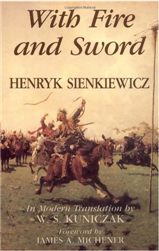
Cover for With Fire and SwordBest Book of Week 11!

Two years ago I read an exciting trilogy of Polish novels written in the 19th Century by Henryk Sienkiewicz, a Nobel prize winner for lifetime achievement in writing epic literature. The books were wildly popular for about 50 years, and Polish friends of mine tell me that they were their childhood reading. My review of the trilogy was published on Nancy Pearl’s blog (the librarian who has her own action figure), and I wrote to her awhile back asking if I could republish it here. She did not respond, so without further ado, I am going to write another review of the first book, With Fire and Sword. I will of course crib from my original review. The three books are stand-alone but with recurring characters, so you can read just one without missing important plot points.

It is 1647, and the Polish-Lithuanian Commonwealth is having some trouble—there are rumblings of rebellion among the Cossacks, who are a major force in the Polish army. Yan Skshetuski is a young Polish officer in the hussars of the Ukrainian Prince Yeremi Vishnovyetski. Prince Yeremi sends him on a mission as an emissary to Bohdan Hmyelnitzki, the leader of the Cossack rebellion. Yan has just become engaged to the beautiful Helen, but duty calls, so he makes his way through down the river to where the Cossacks are gathering.

Yan has been sent too late, though, for the rebellion has already started when he arrives, and he is made a prisoner. He escapes with difficulty and makes his way through the war-torn landscape, all the time worrying about Helen.

The political situation in Poland is very unstable, so no one comes to Prince Yeremi’s aid as he is attacked by hoards of Cossacks from the southeast. Even though Helen has been kidnapped by the wild Cossack Bohun, Yan cannot take time to look for her because he is embroiled in another mission for the Prince. So, his friends, the fat buffoon Pan Zagloba, the lovelorn knight and master swordsman Michal Volodyovski, and the gentle Lithuanian giant Longinus Podbipyenta decide to help Yan by rescuing Helen themselves.

This novel is all adventure and romance, and it is truly exciting. Along the way, you learn something about 17th century Polish history.

If you are interested in reading the book, you may have  a hard time finding it (although I see it is available in a print-on-demand basis). It is also available in several translations, about which there is some debate. The original translation by Curtin is said to be truer to the book, but I took a look at it, and it is also fairly badly written. The translation that I read by Kuniczak takes some liberties with the structure of the novel, but is eminently readable, if you can find it. The cover picture at the beginning of the article is from the edition that I read.