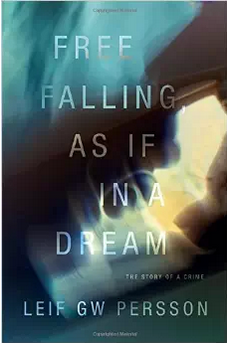
Day 735: Free Falling, As If in a Dream

Cover for Free FallingWith the last book in the series Leif GW Persson calls the Fall of the Welfare State, he finally, as promised, gets to the actual assassination of Swedish Prime Minister Olof Palme in 1986. The novel begins in 2007, when Chief of the National Bureau of Criminal Investigation Lars Martin Johansson (whom we have met in the two previous books) decides it is about time someone solved Palme’s murder.

Most Swedes believe the murderer was a madman named Christer Petersson. But Johansson doesn’t believe this, and he has brought together a team of Superintendent Anna Holt and Chief Inspectors Lisa Mattei and Jan Lewin to try to solve the crime before the statute of limitations expires.

This excellent police procedural, like the others in the series, is based on actual events and written by the man considered the foremost expert on crime in Sweden. To see if anything was missed, the detectives laboriously untangle the threads of various “tracks,” or theories of the crime, that were followed during the original investigation. Almost immediately they find evidence of a witness that may indicate the assassin took a different escape route than prevously believed. The witness’ testimony was discounted because she was a drug addict and prostitute. Although struggling with difficulties of an unofficial case and long-dead witnesses, the detectives make impressive strides.

In the meantime, Johansson explores the perilous channels of political intrigue, for Persson’s novel makes an almost perfect combination of political thriller and police procedural. In this novel, we encounter some of the people whose exploits were featured in the previous two, including the ridiculous buffoon Bäckström, who thinks every crime has to do with money or sex, and the dangerous Waltin, long dead but important to the case.

This is an excellent series. Its political ramifications are similiar to those of the works of Stieg Larsson. It is well written, sometimes funny, and also compelling.
Related Posts

Between Summer’s Longing and Winter’s End

Another Time, Another Life

The Girl with the Dragon Tattoo

Day 625: Another Time, Another Life

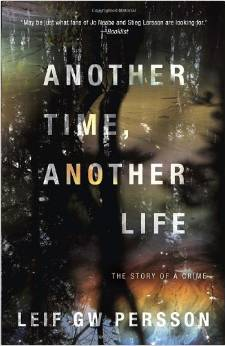
Cover for Another Time, Another LifeAnother Time, Another Life is the second book in a trilogy of complex political police procedurals by Leif GW Persson. I reviewed the first book last spring.

At first, it is difficult to see the connection between the two books, but eventually some of the names and events from the previous book re-emerge. Another Time, Another Life begins with two crimes 14 years apart. Like Between Summer’s Longing and Winter’s End, one of the crimes is based on an actual event, in this case the bombing of the West German embassy in Stockholm in 1975 by German terrorists. Although the Swedish authorities are certain that the Germans must have had help from Swedish citizens, the case is wound up fairly quickly without any indication of who those Swedes might be.

Inspector Bo Jarnebring was on the scene right after the bombing, and 14 years later he is the first to respond to a call for help. A little old lady has overheard an argument in a neighboring apartment and called to report that someone is attacking her neighbor. When Jarnebring and his partner Anna Holt arrive, they find Kjell Göran Eriksson stabbed to death in his living room.

Eriksson turns out to be an unpopular man—no one at his workplace liked him and he had only two friends, both of whom have not seen him in awhile and have alibis. Bäckström, the inspector in charge of the investigation, gets it into his head that the crime involves homosexuality, based solely on there being no evidence that Eriksson had a girlfriend. He has no compunction in using illegal means to make the facts fit his idea of the crime. Jarnebring and Holt are suspicious of the amount of money in Eriksson’s bank account, not justified by his salary or his background. But Bäckström won’t let them pursue their leads, and no suspect is ever identified.

Ten years later, Lars Johansson has just taken a job as head of the Swedish Security Police when he finds some puzzling information in his files. The names of four Swedes suspected of helping the German terrorists in 1975 were redacted from a file, but then two were reinstated. Both men are dead, and one of them was Kjell Göran Eriksson. The other was one of his two friends. This discovery leads Johansson back to his friend Jarnebring and to an official reopening of the Eriksson case and an unofficial reopening of the embassy bombing case.

Having read the first book in this series, I was not surprised to find the case becoming very complex, with important political ramifications. Persson’s work is reminiscent of some of John Le Carré’s political thrillers, although not as exciting and probably not as well written (hard to tell with a translation). The novels are intended more as complex procedurals, though, than thrillers, and they succeed in keeping my attention. As with the first book, Persson seems to delight in depicting incompetence and idiocy in the police and government. Jarnebring and Johansson’s teams are capable and intelligent, though, and for once we meet detectives who are happy with their wives.

Day 480: Playing with Fire

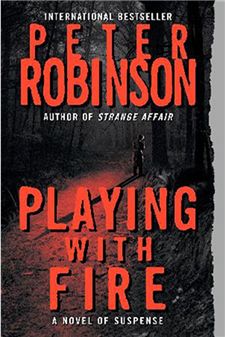
Cover for Playing with FireThis DCI Alan Banks mystery begins with a fire on a couple of canal barges. A squatter named Tina Aspern has been killed on one and an artist named Tom McMahon on the other. Accelerant is present, and it appears that McMahon’s boat was the origin of the fire.

On the scene appears Tina’s boyfriend Mark Siddons, but his alibi that he was with another woman after a fight with Tina checks out. Banks and DI Annie Cabbot and their team are able to discover very little about McMahon except that he has failed as an artist and buys cheap old books from a store owned by Leslie Whitaker.

Soon another fire kills Roland Gardiner in his caravan (mobile home). The police are trying to link the two men, but Gardiner was unemployed and almost a recluse. Tests reveal that both McMahon and Gardiner were drugged before the fires were set.

Annie’s boyfriend Phil Keane, an art expert, suggests that one use for old paper is to employ it in forged artworks. When the police find a fire-proof safe in Gardiner’s caravan containing money and some drawings that seem to be Turners, Banks and Cabbot think they may at least have uncovered a motive. But who could the murderer be? Is it Leslie Whitaker?

Finally, tracing a rented Jeep leads them to a shadowy figure, a man who does not seem to exist. He turns out to be very dangerous indeed.

Playing with Fire is a fast-paced and complicated mystery. Some sixth sense made me guess the killer almost as soon as he appeared, but I don’t think the solution is obvious. If you enjoy an intelligent police procedural, I think you’ll like Robinson’s series. The only other book I have read by him, which was not really part of the series (a more atmospheric novel in which Banks appears but is not part of the story), I enjoyed even more.

Day 273: Sun and Shadow

Cover for Sun and ShadowTwo people are murdered in their apartments and their heads exchanged. Erik Winter and his team try to figure out what this means, fearing that a serial killer is at work. At the same time, Erik tries to cope with his father dying in Spain and his girlfriend’s pregnancy.

Edwardson, as with other Scandinavian mystery writers, tends to depict police work more as a grind than as food for a thriller. In this case, suspense was generated because, from almost the beginning, I was convinced the murderer would kidnap Erik’s girlfriend.

The novel was also clever enough to trick me. I was sure that the murderer was a certain character, but the book made me think that the killer was another person. It turned out I was right all along.

If you are interested in a slower-moving mystery that grows organically and is probably more realistic than our American mysteries/thrillers, you may enjoy reading Ǻke Edwardson.

Day 153: The Shadow Woman

Cover for The Shadow WomanIn The Shadow Woman, a woman is found dead in a park during the Gothenburg Party, a citywide festival that is taking place during a blazing summer. Chief Inspector Erik Winter and his team are having a hard time finding leads or even identifying the body. All they have is footage from a surveillance camera of a Ford Escort and a strange symbol painted on a nearby tree.

Sandwiched into the criminal investigation is the narration of a little girl who doesn’t know where her mommy is and is being kept by strangers. When Winter’s team finally identifies the body, they find that the woman had a little girl. No one seems to know where the child is.

During an investigation that lasts months, Winter and his team begin to find links between the crime and a robbery that occurred 25 years ago. In the meantime, Winter’s long-time girlfriend Angela is thinking of giving him an ultimatum about their relationship.

I haven’t been reading Åke Edwardson’s Erik Winter mysteries in order, making the private lives of the recurring characters a little difficult to follow. The books keep my interest and provide complex puzzles, but I still don’t feel like I get much insight into the personalities of the main characters. The slower pace of Edwardson’s police procedurals is probably more realistic than the speed with which crimes are usually solved in fiction, but the author’s ability to effectively build suspense is also affected by this pace.

Day 108: The Cruel Stars of the Night

Cover for The Cruel Stars of the NightThe Cruel Stars of the Night is Kjell Eriksson’s second mystery featuring Ann Lindell but the first one I read. Although the series is labeled Ann Lindell mysteries, the novels actually feature an ensemble cast of characters and take awhile to develop the personalities of the team in the Uppsala Violent Crime Division.

The chapters in this novel alternate between the investigations of the Violent Crime Division into suspicious incidents involving old men and the thoughts and experiences of Laura Hindersten, whose father is missing. After awhile, having information not available to the investigators, you realize how the two narrations are linked, but the team takes longer to connect the dots.

One of the two suspicious deaths of elderly men is that of Petrus Blomgren. He wrote a suicide note, but he was murdered before he could kill himself. The police are sure that Laura Hindersten’s father, a professor and Petrarch scholar, will turn up, but she is convinced that something horrible has happened to him.

The novel makes for an interesting enough story, although the only fully developed character is that of the serial killer. I am interested in reading more, though, and getting to know Lindell and her coworkers Sammy Nilsson, Allan Fredericksson, and Stig Franklin, better.