Review 2660: Little Boy Lost

When World War II broke out in France, Hilary Wainwright left his pregnant wife Lisa in Paris to rejoin his regiment, thinking that the British would be fighting in France. He only saw his son, John, once, shortly after he was born. Later, he heard that Lisa, who was working with the resistance, was dead. He had no idea what happened to the baby, but he once received a visit from Pierre Verdier, the fiancé of Lisa’s best friend, Jeanne. He reported that Lisa had given the baby to Jeanne shortly before she was arrested, but that now Jeanne was dead, and he did not know what happened to the baby.

The war is over, and Pierre returns. He tells Hilary he wants to look for John for him. Hilary is now ambivalent about finding his son. When Lisa was killed, he envisioned getting comfort from raising his son, but it has been five years. Now he’s more worried about how to tell whether any boy they find is really his.

Pierre eventually traces a boy who might be John to a Catholic orphanage in Northern France. Hilary goes to Paris to meet the people Pierre traced. He has always loved France, but post-war, the country is in dire straits. Hilary travels to the northern town to try to determine whether the boy, called Jean, is his.

Frankly, I disliked Hilary pretty much all the way through this novel. The Afterword says that it takes Hilary until the last few pages to know his own mind, but in fact, he uses every excuse to try to disassociate himself from responsibility. When he thinks he would be betraying Lisa if he accidentally took home the wrong boy, for example, it seems clear from what is said about her that she would have taken Jean as soon as she saw his plight.

Small spoiler—when it seemed Hilary was going to use his lust for an obvious slut to break his promises, I was really disgusted.

That being said, I still enjoyed reading this novel, which is touching and insightful into human weakness. It also provides a post-war view of France that is bleak and that I hadn’t read of before.

Related Posts

The Château

To Bed with Grand Music

The Victorian Chaise-Longue

Review 2656: The Edinburgh Murders

I still prefer McPherson’s stand-alone thrillers to any of her mystery series, but Helen Crowther is starting to grow on me. This is the second book in the series.

Helen is an almoner serving the poorest neighborhoods in Edinburgh post-World War II. Her title has just been changed to welfare officer, but her job is a lot more hands on than we would expect. So, she is bathing a woman at the public baths when two things happen—first, she spots her father in a booth but it is not the family’s usual night. Then, in the next booth an attendant finds a man who has been boiled to death. Helen, trying to help, notices that although his clothes are those of an abattoir worker, his hands are not those of a working man, and someone has removed his signet ring.

No one comes to identify the body, but Helen thinks her father knows something about it.

Helen’s personal life is complicated. In the first book, she was newly married and wondering why her marriage was not consummated. (Spoiler for the first book.) She has discovered her husband Sandy is in love with a man, Gavin. Now she lives alone in an upstairs apartment with Sandy and Gavin below. Things are going to get more complicated, because Helen is attracted to Billy, a technician in the morgue. Her friend Caroline wants to visit the morgue, so they arrive there to find out that another corpse has arrived, this one forced to eat himself to death and dressed like a tanner with a signet ring missing.

Helen agrees to go ice skating with Billy, Caroline, and Billy’s coworker Tom, and another body is found frozen under the ice. Then there is a fourth.

Helen and Billy begin investigating the murders, which are being blamed on an escapee from a mental hospital. But they don’t think he did it.

In the meantime, Helen and Caroline are arranging a Halloween party for the local kids at an Adventist church. It turns out spookier than they planned.

I like the flavor of Edinburgh in these mysteries, although like her Dandy Gilver series, they are super complicated, without much of a hint about the perpetrators until the end.

Related Posts

In Place of Fear

The Reek of Red Herrings

The Turning Tide

Review 2655: #NovNov25! A Pale View of the Hills

A Pale View of the Hills, Kazuo Ishiguro’s first novel, is restrained and delicate and at first seems relatively straightforward. But towards the end, ambiguity sets in, forcing the reader to think back through the events of the novel. I read it for Novellas in November.

Etsuko is a Japanese woman, a widow living in England whose eldest daughter, Keiko, has recently committed suicide. Her younger daughter, Niki, is visiting from London, and a child they see on a walk together reminds Etsuko of her life in Nagasaki just after World War II. Particularly, she is reminded of her friendship with a woman named Sachiko.

Nagasaki is recovering from the bombing. Etsuko is married to Jiro only a short time, and she is pregnant. The other women in her apartment building talk about Sachiko and say she is unfriendly. She lives with her daughter Mariko in the only house left in the area, a rundown cottage.

Etsuko meets Sachiko when she expresses worry about Sachiko’s young daughter, who seems to be left alone quite often. Sachiko talks as if her daughter is the most important thing in her life, but she doesn’t worry when she is out late, and Mariko is a very strange girl. Also, we eventually learn that Sachiko has an American lover, Frank, who keeps promising to take them to America but then abandons them and drinks up all their savings.

For her part, Etsuko behaves like a dutiful housewife and entertains Jiro’s visiting father, whom she likes very much. But in the present time we understand that she left Jiro to move to England with Niki’s father.

The plot of the novel centers on Sachiko’s choice—whether to return to live with her rich uncle and cousin, who welcome her, to live the life of a traditional widow, or to go off with Frank. The girl Mariko detests Frank, by the way, and she is also concerned about the fate of some kittens.

There is a moment late in the book that made me doubt that I fully understood what was going on, and this ambiguity is not resolved. As a narrator, Etsuko is not altogether reliable, but whether this moment is a slip of self-identification or of something more sinister, readers have to decide for themselves. Certainly, by then the story has taken on a darker tinge.

Some readers may not care for this ambiguity and others, I understand, have come up with some far-fetched theories, but along with its elegiac pure prose, it is this moment that turns the novel into one you will remember and think about.

Related Posts

The Remains of the Day

Nocturnes

The Buddha in the Attic

Review 2604: The Safekeep

In 1961 Utrecht, Isabel lives in the house her uncle bought for her mother during the war. Her mother died, and Isabel is very protective of the house’s contents, although she doesn’t own them. Her uncle intends to leave the house to her oldest brother Louis.

Isabel is in her thirties—particular, with a dislike of things that are different, stiff, unfriendly, and solitary. She has no sexual experience. She doesn’t like people to touch the things in the house, and she frequently thinks the help is stealing.

Isabel, Louis, and her other brother Hendrik have periodic dinners in the house, although both men now live in The Hague. Louis often misses the dinner, though, or if he comes, he brings his latest in a long string of girls he’s been in love with. These relationships only last a short while, however, so Isabel and Hendrik resent the inclusion of the women. Isabel, though, refuses to invite Hendrik’s partner, Sebastian.

Louis comes to dinner with a new girlfriend, Eva, whom Isabel thinks is low-class and treats with hostility. To her dismay, Louis tells her he must travel for business and wants Isabel to have Eva for a guest while he is away. He points out that the house isn’t really Isabel’s but is intended for him.

So, Isabel reluctantly takes Eva in, but she is not nice about it even though Eva tries to be friendly. The atmosphere is charged.

I found a lot of this novel very interesting, especially in its revelation of how The Netherlands treated Jews returning from the concentration camps after the war. Yes, mild spoiler, this novel does have to do with the aftermath of the war. I am not a fan of explicit sex, however, no matter who it involves, and there was a lot of that going on for about 100 pages.

The novel takes an unexpected turn at the end, and I think, besides the character study of Isabel, I found that part the most interesting.

I read this book for my Walter Scott Prize Project.

Related Posts

Sarah’s Key

The Postcard

A Town Like Alice

Review 2570: #1952 Club! Excellent Women

Entry #2 for the 1952 Club!

By “excellent women,” Pym seems to mean a type of English spinsters who occupy themselves with charity events and helping others, dress drably, and are taken for granted by men. That’s what Mildred Lathbury seems to think she is. She’s a clergyman’s daughter of limited means, mild-mannered and religious but observant of others’ characters while not wishing them any harm. In Excellent Women, she gets a surprising amount of attention from men, but then she’s always picking up after them.

Mildred lives upstairs of a vacant flat, and she’s curious about what her new neighbors will be like. She knows they’re named the Napiers by the sign at the doorbell. She meets Helena Napier on page 2, a young, stylish woman, and sees her around with a man, whom she assumes is her husband, Rockingham (known as Rocky). But he is not. He is Everard Bone, an anthropologist, and he and Helena, also an anthropologist, are writing a paper together. Rocky is off serving in Italy.

Mildred is good friends with Julian Malory, the vicar of her rather high church, and his sister Winifred. It is the expectation of several characters in the book that Julian will marry Mildred, but she doesn’t seem to expect it. Or does she? It’s hard to tell. Certainly, he is very friendly with her, but she thinks he is not the marrying kind.

Mildred meets Everard before she meets Rocky. Although he seems not to notice her at first, after a while he begins seeking her out. He is abrupt and serious, and she doesn’t think she likes him. Or does she? It’s hard to tell.

Once he shows up, Rocky is utterly charming and handsome. He is very friendly to Mildred and keeps popping up for tea. Mildred senses friction in the Napier home—well, she can hear them arguing. Rocky does all the cooking and cleaning in their home, because Helena is completely undomesticated. (She sounds like my kind of gal, even though she isn’t depicted particularly positively.) Mildred distrusts Rocky’s charm. She understands from Everard that Helena thinks she’s in love with him (Everard).

It being post-war London, it is still hard to find a place to live, so the Malorys decide to lease their upper floor. Soon, it is taken by Mrs. Gray, a beautiful clergyman’s widow. Mildred finds both Julian and Winifred transfixed by her, so she steers clear. It’s pretty evident what Mrs. Gray thinks Julian’s fate should be.

Mildred isn’t at all liberated. She is constantly cleaning up after men or doing ridiculously involved favors for Rocky and Helena, and all take her for granted. Yet, this is a lively, amusing social comedy. It is also a tale of the rapidly disappearing lives of upper- and middle-class English people.

Related Posts

The Camomile

Alice

My Brilliant Career

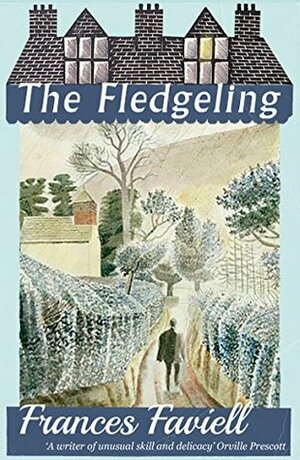
Review 2518: Dean Street December! The Fledgling

Here’s another book for Dean Street December!

I have read two memoirs by Frances Faviell, but The Fledgling is the third of her three novels and the first of her novels I’ve read. For me, It wasn’t as successful as her memoirs.

One reason is the main character. He is not very appealing. I’ll explain why later.

Neil Collins is serving his compulsory military service in 1950s England. This service was apparently controversial because the country was not at war.

Neil is a fragile, small young man who gets so nervous when ordered around or bullied—which he frequently is—that he gets stupid and can’t remember how to do things. He has already gone AWOL twice and has promised his grandmother he won’t do it again.

Everyone in his unit picks on him. He thinks he has one friend, Mike, but when Mike bullies him to desert, planning to follow him and use Neil’s contacts to get to Ireland, he realizes Mike has just been using him. So Mike bullies him more until he goes. Sexual abuse is implied.

Neil shows up in his grandmother’s rooms hoping to get his twin Nonnie’s husband, Charlie, to take him to Southampton before the arrival of Mike, who was supposed to leave the next day. However, his grandmother wants to turn him in, like she did last time, and Charlie doesn’t want to help him. To make matters worse, the walls of the rooms are very thin and people keep dropping by and trying to come in. Meanwhile, unbeknownst to the family, Mike is across the street all day watching the house.

I found Neil unlikable not so much because of what he is doing but how he acts. He is like the most timid heroine in a Gothic novel. He gasps loudly when he’s hiding, he keeps raising his voice despite many warnings about the nosy neighbors. He actually falls through the door when he is eavesdropping on his grandmother and her social worker. Basically, he’s an idiot with no control over himself. He acts more like a five-year-old than a twenty-year-old.

Of course, the book is about how he gets some stuffing to brace him up, but some of the book’s values are very dated. For example, Nonnie is supposed to tolerate Charlie’s infidelity because he’s jealous of her connection with her twin. And Neil has to get in a physical fight to gain some confidence. I also didn’t really find any of the characters to be that likable.

Related Posts

A Chelsea Concerto

The Dancing Bear

The World My Wilderness

Review 2512: Dean Street December! The Dancing Bear

The rate I’m knocking out books for my A Century of Books project has been slow lately because first I was reading books for Novellas in November (some of which also qualified for ACoB), and I also wanted to read at least a few books for Dean Street December. And I don’t know what I was thinking, but I also put several books for my other projects on my library reserve list, and they have arrived. I must be crazy! Anyway, I read The Dancing Bear for Dean Street.

Although The Dancing Bear is set in time after Faviell’s A Chelsea Concerto, it is actually her first memoir. It covers her time in post-World War II Berlin, where her husband was part of the Occupation. The people in the city are freezing and starving, and even their occupiers are on strict rations of many commodities.

Much of the book is about Faviell’s relationship with the Altmann family. She is being driven in her car when she spots Frau Altmann, an older lady of fragile build, trying to move a heavy cart of furnishings through the streets. Faviell’s German driver thinks it’s hilarious when she falls, but Faviell stops to help her and shames him into helping, too. Despite the dictum not to give rides to Germans, she takes Frau Altmann home in her car.

There, she gets to know Herr and Frau Altmann, two gentle and dignified older people, their daughters Ursula and Lilli, and their sulky son Fritz, a former member of a Nazi youth group against his parents’ wishes. Ursula is the only bread-winner, making money by fraternizing with the British and American soldiers. Lilli, extremely frail, is a ballet dancer.

Aside from descriptions of the living conditions and the changing situation between the Soviet and the other occupiers, much of the story is about Faviell’s relationship with the Altmann’s and with her regular driver, Stampie, who trades on the black market to keep some German families alive.

This is a fascinating account of how some people meet and overcome difficult situations and some don’t. I also wasn’t aware of the conditions in Berlin (although I had heard of the Berlin Flyover) and all the manipulation the Soviets did to try to claim the entire city from their other allies.

Related Posts

A Chelsea Concerto

In the Garden of Beasts: Love, Terror, and an American Family in Hitler’s Berlin

The Oppermanns

Review 2509: The Château

I found The Château when I was looking for a book to fill the 1961 hole in my Century of Books project. Although the blurb calls Maxwell “one of our greatest practitioners of the art of fiction,” I hadn’t heard of him before.

Harold and Barbara Rhodes, a young American couple, have taken one of the first opportunities of Europe reopening for tourists after World War II to visit France in 1948. Although they have some other adventures first, the bulk of the novel concerns the two weeks they have booked at a château, where they will be having meals with and visiting with the family. They made this decision to try to improve their French.

Although they meet mostly with kindness, they find post-war France difficult to travel in. The destinations they have in mind take several trains and sometimes other modes of transportation to get to, and they have brought too much luggage. Sometimes they are recommended not to go to a destination they planned. They end up going to the château early.

At first, nothing seems to be going well. No one meets them at the station, and although their room, when they finally see it, looks nice, it is cold and the fireplace is blocked. They were promised a bathroom and they get one but with only cold water from the sink and none at all from the tub, and the toilet is on another floor. The bicycles they were promised don’t appear. Moreover, their host, Mme. Viénot, seems cold and distant and their French isn’t up to the conversation. It is clear that the family is of the upper echelons of society, but now they are broke.

The Rhodes take a break of three days in Paris, and after that, they find things improving. They meet guests and younger family members whom they like very much, their French has improved, and Mme. Viénot seems happy to see them.

This novel takes a gentle, sometimes amusing look at the differences between the French characters and the Americans—Harold especially beaming good will but sometimes putting his foot in it—basically culture clash and a clash of social classes. It also describes the post-war conditions in France. I enjoyed reading the novel very much. Its descriptions of landscapes are lovely. It is both appreciative and ironic.

Related Posts

The Postcard

Wonder Cruise

The Flight Portfolio

Review 2313: Kate Hardy

I usually like D. E. Stevenson’s novels for very light reading, but Kate Hardy seemed all over the place.

Old Quinings is a village that has been left in the past, and the residents like it that way. They are interested to learn, though, that Mr. Morven has sold the Dower House. The new owner is Kate Hardy, a writer of adventure stories who has been yearning to get out of London and away from her selfish sister and spoiled niece.

Kate has bought the Dower House sight unseen, but she loves it as soon as she sees it, even the resident ghost. She meets Mr. Morven early on, but he is careful to visit only rarely because he is old-fashioned and married, although he and his wife live apart.

Kate doesn’t mean to be a recluse even though she needs time to write, and she gets involved in all kinds of things. When she barely knows Mr. Morven, she receives an anonymous letter alleging an improper relationship between them. Another letter goes to Mrs. Morven, who comes back from America hoping her husband wants a divorce. Then Kate arranges to take care of the couple’s nine-year-old daughter Susan, which is an odd offer to a stranger and even odder for the stranger to accept. Susan arrives, but we hardly spend any time with her.

In a gesture that seems sweepingly condescending, Kate also gives a party to welcome back Mrs. Stack’s son Walter from his service in India even though she has just met Mrs. Stack and doesn’t know Walter. There’s a class issue here, not only because of the invitation but because Walter has bettered himself in the service but is stubbornly insisting on keeping his promise to take back his old job and take care of his mother. His old mates are resentful of his getting his job back, although that was promised when he went to war, and his mother and Kate think he could do better.

Then there is the witch plot, which is just silly.

I think there is too much going on in this novel. Maybe the whole thing with the witches was meant to give atmosphere, but it just seemed sort of thrown in, as does the presence of Mr. Morven’s daughter. Also, Kate ends up with two suitors without us having much of a sense of what they are like. I noticed in addition a couple of occasions when Stevenson tells us what people talked about without recounting the dialogue—and the dialogue gives us a better sense of what people are like. Its not very convincing to be told a character’s views are interesting instead of learning what they are or hearing the character say them.

So, I don’t think that this was one of Stevenson’s best.

On the old subject of mistakes in the Furrowed Middlebrow series, which we haven’t encountered in a while, Mrs. Stack is called Mrs. Stark on the back cover of the book, and there is a section after the novel ends that was apparently written by Stevenson but in my copy appears to be missing pages, because it has no heading and starts in the middle of a sentence.

Related Posts

The Baker’s Daughter

The Blue Sapphire

Vittoria Cottage

Review 2286: #DeanStreetDecember! Because of Sam

I could fairly easily guess the main plot of Because of Sam from about page 3, but that didn’t make it any less enjoyable to read.

Mild-mannered Millie Maitland has not had an easy life. Her feckless husband died leaving her badly off when her daughter Amabel was a child, and she has had a financial struggle ever since. When a relative died and left money for the use of Amabel, Millie was only delighted that she could provide for her daughter. Even though her lawyer believed she could fairly spend some of the money for her own benefit, or rather for the benefit of both of them, she refused. She has done everything for Amabel, so that her daughter has no idea of how hard Millie has worked. The result is that Amabel, now in her late twenties, is a little spoiled, plain-spoken, used to being waited on, and inconsiderate.

The farmer Martin Heriot catches sight of Millie looking young and pretty at a wedding and decides he wants to get to know her better. She makes a little money taking care of people’s dogs, so he soon makes arrangements for her to board Sam, a Labrador puppy he says belongs to his cousin. This gives him an excuse to visit Millie. But Millie, with no idea of her own attractions, gets it into her head that he is coming to see Amabel.

On another front, a new arrival to this small post-World War II Scottish village is causing problems. Mrs. Noble is a predatory blond whose husband is stationed abroad. She first goes after Martin and then after a young husband of a new mother.

Although Clavering’s books are similar to those of D. E. Stevenson, her friend and neighbor, I think that without becoming at all heavy reading, they go a little more below the surface. I enjoy them very much.

Related Posts

Mrs. Lorimer’s Quiet Summer

Near Neighbors

Dear Hugo