Day 306: The Cat’s Table

Cover for The Cat's TableIn the early 1950’s, the 11-year old Michael Ondaatje set sail from his home in Sri Lanka for England to meet his mother and go to school. The Cat’s Table is a fictionalized tale of this journey, he tells us.

On board the Oronsay, Michael (nicknamed Mynah) becomes friends with two other boys–Cassius, a wild, rebellious boy from his school, and Ramadhin, gentle and contemplative, with a bad heart. Also on board is Michael’s cousin Emily, a 17-year-old beauty with whom he is close.

Although Michael’s father has arranged for an acquaintance to look after him, she is in first class and only summons him occasionally during the voyage. Michael and his two friends are assigned to the “cat’s table” with the most insignificant passengers on board–a tailor who never speaks; Mr. Mazappa, a jazz musician who admits he is “on the skids”; Miss Lasqueti, a seemingly colorless spinster; Mr. Fonseka, a literature teacher from Colombo; and Mr. Daniels, a botanist who is transporting an entire garden in the hold of the ship. Other important characters are a deaf Singhalese girl named Asuntha whom Emily befriends and a mysterious prisoner who is brought above board late each night and provides fuel for the boys’ imaginations. Michael and his friends find that no one is paying attention to them, so they run wild all over the ship.

At first this narrative proceeds more or less sequentially in a series of vignettes telling of different passengers or events. Later, the narration branches out, moving forward in time to later periods and incidents in Michael’s life related to the people he knew on the ship, and then back again. Toward the middle of the novel I felt confused, as if the narrative would never resolve itself into a coherent story.

But it does. Events on board the ship affect the future lives of several of the passengers, particularly those of Michael and Emily. In getting to that place, we experience the sights and sounds of this exotic and evocative passage across the Indian Ocean and the Arabian Sea, up the Suez Canal, and into the Mediterranean.

The novel is beautifully written, with the vignettes working together in the same way that Michael describes a series of paintings by Cassius, which he sees in a gallery years later. At first the paintings seem abstract, but if he looks at them from the right distance, he sees they perfectly depict the events of a particular night in their voyage together. The vignettes, like fragments seemingly disconnected and abstracted, slowly come together to show us a coherent whole, of Michael’s understanding of the events of the voyage, of his reinterpretation of those events later in life, of how they affect his life and those of others.
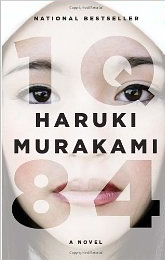
Day 301: 1Q84

Cover for 1Q841Q84 is an extremely unusual novel. I notice that the blurbs about it don’t reveal much about the plot, but I have chosen to describe the incidents in the beginning of the book because I found it difficult to decide whether to read it (I prefer book covers that give some indication of the plot or subject matter instead of just quotes) and probably wouldn’t have were it not for all the buzz.

1Q84 was originally published in Japan as three books, so it is very long. It is sort of a combination of a fantasy novel, a romance, and a mystery, but it is not by any means a genre novel.

In 1984 Tokyo, Aomame is on her way to an important meeting with a client when traffic becomes gridlocked on an elevated expressway. The taxi driver, who has Janáček’s Sinfonietta playing on the radio (which Aomame is surprised that she can recognize), tells her that there is an emergency staircase nearby that will allow her to exit the expressway and catch the train. He mysteriously reminds her that there is only one reality. Aomame climbs down the stairway–and enters a world on a slightly different track from her own.

Aomame is a physical therapist who works occasionally as an assassin, murdering men who have repeatedly abused women. Her appointment is with a victim, whom she murders. When she emerges from his hotel, she notices there are two moons in the sky and realizes she has entered a slightly different world, which she decides to name 1Q84.

In a parallel story also set in 1984 Tokyo, Tengo is a part-time math instructor who wants to be a writer and happens to like Janáček’s Sinfonietta. He is approached by Komatsu, a publishing company editor who is familiar with his work, to rewrite a novel that has been submitted to a competition. The story is unusual and imaginative, he says, but poorly written, and Komatsu believes that with help it can become a sensation. This suggestion is highly unethical for a submission to a literary competition, and Tengo is reluctant, but once he begins working with the material, he can’t resist it.

Tengo finds that the novel, named The Air Chrysalis, was written by a teenage girl named Fuka-Eri, who is a fugitive from an idealistic commune that has become a secretive religious sect. The novel is about Little People who weave a chrysalis out of the air and live in a world with two moons. Fuka-Eri tells Tengo that the Little People exist.

I was driven to finish the first book to try to figure out the connection between the stories of Aomame and Tengo. There are many echoes between the two stories, but the two characters seem to be living in different worlds, as tracked by the number of moons.

In the second book, the connections become clearer. By the third, I was reading to see if Aomame and Tengo are finally able to meet and emerge from danger.

Reviews of this novel are mixed, and I find that I feel the same way. I have seen 1Q84 compared to Ulysses, which is absurd, and on the other end of the spectrum, completely dissed. Certainly, Murakami has written a story that compels you to finish, but I found the mystery of the Little People to be lacking any internal logic and even a bit silly. I also have a sneaking suspicion that if The Air Chrysalis was really published, it would not be a publishing sensation but more likely a publishing joke. And don’t get me started on Cat Town.

Moreover, although Tengo as a character seems attractive and convincing, I found Aomame much less likely. To mention one detail, yes, many women are unsatisfied with their own appearance, including their breast size, but they don’t think about it constantly. After about the twentieth mention of Aomame’s breasts, this repetition becomes tiresome.

Tengo also has an obsessive memory of his mother’s breasts. In fact, the sexual context of the novel is definitely peculiar, with lots of odd descriptions of pubic hair and references to intimate body parts. The physical focus is just one facet of Murakami’s use of repetition as a thematic technique.

My prediction is that if you choose to read this novel you will want to finish it, but you may find parts of it absurd.

Day 286: Await Your Reply

Cover for Await Your ReplyLucinda Rosenfeld with the New York Times was stuck by this novel’s bleakness. I was more struck with its cleverness. In fact, I think I’ll have a hard time conveying what an incredible novel it is.

At first, it seems to be a set of three stories about people who are not connected, but the connections begin to occur to you as you read it. Although the novel plays with time by relating incidents out of order, you eventually understand how the characters and the incidents are related.

Ryan is traveling to the hospital with his severed hand in an ice bucket. He has been holed up in a remote cabin in Michigan with his father Jay, but a violent incident has just occurred. Later, we learn that Ryan was a student at Northwestern University until he was contacted by Jay, who told him he was his real father–that the parents who raised him actually were his aunt and uncle. Ryan, feeling his life is a sham, has abandoned his school and parents and gone to work with his father as an identity thief.

Lucy has run off with her high school science teacher George, who has promised her they are going to make a lot of money. Lucy has been dying to leave her hick life in a hick Ohio town, as she sees it. She is dismayed, however, when they arrive in Nebraska at an abandoned motel shaped like a lighthouse near a dried-up reservoir and take up residence in a creepy old house the description of which reminds me of the one behind the Bates Motel.

Miles has been searching for his twin brother Hayden for ten years. After a period of extreme mental illness in high school, Hayden disappeared. Miles has never been sure whether his brother’s condition was real or faked, because Miles and his brother used to spend a lot of their time creating elaborate fantasies. Now, every once in awhile, his life working in a mail-order magic store is interrupted by a paranoid and semi-coherent letter from Hayden offering Miles clues of his whereabouts, which sends him off in pursuit. Each time he arrives late, after his brother has left the area, and finds that his brother has been using a different name, working a different job. Now Miles is driving to the farthest reaches of Canada to try to find Hayden.

The novel is constructed like a puzzle, providing the pieces, but jumbled up, and building a sense of suspense and dread. You become completely absorbed in reconstructing the events and connecting the stories. You begin to wonder what has happened to some of the characters, who seem to have disappeared.

My only small problem with the novel is a key incident, where a character is lured to Africa by the classic Nigerian Letter scam, which offers a huge amount of money for helping a stranger get a larger sum out of the country. This scam is well known on the Internet, and I in fact ran into it in letter form about 20 years ago. I have always been incredulous that anyone would fall for it, although I realize that people still do. But the character who falls for it in this novel is one who has long used the Internet for identity theft. It seems as if he would be likely to know of the scam, even though his character is one who seems compelled to believe in the fictions he has created.

This novel is about identity and its relationship to death. Various characters take on different identities throughout the book. In doing so, they come to view their old selves as dead. It is almost as though Chaon views identity and selfhood as being entirely fluid–or perhaps his message is that this is a change wrought by our uses of the Internet.

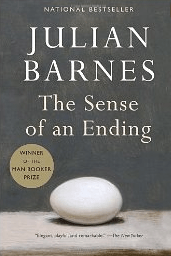
Day 214: The Sense of an Ending

Cover for The Sense of an EndingBest Book of the Week!

The Sense of an Ending is a quiet novel that made me stop and consider. It is a meditation on memory–how we reinterpret past events. It is also about the lost opportunities of life.

Tony Webster begins the novel by considering his past, particularly his relationships with his pals from school. He and two other close friends chose to enlarge their circle to include a new boy, Adrian Finn, who was extremely intelligent and analytical. Adrian’s indifference to seeming cool made him very cool indeed. The four friends remained close throughout college and for awhile after, until Adrian committed suicide.

Tony also remembers his first serious relationship, with Veronica Ford, particularly an unpleasant weekend he spent with Veronica’s family. After they broke up, Adrian went on to date Veronica. He wrote Tony a letter apprising him of this as if he were asking permission to date her, and Tony’s recollection is that he ironically assented.

Tony has lead a comfortable life avoiding too much effort in his relationships. He sees himself as a “peaceable man.” He believes he understands the events from the past until he receives a legacy from Sarah Ford, Veronica’s mother–the only member of her family who seemed sympathetic during that long-ago visit. In addition to a small bequest, she has left him Adrian’s diary. This legacy confuses him. Why would a person he only met once leave him anything, and why would she possess Adrian’s diary? When Tony asks for it, he finds that Veronica has taken it.

In Tony’s attempts to gain the diary and his subsequent inquiries, he learns things that force him to re-examine and reinterpret his memories of long ago events and to reconsider the consequences of his own actions. He ends up also contemplating where his own life has gone and how he has evolved into this “peaceable man” from a boy full of curiosity and promise.

This very short novel is crammed with thoughtful observations, often wittily and wryly expressed. I found myself turning back to re-read and reconsider certain passages, which is something I seldom do. Sparely and beautifully written, the novel is an excellent illustration of the use of an unreliable narrator.

Day 163: Ghostwritten

Cover for GhostwrittenBest Book of the Week!

Ghostwritten, one of David Mitchell’s earlier books, is about the nature of fate and the strange interconnections between people and events in the modern world. In this unusual novel, Mitchell illustrates his points through the narrations of nine different characters, who at first seem only vaguely connected.

The novel begins with the crazed Quasar, a member of a religious cult who has fled to Okinawa after placing poisonous bombs in the Tokyo subway. As his sect falls apart, he waits for word and instructions from his leader, His Serendipity.

In Tokyo, Satoru, a teenage employee of a record store, falls in love with a pretty customer. In Hong King, Neal Brose, a financier who has conducted some shady business with a mysterious Russian, is letting his life fall apart after his wife leaves him.

In China, an old lady lives through the various upheavals of the 20th century while she tries to keep her tea shop on a sacred mountain from being destroyed, again. In Mongolia, an entity that can move from one human being to another tries to find out what it is and where it came from.

In Russia, Margarita Latumsky, a woman who has made her way in life by seducing powerful men and has landed a job at the Hermitage, is plotting with her gangster boyfriend to steal a Delacroix. In London, Marco Chance is a drummer, ghostwriter, and womanizer whose day isn’t going very well.

Mo Muntervary is a world-famous physicist who returns home to a remote Irish island after fleeing from the CIA for several months. Her decision to stop running has fateful results. Finally, Bat Segundo is a late-night DJ in New York who begins getting annual phone calls from the mysterious Zookeeper.

As these characters pursue their own activities and thoughts in a way that seems completely organic to their natures, Mitchell slowly and skillfully weaves their stories into a dystopian nightmare that works in actual events from the late 1990’s, when the book was written.

I am continually amazed by Mitchell’s imagination and intellect and his ability to write novels that are completely engrossing. Although not every technique he uses is completely successful–for example, there are real and metaphorical ghosts in the novel (in addition to the entity, whatever it is)–his approaches are all still interesting. Ghostwritten reminds me a bit of one of his later books, Cloud Atlas, which I admire very much.

Day 113: Extremely Loud and Incredibly Close

Cover for Extremely Loud and Incredibly CloseI’m probably the last person to read Jonathan Safran Foer’s Extremely Loud and Incredibly Close, which was enormously popular six years ago. I suspect I avoided it for awhile because of the subject matter, which is, of course, 9/11.

Oskar Schell is an extremely precocious nine-year-old boy who is grieving for his father, a casualty at the World Trade Center on 9/11.

Hidden away in a vase in his father’s closet, Oskar discovers a key with a label that says “Black.” Since his father was always leaving him puzzles, he believes that if he can find the person named Black who has the lock that goes with the key, he will get a message from his father. He especially needs this message because that day, his father called repeatedly from the World Trade Center but Oskar could not make himself pick up the phone. In search of this message, Oskar begins visiting everyone in New York whose last name is Black.

The story of his grandparents’ past is told in parallel in a series of notes and letters. His grandparents both lost their families in the bombing of Dresden (perhaps too neat a parallel). Later, they met in New York, but his grandfather, severely traumatized and unable to speak, deserted his grandmother when she became pregnant.

Although it has been criticized for triteness, I found Extremely Loud and Incredibly Close a touching and funny novel about loss and about the relationship between fathers and sons (but also implicitly about mothers and sons). It is told in the nontraditional narrative style that is becoming almost traditional–in first-person narration by Oskar, in letters and pictures, and even in pages of illegible typing.

Oskar is a frighteningly intelligent, creative, unusual, and quirky child, and the depiction of his character is my major criticism. To me, he seemed very similiar in tone and style, and in repetitions and oddness, to the autistic older boy in The Curious Incident of the Dog in the Night-Time by Mark Haddon. Other reviewers have mentioned Holden Caulfield. In fact, although you will like Oskar, you will also find him annoying at times and, I feel, unbelievably precocious for his age. He does not make a believable nine-year-old, no matter how intelligent.

Day 31: Look at Me

Cover for Look at MeIn Look at Me, Jennifer Egan explores the meaning of identity in the modern world, where new identities can easily be created with a few clicks of a mouse. This academic beginning to my review should not dissuade you from reading this absorbing book.

Charlotte Swenson is a fashion model just recovering from surgery after a horrific car accident that smashed every bone in her face. The accident happened near her home town of Rockport, Illinios, which she has not visited in years. She is vague about what happened and what she was doing there: it is hard to tell at the beginning whether she can’t remember or doesn’t want to tell. When she returns to her home in New York, she finds that not even her closest friends recognize her new face. She has become invisible.

Before she leaves for New York, Charlotte meets Charlotte Hauser, the plain sixteen-year-old daughter of her best friend from high school, whom Charlotte has also not seen in years. The younger Charlotte has met a man on a river bank who looks like he has been in an accident.

In New York Charlotte Swenson is futilely trying to resurrect her career when she hears from a private detective who is looking for a mysterious man she met a few times named Z.

In the meantime, Charlotte Hauser has begun studying with her uncle Moose, whose life was changed when he had a revelation about light and history as a young man. Moose has been trying to find a student who can take up his ideas and thinks that Charlotte may be that person. He has struggled with mental problems and was forced to leave a prestigious job in academia to teach part time at a local community college.

Because she made a “timing error” in her first sexual explorations, Charlotte has been ostracized from her high school crowd and has decided to change schools to the rougher one across the river. She is also having an affair with the man she met along the river bank.

Charlotte Swenson has always looked for a way into the “mirrored room” of fame and fortune. Now, without her famous face, she is depressed and struggling to pay the rent until an internet intrepreneur comes to her with a tempting proposal.

Egan skillfully weaves these characters’ stories into an engrossing, thought-provoking novel. Some critics felt the novel suffered from the focus on the empty life of the glitterati that fascinates Charlotte, and truthfully, sometimes you sincerely dislike her. But you also like her pluck and self-truthfulness, and the focus is necessary to the novel’s themes.

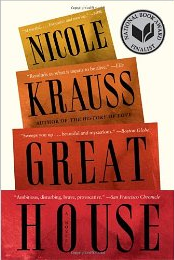
Day 24: Great House

The tale this collection tells is so complex that my book club members asked me to send them an email explaining the sequence of events, once I had figured it out. Great House by Nicole Krauss is written as a series of interleaved stories without regard to sequence, almost as if she wrote the stories in order as a novel and then cut it up into pieces and rearranged it. The effect is interesting, but it is difficult for readers to understand where they are in time as they go from one story to another.

A labyrinthine tangle of people’s stories is written around the migration of a desk from one person to another. Nadia, a writer, tells the story of how she accepted the loan of furniture from Daniel, a Chilean poet, who was soon after murdered by Pinochet’s regime. Years later, a woman comes to her claiming to be Daniel’s daughter and asking for the desk, so Nadia gives it to her.

Arthur, the husband of Lotte, the writer who gave Daniel the desk, finds a secret while he is going through his dying wife’s things. This secret may be the clue to where Lotte got the desk.

Nadia goes looking for the desk to ask for it back because she finds she cannot write without it. She eventually finds herself in Israel. Other characters encounter the desk, are affected by the search, or meet Nadia or each other. We find out that the woman who claimed the desk was not the daughter of Daniel after all, but the daughter of someone who has an even better claim to it, as his family lost it in the holocaust.

Most of the members of my book club were perplexed, and many of them did not like any of the characters. I had a more neutral reaction. The desk eventually comes to represent all of the things that were lost in the holocaust. The stories as a whole are demanding and interesting, and Krauss purposefully leaves you with unanswered questions.

Day Eight: The Virgin Suicides

Cover for The Virgin SuicidesI haven’t read this book in a year, but my brother asked me to review it. So, excuse me if I get the chronology mixed up or something. The book is told mostly in flashbacks, and it’s hard for me to remember what happens first.

The Virgin Suicides by Jeffrey Eugenides is one of those incredible books that make you wonder how they could be someone’s first novel. I was turned off by the title and subject matter of the book so I didn’t read it at first. But I caught the movie one night on TV and was mesmerized by it, so I decided to read the book.

The Virgin Suicides is written from the point of view of a group of boys growing up in the 70s in Grand Blanc, Michigan, a wealthy suburb of Detroit. The boys are fascinated by the five beautiful Lisbon sisters and their family life. Although they all go to the same school, the girls are kept isolated from other teenagers by their mother’s strictness. Their father is an easy-going science teacher at their school.

The boys begin by spying on the girls, then collecting souvenirs of the girls’ lives, which they go over incessantly, trying to understand them. In an experiment of leniency, Mrs. Lisbon allows the sisters to have a few classmates over to the house, including the boys, but the deadly dull party ends disastrously with the suicide of the youngest girl.

As the boys begin to connect more directly with the girls and the family alternates between trying to be more normal and totally isolating the girls, the family becomes more unhinged.

The book is sometimes lyrical, sometimes sophomoric sounding, sometimes witty, and savagely ironic, painting a vivid picture of the time and place. The disintegration of urban Detroit and its surrounding areas, symbolized by the neighborhood losing all its trees to the Dutch Elm disease, parallels the disintegration of the Lisbon family.