Review 2296: Lament for Julia

I tried to read Lament for Julia several times, but I just couldn’t do it. Taubes’s father was a psychoanalyst who believed writing is a disease and her husband disapproved of it for religious reasons, so it’s no wonder it’s quite bizarre.

Lament for Julia is a novella that takes up more than half of the NYRB edition. It is narrated by a disembodied spirit that seems to be part of and not part of a girl named Julia Klopps. Since Taubes believed that each person is a multiplicity of selves, I took it more as another self. Nothing much seemed to be happening in the novella except Julia growing up and the second self obsessing about her, but I didn’t really find any of it interesting. The writing is beautiful, and the second self’s obsessions are akin to those of Humbert Humbert in Lolita. But while I found that novel fascinating, I found the novella too sexualized, too perverse, too Freudian, and too interested in dreams for my taste.

I tried reading some of the short stories, but “The Patient,” about a mental patient who lacks an identity, is told by her psychotherapist that her name is Judy Kopitz, and we seemed to be in for a rehash of Lament for Julia.

The next one was “The Sharks,” about a boy who keeps dreaming he is being eaten by sharks. (Julia also dreams of being eaten.) Nope, couldn’t do it.

I received this book from the publishers in exchange for a free and fair review.

Related Posts

Dangerous Ages

Murmur

Umbrella

Day 458: Quiet: The Power of Introverts in a World That Can’t Stop Talking

Cover for QuietMy first impression of Quiet was that it seemed much like many management books I have read and at one time (when I had a director who enforced a “management book club”) considered the bane of my existence. Hallmarks of many of these books are to base broad conclusions on a few examples and to endlessly repeat the same information. Writer and lecturer Susan Cain’s focus on business and examples of individual people’s experiences made me fear this was yet another such book, so I continued only because it was recommended by someone I trust. However, I was pleasantly surprised, for Cain’s scope broadens as the book continues, and the book shows plenty of familiarity with studies and theories that support her positions.

Cain’s initial observations are about how Western, particularly American, society and business reward extroverted behavior and consider introverted behavior a fault. Since I am myself an introvert, I was happy to read her extensive support for the position that these attitudes can be harmful for business and other endeavors and are based on false assumptions that extroverts are smarter than introverts.

Just to go off on a personal tangent, one of Cain’s points—that volubility is often mistaken for intelligence—was demonstrated to me years ago when I worked with a loud, aggressive woman. One day after a coworker and I had been sledgehammered into submission for some minutes, the coworker remarked that she was annoying but smart. I rejoined, “Did you listen to her? What she said didn’t make any sense!” The coworker had not noticed, seemingly bowled over by the woman’s verbosity.

Cain’s book is full of examples of the qualities of introverts that should be more valued. She gives advice for introverts who want to appear more extroverted, both things people can do and thoughts about how they can evaluate whether that approach is best for them. She also provides suggestions for managers who are interested in creating a workplace that is effective for both extroverts and introverts. She talks about the challenges of Asian students, who tend to be more introverted, in American society. Especially valuable are her suggestions for parents and other adults in dealing with and helping introverted children.

Overall, I find the book to provide perceptive observations and practical suggestions for dealing with work and social life as an introvert, as well as providing insights about the unrecognized value of introverts in our society.

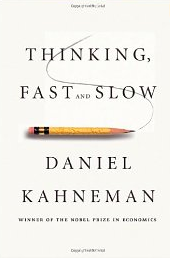
Day 71: Thinking, Fast and Slow

Cover for Thinking, Fast and SlowEarly in his career, Daniel Kahneman got interesting in why people, even experts, do not seem to use statistics and follow economic models in making decisions and judgments. His research with his main collaborator Amos Tversky eventually ended in his winning the 2002 Nobel prize in economic science, which is unusual because he is a psychologist. Thinking, Fast and Slow explains the results of years of studies on understanding how the human brain makes decisions and judgments. His major theme in this extremely interesting, well-written book is human irrationality. His work with Tversky, he says, “challenges the idea that people are generally rational.”

For better understanding of the ideas explained in the book, Kahneman begins with the analogy that there are two systems employed in decision making: the fast-thinking, intuitive, unconscious system that keeps us safe and handles our day-to-day actions but is prone to error, and the deliberative system that reasons through more informed decisions but is lazy and has to be actively engaged.

Kahneman shows the evidence from experiments that many more of our decisions are controlled by our unconscious than by conscious decision-making, and therefore, we do not always make decisions the way that economic models have assumed. He makes his points using fairly simple experiments that you can try yourself, so that you recognize the faulty assumptions and cognitive biases underlying your own reasoning. In examining these experiments, he shows their profound implications. The result is an entertaining book full of intellectual surprises that was chosen as one of the New York Times Best Books for 2011.

Although Kahneman provides some ways of recognizing patterns that can result in bad decisions, he cautions that it may be impossible to teach yourself to always avoid these pitfalls and says that he is unable to do it consistently himself. He reminds us that all of us tend to have an exaggerated sense of our understanding of the world and shows that much more of what happens is random than we acknowledge or understand.