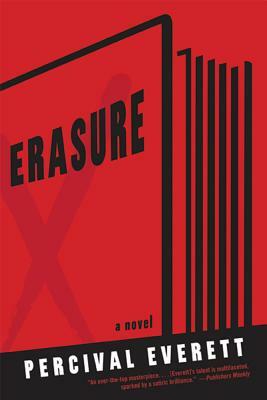
Review 2541: Erasure

If you’ve seen the movie American Fiction, you already know the plot of Erasure. I haven’t seen it yet, and I read this book for my A Century of Books project.

Thelonius (Monksie) Ellison is a writer of high intelligence whose dense, uncompromising novels have failed to make a hit with the general public. He has just put out his latest book, but his agent, Yul, is having difficulty placing it and has been told that Ellison is too far from his ethnic origins as a Black man.

Ellison lives in California, where he is a university professor, but on a visit to Washington, D. C., for a conference, he finds that his mother isn’t doing well. Eventually, he is forced to move back to D. C. to take care of her. That means taking a leave of absence, but he hasn’t sold his book. His mother’s affairs are in poor shape, so he finds he needs money.

He is infuriated by a recent book that is making a splash, We’s Lives in Da Ghetto. It’s written by a middle-class midwestern Black woman based on one week that she spent with relatives in New York, and it employs every known cliché about the lives of Black people.

On a whim, Ellison sits down and writes a parody of this kind of novel, which he titles My Pafology. He submits it to Yul, who is horrified, and asks him to submit it to publishers under the name of Stagg Leigh. Shockingly, Random House takes it as straight and offers him lots of money.

This novel produces spoof upon spoof. Even Everett’s character Ellison takes himself so seriously that I think he’s being mocked. Certainly, he starts out mocking academia with the learned talk he gives at the beginning of the novel. This talk is incomprehensible, and yet it makes another academic leap up and shout, “Bastard!” at him. He also hits the publishing industry, the reading awards organizations, and television interview programs.

The novel is presented as Ellison’s diary, so it includes learned jokes (most of which I didn’t understand), imagined conversations between various dead people in the arts, recollections from his past, especially about his father, and the entire text—about 50 pages—of My Pafology.

As My Pafology gains attention, Ellison begins to lament that he ever compromised his standards. Forced occasionally to masquerade as Stagg Leigh, he feels as if his own persona as a cultured Black man is being erased. Maybe he feels that that whole culture is being erased.

Parts of this novel were above my head, particularly some of the little scribbles in the diary. Also, when I say Everett is heaping on the satire, I’m not saying that the novel is funny (although some of it is). Most of the time I felt sorry for Monksie, who is too unyielding for his own good and knows it, but cannot stop.

Percival Everett is having a moment lately, which has resulted in four of his books being in my pile, of which this is the second. I’m not sure if I like his work, but it is at least interesting.
Related Posts

The Trees

Flights

Ferdydurke

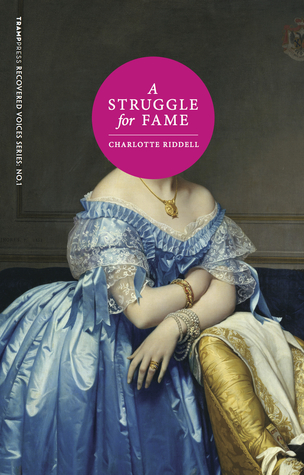
Review 1565: A Struggle for Fame

After reading The Uninhabited House, I looked for more books by Charlotte Riddell and came across the Recovered Voices series published by Tramp Press and this book, A Struggle for Fame. A Struggle for Fame is Riddell’s semi-autobiographical novel about the publishing industry.

Although Glen Westley is the main character in the novel, it follows the progress of two Irish young people who meet on the ship from Ireland and both end up in London’s literary milieu. Through poor investments, Glen’s father has lost the family home and all his money. She determines that they will travel to London so she can try to make a living as a writer.

On the ship, they meet Barney Kelly, a young chancer who is looking for a way to make money.

Glen works hard at good literary fiction and is repeatedly rebuffed by editors even while being told she has promise. Barney, on the other hand, falls into an opportunity to write articles for a journal. The novel makes clear that Glen has much more ability than Barney, but he is able to make a living at writing much earlier than Glen. It is clear from the beginning that the novel is about Glen’s rise and fall, but we are drawn in to see what happens.

A lot of characters are vividly drawn and quite Dickensian in their idiosyncrasies. It is fairly obvious that Riddell is depicting, sometimes satirically, publishers and authors she knew. Although written in 1883, the novel has observations about gender and ability that still apply today.

Related Posts

The Uninhabited House

The Blazing World

The Muse

Day 1035: Literary Wives: The Wife

Cover for The WifeToday is another review for the Literary Wives blogging club, in which we discuss the depiction of wives in modern fiction. If you have read the book, please participate by leaving comments on any of our blogs. Be sure to read the reviews and comments of the other wives!

Ariel of One Little Library
Emily of The Bookshelf of Emily J.
Kate of Kate Rae Davis
Lynn of Smoke and Mirrors
Naomi of Consumed By Ink

My Review

I’ve only read one other book by Meg Wolitzer, and I found it mildly interesting. The Wife, however, I found much more impressive.

Joan Castleman is traveling to Finland at the beginning of the novel. Her husband Joe is a famous novelist, and he is on his way to accept the Helsinki Prize for literature. On the flight, Joan decides their marriage is over. For too long, Joan has put up with Joe’s selfishness, including his infidelities. But their marriage is founded on a more fundamental lie.

The novel flashes back to incidents in the couple’s life, beginning with Joe’s seduction of her when she was a Smith co-ed in the 50’s and he was her literature instructor. Their relationship caused the end of his marriage and his fatherhood of a new baby.

Aside from a deft and insightful portrait of the end of a marriage, this novel deals with such feminist themes as the bias against women in the publishing industry and the sexual politics of marriage. Although I sometimes dislike Wolitzer’s apparent fascination with bodily functions, I found this carefully observed novel both dryly amusing and terribly sad. It had a twist that I saw coming, but that did not lessen the power of the novel.

What does this book say about wives or the experience of being a wife?

Although this novel comments on the experience of wives from the Greatest Generation, these experiences continue, in their own way, in many current-day marriages. In her marriage, Joan continually caters to the needs of her selfish and unfaithful husband on the grounds that he is a great writer. But she does even more for him than raise the kids, keep his house, meet his every need, and be a loyal wife. In fact, their relationship is entirely one-sided, with him becoming ever fatter and more self-satisfied.

In fact, the sacrifices Joan makes for her husband are shocking. But I am determined not to tell too much. Although Joan thinks the bargains they’ve made are exciting at first, she goes into her marriage with extreme naivety. In fact, over time, it is difficult to understand what Joan gets from the marriage at all, while it is clear what Joe gets from it.

Related Posts

The Interestings

The Blazing World

Ahab’s Wife Or, The Star-Gazer