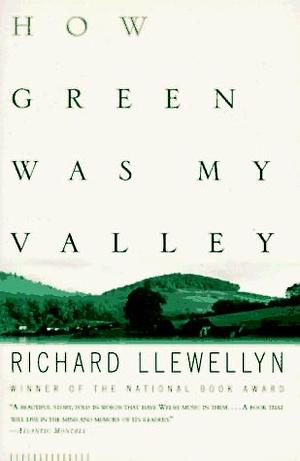
Review 2558: Reading Wales Month ’25! How Green Was My Valley

I didn’t intend to participate in Reading Wales Month ’25 this year, but when this novel fit into my A Century of Books project, I decided to fit it in for Reading Wales, too.

Such a lovely book this is, especially in the music of its language. It’s the story of the Morgans, a family of Welsh coal miners, told by one of its youngest members, Huw.

Huw is six when the novel begins. His family and those of the others in the valley are relatively prosperous, but there are signs that with the mine owners, profits are becoming more important than the lives of the men. Huw’s older brother Davy has been reading socialist literature and is talking about a union, but his father is against it.

It’s difficult to summarize this book because it’s full of family events, one of the first being Huw’s brother Ivor’s marriage to Bronwen. And there is the arrival of Mr. Gruffydd, the new preacher. But overarching everything for the men is the work, as pay gets lower and the valley begins experiencing periods of hunger and want.
I was as entranced by this novel as I ever was, the family so upright, god-fearing, and loyal, Huw’s experiences as he grows up. All the while, the fate of the valley is foreshadowed as Huw speaks from his 60s, returning just as his house is being destroyed by a mountain of slag.

It’s a real page-turner, not in terms of action, but for other reasons.

Related Posts

Germinal

That Lass O’Lowries

Country Dance

Review 2146: Country Dance

In the mid-19th century, Ann Goodman is a young woman whose shepherd father is English and whose mother is Welsh. At the beginning of this novella, Ann lives in Wales near the English border. Although she speaks and understands Welsh, she’s been raised by her father to despise the Welsh. She is promised to Gabriel Ford, an English shepherd who is jealous of her.

Ann has been living with her cousins for 15 years when her father summons her to the English side of the border to help care for her ailing mother. At that time, Gabriel gives her a journal so she can write what she is doing and he can check up on her. Ann faithfully records her life, giving us great insight into farm life at the time.

Ann’s father works for a Welsh farmer, Evan ap Evans. Evans begins to pay attention to her, but she avoids him or is rude to him and says she hates Welshmen. When Gabriel comes to visit her, Evans speaks an endearment to her in Welsh, which makes Gabriel break up with her.

After her mother’s death, her father sends her back again to her cousins—in fact, never shows her any affection—and Gabriel attempts to court her. But Ann is angry that he wouldn’t take her word that nothing was going on with Evans, and also that when Evans tried to put things right, Gabriel attacked him.

As Ann relates her everyday activities, a feeling of dread grows in the reader. It’s no surprise to us that things go badly wrong, because the Introduction tells us so. But Evans, the author not the shepherd, gives this simple story depth by bringing in Ann’s ambivalence about her Welsh/English mixed heritage. This is a deceptively simple, sparely written story that I enjoyed reading for this month’s Reading Wales

Related Posts

Fair Helen

The Unquiet Grave

See What I Have Done