Review 2648: #ReadingAusten25! Persuasion

Persuasion is a reread and re-review for me, and I see that my original post works just as well as it did before for a general review. So, I was trying to think of a topic I could discuss, and I decided to focus on its villains.

Maybe “villains” is too strong a word for this novel. The only outright villain in Austen that I can think of now is Mr. Wickham in Pride and Prejudice. But certainly Austen’s work features selfish people, people who wish ill to others, and even people who actively work against others. It strikes me that, although many of these characters are comic, they are less comic as she goes on. Is it my imagination, or are there also more of them?

First, there’s Anne Elliot’s entire family. Her father and sister Elizabeth are cold and snobbish and care only for appearances. Neither of them thinks Anne is of any account. And Sir Walter Elliot holds this high opinion of himself despite his having recklessly outspent his income, he and his daughter refusing to retrench where it might lessen their consequence. Above all, Sir Walter felt that Frederick Wentworth was beneath Anne when she fell in love with him seven years ago.

Anne’s sister, Mary Musgrove, is a little more bearable, but she is also self-consequential, as evidenced by her disdain of the Hayters, her husband’s cousins. However, she finds Mary useful (selfishly so, but Anne wants to be useful) and although she never considers Anne’s comfort, the contrast between Anne’s life in her father’s house and the one in Mary’s, with her nearby warm and welcoming in-laws and the visits with the neighbors, is striking. Of course, Anne has to bear Mary’s whining.

Then there is Mrs. Cox, Elizabeth’s friend, a poor widow and daughter to Sir Walter’s lawyer, so of inferior station. Pretty much everyone except Sir Walter and Elizabeth understands that Mrs. Cox means to marry Sir Walter if she can. However, she isn’t actively malevolent, and the only aspect we see of her is excessive agreeableness (sycophancy?). As she is living with two such people and probably endures many humiliations, I sort of feel sorry for her.

Now, if you don’t want spoilers, skip this part, because it’s about Mr. William Elliot, the young, handsome, well-mannered relative, Sir Walter’s heir, whom Anne encounters briefly in Lyme and meets later in Bath. Everyone thinks he and Anne will make a match (except Elizabeth and Sir Walter, who think he’s after Elizabeth), but Anne has one safeguard—she has been in love with Captain Wentworth since she was 19. Also, she instinctively feels that there is something about Elliot she doesn’t understand. He turns out to be the moral equivalent of Mr. Wickham, although he doesn’t do anything as dastardly. Still, his attentions to Anne get in the way for a while of her gaining an understanding with Frederick Wentworth.

These negative characters are maybe a bit more nuanced but also more seriously depicted than equivalent characters in her other books, where they are often comic. They’re not at all funny in this book, and notice how almost all of them are related to Anne.

Austen is certainly a master at showing us people’s foibles in a way that is absolutely believable.
Related Posts

Pride and Prejudice

Northanger Abbey

Emma

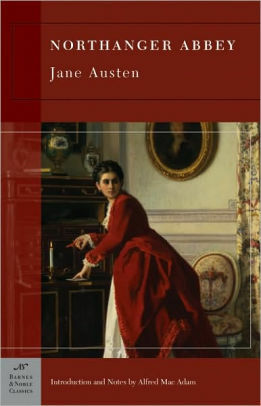
Review 2632: #ReadingAusten25! Northanger Abbey

Northanger Abbey is, of course, partially Jane Austen’s spoof of Gothic novels, and her heroine, Catherine Morland, is definitely a fan of them. But before that story line kicks in, Catherine gets to visit Bath in the company of family friends, Mr. and Mrs. Allen.

Catherine is not a well-informed girl and tends to be naïve and to take people as they present themselves. The first few days at Bath go slowly, because the Allens don’t know anyone. Catherine, however, has a dance with Henry Tilney and is inclined to like him. Then Mrs. Allen meets an old school friend, Mrs. Thorpe, and Catherine immediately becomes bosom pals with Isabella Thorpe.

It seems that Catherine’s brother James is friends with Isabella’s brother John, and Isabella has set her sights on James. Despite the vaunted friendship, Isabella and John (who is obnoxious enough that even Catherine notices it) do a great deal to disrupt Catherine’s growing acquaintance with Henry Tilney and his sister Eleanor in favor of foursomes with them.

Finally, Catherine is invited to stay with Eleanor and delighted to learn the Tilneys own an old abbey. Unfortunately, Catherine lets her taste for Gothic literature carry her away.

Catherine is one of Austen’s most serious heroines, trying to navigate society and do what is right but fallen in with people whose intentions aren’t as honorable. But she is adorable, and her naïve reactions are amusing. Henry is genuinely witty and just the man to teach her to examine her assumptions a little more thoroughly. All in all, this is one of the lightest and most fun of Austen’s works.

Related Posts

Pride and Prejudice

Mansfield Park

Sense and Sensibility

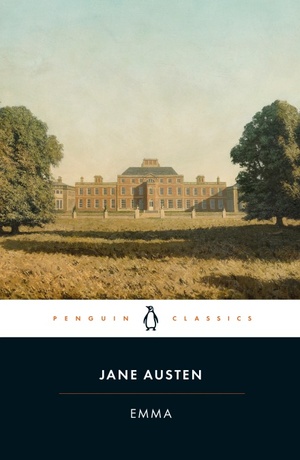
Review 2601: #ReadingAusten25! Emma

After rereading Emma, I can understand in a way why Austen called her her favorite heroine. She has a long way to go in self-awareness, and I think that’s something novelists enjoy.

Although Emma has been played as a sparkling beauty by such actresses as Gwyneth Paltrow, when I began this reread, I found a lot to dislike in her. Fortunately, she is also easy to come to like. Rich, charming, somewhat spoiled, and managing, she is also bored, because her beloved friend and ex-governess, Miss Taylor, has recently married Mr. Weston. Since she prides herself on having made the match and has recently befriended Harriet Smith, she decides to make a match for her.

Now, Emma’s biggest fault—besides trying to arrange the lives of other people—is that she decides something and then sees nothing that doesn’t support that decision (despite hints by her brother-in-law, Mr. Knightly). Harriet is a beautiful girl, but she is the illegitimate daughter of who-knows-who. Emma, based on no evidence, decides she is the daughter of someone important, and the first harm she does to the suggestible Harriet is convince her she’d be throwing herself away by marrying Robert Martin, a farmer who has proposed to her. Emma intends her for the vicar, Mr. Elton, ignoring Mr. Knightly’s warning that Elton is looking for a marriage that will advance him. In fact, Emma, having decided for the match, takes his attentions to point at Harriet when in fact he is courting Emma herself. Harriet would never consider Mr. Elton without Emma’s management, so she develops affections where there will be no return.

Then there is Jane Fairfax, a lovely young woman who has recently returned from years of living with friends to the home of her impoverished aunt and grandmother. Jane Fairfax’s friend being recently married, Jane has returned home for a few months before seeking a position as governess. Although Jane is the only young woman of Emma’s age and birth in the neighborhood, Emma says she finds her too reserved to like. Emma is jealous of Jane’s accomplishments but doesn’t know it.

Mr. Weston has a son who was adopted by his wife’s family after she died. Although Frank Churchill is now a young man, he has never visited his father, having many times promised to come. He finally arrives, and Emma, who has not taken a hint about his character from his continual nonarrivals, finds she likes him very much.

As usual with Austen, there are lots of comic characters who echo people we know in real life. Mr. Woodhouse, Emma’s father, worries continually about his and everyone else’s health, and if Emma isn’t around when they entertain, he’ll have guests eating gruel instead of their dinners. Mr. Weston is so open and sanguine that if he knows something is a secret, he’ll only tell five or six particular friends. Mrs. Elton, once there is one, is full of self-importance, despite coming from an inferior background, and tries to patronize people, especially poor Jane Fairfax.

Of course, class difference is important in this novel, maybe more so than in much of Austen (except maybe Persuasion). So, some of the problems may not be obvious to modern readers.

Even if you don’t like Emma’s managing at first, she is such a sparkling and witty creation, fond and gentle with her silly father, and she is truly repentant of her faults once she comes to see them. This is a great book.

Related Posts

Pride and Prejudice

Mansfield Park

Sense and Sensibility

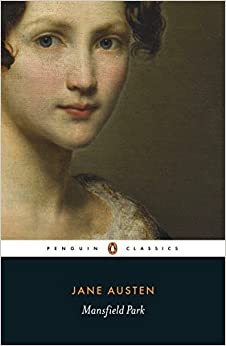
Review 2582: #ReadingAusten25! Mansfield Park

I decided to reread all of Austen for Reading Austen 25, even the books I had already reviewed. That said, I looked at my original review of Mansfield Park and thought it was still valid, so I thought I’d write about something else—the modern perception of Fanny Price.

The Introduction to my Folio Society edition by Richard Church asserts that the novel was written as a “self-disciplinary work imposed by Jane to exorcise grief and rebellion” after a promising courtship was cut off by the death of the suitor. Church himself rates Mansfield Park either 2nd or 3rd of Austen’s books, depending on where you put Emma (with Pride and Prejudice first).

A brief glance at Goodreads, however, tells me exactly what I expected to see—that of the six books counted as Austen’s oeuvre, (Sanditon isn’t usually included) Mansfield Park is the lowest rated. I suspect that’s because of Fanny Price, who is not at all a modern heroine. In fact, a few years ago someone made an “updated” movie that depicted Fanny as more of an Elizabeth Bennett- or Emma Woodhouse-like character, full of wit and energy. That movie missed the point. We have to view Fanny with early 19-century eyes, not 21st-century ones.

First of all, think how Fanny was raised. She is brought from her poor family to a wealthy one when she is only 10. She probably already has a retiring and timid disposition. Then for seven years she is treated with no regard for her feelings or wants except from her cousin Edmund. In fact, she is purposefully meant to feel the difference between herself and her cousins and is largely treated as a hanger-on, especially by horrible Mrs. Norris. In fact, it’s shocking to me that such a close relation is so treated, but we’re looking at money and class distinctions that may have been common in families. Think of Jane Eyre in exactly the same position.

But more difficult for the modern mind to deal with are the principles she’s been brought up with. To us, some of the distinctions that Fanny makes seem finicky, to say the least. (Others, like her reaction to Mary Crawford’s remark about the fate of Edmund’s very sick older brother, are not.) But to most of the early 19th century population, at least among the middle class or well-born (excepting, probably, the fashionable), they were not. As far as Henry and Mary Crawford are concerned, they have revealed too much of themselves, Henry in his dalliances with both the Bertram sisters and Mary in her remarks.

Fanny is growing up in this novel, learning to become herself. Much of her improvement comes from being able to develop a sense of self-worth after Sir Bertram returns from his travels and is happy to see her, and Lady Bertram discovers how useful and comforting she is, and different characters suddenly turn to her for advice. She may have learned her principles from Sir Bertram and Edmund, but by the middle of the novel, she is the one who recognizes principled behavior and speech, as Edmund becomes more in love with Mary Crawford and not only makes excuses for Mary’s remarks but is convinced to break his own principles.

Of course, the ultimate behavior of the Crawfords shows that Fanny was right all along, but before that, when Crawford decides he’s in love with her, she has the difficult task of sticking to her principles when everyone else disagrees with her. She may be gentle and retiring, but she resists all pressure. Think how much more difficult that would be for a person of her nature than for Emma or Elizabeth.

This has been rather a wandering post, but I hope that readers will look at Fanny differently.

Soon, we’ll be reading a book with a heroine much more like Fanny than the others, in Persuasion.

Oh, and I just have to say one more thing about the book in general. Edmund takes orders and has a parish, and then we never see him paying any attention to his job. He doesn’t stay in his parish; we don’t see him working on sermons. It’s like he’s completely forgotten about his work. I don’t think I ever noticed that before. There might be something about that which I don’t understand, though.

Related Posts

Mansfield Park

Pride and Prejudice

Persuasion

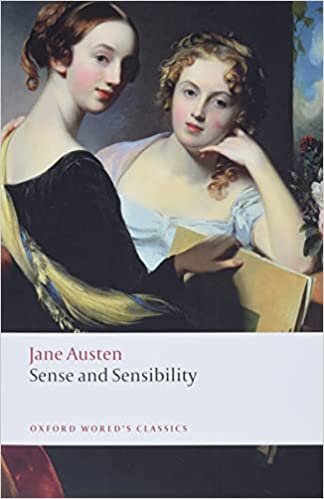
Review 2534: #ReadingAusten25! Sense and Sensibility

My original intention for ReadingAusten25 was to reread only the books I hadn’t reviewed yet. But I can’t resist Austen, so here I am reviewing Sense and Sensibility. I am not going to repeat my review of 2022, though, so you can find it here. Instead, I thought I’d look at whether the book struck me differently this time and a little at Claire Tomalin’s point of view (the wobble), as cited by Brona.

It did strike me differently. Although Elinor is still my favorite of the two sisters, they both struck me more extremely this time. Marianne seemed like a true modern teenager, not as much for her reactions to Willoughby but more in her sulking (call it what it is), her rudeness to various kind characters whom she thinks ill-bred, and so on. But the thing is, 16 in the early 19th century meant she was supposed to be an adult, or almost. (Of course, she is also under the influence of the Romantic movement in art, literature, and music.)

As for Elinor, sometimes I felt she carried her comments a little too far, into preachiness. I got a little tired of her dissections of other people’s behavior.

I also appreciate the wit of the novel more. Although I always find Austen witty, she has drawn us some priceless characters and written quite a few zingers.

I am not so sure about Tomalin’s “wobble.” I looked for it but didn’t find much evidence for it unless you count Elinor’s dash out of the room after she finds out Edward isn’t married. I’d like to hear if anyone was struck differently. I remember not agreeing with some of Tomalin’s interpretations when I read her biography of Austen.

Related Posts

Jane Austen: A Life

Jane Austen at Home

Persuasion