Day 1233: History of Wolves

Cover for History of WolvesOne of the themes of History of Wolves is the horror that can result from a belief taken too far and the subservience of one person to another. This theme resonated with me very particularly because of the history of my family.

My grandmother was a Christian Scientist. She and her mother were very active in the church, and I know from reading her diary from her college years that she took it seriously. My grandfather was an Irish-American Catholic who converted to marry her.

When my mother was a baby, she got very sick. The story goes that her parents prayed over her, but her fever did not go down. Finally, according to my mother, her father said, “Bill (her name was Beulah, but he always called her Bill or Billie), we have to call a doctor.” Christian Science went out the window, and if it hadn’t, I probably wouldn’t be here today. The main character of History of Wolves, Linda, witnesses what happens in a similar situation.

Linda is a sophomore in high school during what becomes for her a life-changing year. Several things happen that she finds sexually confusing. A teacher, Mr. Grierson, is accused of being a pedophile. Another girl accuses him of molesting her but then retracts her accusation. Linda is attracted to this girl.

Linda herself has had an unusual upbringing. When she was a child, the property where she lives in the woods of Minnesota was a commune. Linda isn’t really sure whether her parents are her parents or just two adults who were left when the commune broke up. She has a distant relationship with her mother, who pays her little attention.

Across the lake, a family moves in. When Linda makes their acquaintance, only Patra, the young mother, and her son Paul are living there. Leo, Patra’s husband, is away in Hawaii working.

Linda begins babysitting Paul. We know from the beginning of the book that Paul will die and that there will be a trial. It takes quite a bit of the book to get to this event, and I think readers will understand what is going on before Linda does.

Even for a teenager, Linda is damaged and needy. She gets a crush on Patra, and that is partially what keeps her from seeing clearly.

There is a lot going on in this novel, and it doesn’t all pan out. Still, I think the novel effectively depicts traumatic events that shape the main character’s future life. I thought the novel was sometimes confusing but also thought-provoking. I read this book for my Man Booker Prize project.

Related Posts

Tell the Wolves I’m Home

The Unraveling of Mercy Louis

Mercy Snow

Day 1136: The Wonder

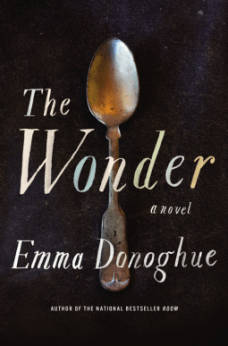
Cover for The WonderLib Wright, a nurse trained by Florence Nightingale, journeys to a small village in Ireland to take on a two-week case. Her assumption that she is being hired by a wealthy family that can afford to bring a nurse out from England turns out to be false. She has been hired by a committee to observe Anna O’Donnell, an eleven-year-old who has reportedly not eaten for months. Her job is to make sure whether the girl is actually eating or not.

At first, Lib suspects that Anna is perpetrating a hoax, but slowly she realizes that the deeply religious girl believes she is living on manna from heaven. Still, she finds the people of the village steeped in ignorance and superstition, the local doctor incompetent, and her employers with a vested interest in a miracle. Her only confidante becomes someone she shouldn’t even be talking to—William Byrne, a journalist.

link to NetgalleyAs Anna shows unmistakable signs of starvation and imminent death, Lib eventually finds out what is going on, but no one believes her. Suspense builds as you wonder whether and how Lib will be able to save Anna.

For me, this was a surprisingly good book. I didn’t think I would enjoy it based on the subject matter, and later, I could not imagine how it would end. It has a great deal of psychological depth and often feels like a mystery.

Related Posts

Room

The Forgotten Garden

Your Presence Is Requested at Suvanto

Day 1105: Fludd

Cover for FluddAll of Hilary Mantel’s writing has some sort of edge, but I’m beginning to feel that I enjoy more her work that isn’t quite as satirical, her historical fiction, for example, as opposed to some of her earlier, blacker works. Fludd was written in 1989 and fits firmly into the latter category.

Mantel’s note states that she depicts a 1950’s-ish Catholic church that never existed, but having read her memoir, I would venture to say that there are seeds of her childhood both in the setting and in her depiction of the church.

Father Angwin is a well-meaning, old-fashioned sort of priest working in an ugly church stuffed with statues of saints in a dismal working-class town called Fetherhoughton. He has long ago lost his faith, but he is struggling along as best he can. The bishop, whom he calls His Corpulence, wants him to make the church more “relevant:” modernize the service and get rid of the saints. He also says he is sending Father Angwin a curate.

Although Father Angwin thinks the people need the saints, he reluctantly buries them in the church yard. Shortly thereafter, a man appears at the door of the presbytery whom everyone assumes is the curate. People find themselves confiding their innermost secrets to him. He never seems to eat, but his food disappears. No one can recall his face when he’s not there.

Sister Philomena is a young Irish nun in the convent. She was evicted from her Irish convent because her mother claimed her skin rash was stigmata, and she went along with it. Her days are tormented by Mother Perpetua, the terror of the convent. She also finds herself confiding in Fludd.

But who is Fludd? Is he the curate, a demon, an angel? In any case, he’s an agent for change.

I don’t think I understand Catholicism, or indeed any religion, well enough to grasp the theological issues or even everything Mantel is poking fun at. I think this novel would be a much more pointed weapon if read by a lapsed Catholic. Mantel claims to have seen a demon, and demons lurk throughout her work. This is a funny but peculiar one.

Related Posts

Giving Up the Ghost

Beyond Black

The Assassination of Margaret Thatcher

Day 1009: The Miracle on Monhegan Island

Cover for The Miracle on Monhegan IslandI enjoyed Elizabeth Kelly’s The Last Summer of the Camperdowns, so I was pleased to find she had written another novel. I felt a further pleasure in store because of its setting. Ever since I found online a map of the island with links and information about rental cottages, I’ve dreamed of renting a cottage on Monhegan Island.

I didn’t count on the dog, though. This novel is narrated by a Pekingese named Ned, a truly intelligent Pekingese with lots of insight to offer. I could almost buy this approach in The Art of Racing in the Rain, but not quite. Here, I didn’t buy it at all.

Ned is stolen from the back of his car by Spark Monahan, who takes him as a gift for his son Hally, whom he hasn’t seen in four years. Hally has been living on Monhegan Island with Spark’s father Pastor Ragnar and his brother Hugh.

Spark is the family black sheep, but Ragnar has recently also run into trouble. He was in charge of a concert on the island, but his security wasn’t able to handle the number of people who tried to attend it for free. Now he is being sued for proceeds that were never collected from the people who got in without paying. He is the pastor of a church he basically invented and has the ambition to be a cult leader.

Hally is just beginning to find out some of the secrets of his family, and he finds them upsetting. One day when he is off by himself, he returns claiming to have seen and spoken to the Virgin Mary. Pastor Ragnar latches on to this event and starts trying to make the most of it, while Hugh and Spark more or less passively object. At a second event, people attending claim to see odd effects in the sunlight, and soon Hally is receiving national attention.

Spark and Hugh know that Hally’s mother was mentally ill when she died, so they are worried about Hally. But no one actually does anything to stop Ragnar.

Aside from the problems of the narration, Kelly leaves nothing unsaid. The dog is always pointing things out to you in case you missed them. At the same time her focus is all over the place. There are discussions about religion and faith, mental illness, inheritance, celebrity. The characters, the most interesting part of the novel, sometimes get lost in the baggage.

Also, I missed the darker overtones of the previous novel. Although this novel provides plenty of dark overtones, it lands solidly in the feel-good zone by the end, which for me is not necessarily a good thing.

Related Posts

The Last Summer of the Camperdowns

The Little Friend

The Burgess Boys

Day 554: The Testament of Mary

Cover for The Testament of MaryIt is years after the crucifixion. Mary is living a quiet life in Ephesus, visited by two of her son’s disciples. It is clear their visits are unwelcome, as they have been trying to force her memories to agree with the documents they’re writing. But Mary has always seen her son’s followers as men with something lacking in them, and she insists on telling her her own truths.

This provocative novella takes the position that Mary was not a believer but was simply trying to save her son from his fate. She grieves his loss and regrets that at the end her courage failed her. While the disciples try to place her and Mary (Toíbín does not name anyone Mary Magdalene, but that is whom he means, I assume) at the grave witnessing a resurrection, they were actually fleeing for their own lives.

While the novella seems to accept some of the miracles, the raising of Lazarus is more of a horror than a wonder. Mary also notices that the jugs of water are brought forward quickly at the wedding at Cana and that only one of them was opened beforehand. Toíbín evokes an atmosphere of feverish excitement and hard fanaticism during these scenes, wherein both Jesus’ enemies and his followers push her son toward his fate.

This novella, which was shortlisted for the Booker Prize, is thought-provoking in its exploration of cult-like origins for Christianity and the shaping of Christian myth after Jesus’ death. As always with Toíbín, it is meticulously and beautifully written.

Day 388: Wise Blood

Cover for Wise BloodFlannery O’Connor stated that she didn’t understand when her works were termed Southern Gothic or grotesque. She continued throughout her life to emphasize that the theme of her works is redemption. Nevertheless, Wise Blood is grotesque.

Hazel Motes has returned from the service after World War II to find his home town in Tennessee deserted and his house crumbling and decrepit, so he goes to live in the city, the fictional town of Taulkinham, Alabama. Having grown up in a fundamentalist environment, he has decided that Jesus was just a man and there is nothing from which to be redeemed. Soon, he is preaching outside movie theaters about the Church of Christ Without Christ.

Haze doesn’t see anything he’s looking at and doesn’t hear anything anyone says to him. He is totally wrapped up in his obsessions about religion. He becomes fascinated by Asa Hawks, an evangelist who supposedly blinded himself for Christ, and can’t see that this man is a con man who is not even blind.

He also meets Enoch Emery, a whining zookeeper who spends his days peeping out of the bushes at the women bathing in the park swimming pool. Enoch tells Haze that his family has “wise blood,” that is, his blood tells him where to go in life and what to do. Enoch’s blood is obsessed with a mummy in the museum, which he thinks would be a Jesus for Haze’s church, not seeming to fully understand the point of Haze’s church. But Enoch doesn’t see or listen either.

In fact, no one in this novel listens to what anyone else says, and all of the characters are incredibly ignorant and uncultured. They are all grotesque, repellent creatures. Although the novel is supposed to be comic, it only made me laugh despite myself, as the situation becomes more and more ridiculous. O’Connor’s humor is brutal.

Everything in this short novel seems significant, is to be paid attention to, even the characters’ names. Both of Hazel Motes’ first and last names refer to the eyes, and Haze can’t see. Enoch Emery is abrasive. Asa Hawks is the “blinded” con artist who can actually see, and his daughter Sabbath Lily is anything but a lily. Hoover Shoats and Onnie Jay Holy try to take over Haze’s church. And speaking of Shoats, keep an eye out for the pig imagery, and think about what pigs are a symbol for in the Bible.

This novel is deemed a work of “low comedy and high seriousness.” Just speaking for myself, the religious theme is not one I find interesting. Yet, when you read O’Connor, you can’t help but be drawn along to the end.

Day 162: Religion and the Decline of Magic

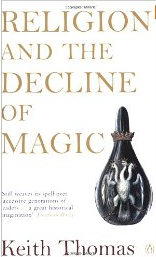
Cover for Religion and the Decline of MagicKeith Thomas’s Religion and the Decline of Magic, first published in 1971, is not for the faint-hearted. Thomas is a British historian, and this book is considered an important work because of its then revolutionary combination of research in the fields of history and anthropology.

With that kind of background, you might expect the book to be academic in writing style. It is not, but in fact is actually very accessible and well written. I say it is not for the faint-hearted because of its length and the numerous examples of every point, expected for an academic text but a little rough on the casual reader. These examples are mostly interesting; it is the number of them illustrating every point that threatens to become tedious. The book is 800-900 pages long, depending upon the edition, and nearly half of it is devoted to notes, additional explanations, and references. And truth be told, I was reading the electronic version so could not judge my progress, but it felt like I was reading a lot more than, say, 500 pages. (I did not read the back matter.)

Thomas concentrates upon the history of magic in England from roughly 1500 to 1700, tracing the changes in how the different types of “magic” are viewed and treated by the common people, the judicial and governmental authorities, and the religious ones. His definition of magic is rather broad, including alchemy–which at the time was considered a science and is now generally regarded as the forerunner to modern science–and astrology–which again was considered a science at the time. I believe his inclusion of these disciplines was because at some time they were also considered magic, at least by the church.

Thomas shows that the Catholic church actually encouraged a belief in magic in some ways–linking the connection between prayer and incantations, for example, and fostering a belief in the efficacy of exorcism–consciously building on pagan beliefs to encourage conversion just as it did when it adopted a slew of pagan holidays and modified them to its own purposes.

The ways in which religious leaders and common folk viewed magic, then, changed radically with the Protestant Reformation. Protestant clerics were actually less likely to, for example, attempt to prosecute witches even though the laws defining witchcraft and the penalties against it were prone to fluctuate between more strict or more lenient over time. On the other hand, prosecutions of witches that originated with demands by the common people–who initially were not inclined to fear witchcraft but had to be taught to do it–became more common and more hysterical as the Protestants increased their preaching against it.

Thomas’s premise is that the ultimate decline in witchcraft as a concern of the public and the powers of justice was a result of the Enlightenment–the increasing number of truly scientific studies and the assumption that everything can be understood in terms of science–and ultimately the increase in technology that eventually became the industrial revolution.

This book can be an absorbing study for those who are interested in the subject. I made a good-faith effort to finish it but found that I eventually was unable to cope with the myriad of examples of every point. I skipped maybe 50-100 pages to the conclusions, but when I found the same technique employed there too, I finally gave myself permission to quit. I found the writing style interesting and even dryly witty, but overall the intent of the work was too scholarly for my total enjoyment as a more casual reader.