Review 2194: The Marriage Portrait

Maggie O’Farrell’s latest novel is loosely based on the life of Lucrezia di Cosimo de Medici, who in 1560 at the age of 15 went to Ferrara to take up her married life with Alfonso II d’Este and was dead within a year, rumored to have been murdered by her husband. None of this is spoiler information. It’s explained before the novel begins.

At the beginning of the novel Lucrezia arrives at a remote country fortress with only her husband and some of his men. Her personal maids have been left behind. Lucrezia is sure her husband is going to murder her.

Then the novel returns to trace her childhood and young womanhood in the Medici family. There, she and her sisters are brought up entirely confined to a few rooms of the house and occasionally allowed outside. On the other hand, she has the example of her parents’ marriage, still loving, with both parents collaborating even in political decisions.

Lucrezia is not a favorite child. She has a core of resistance in her, and she prefers painting small, detailed pictures from nature to social pursuits. Fatefully, when she is ten, she briefly meets her older sister Maria’s fiancé, Alfonso II, heir to the Ferrara dukedom. When Maria dies before her marriage, Alfonso says he is open to taking Lucrezia instead, although she is only thirteen.

At fifteen, she marries Alfonso and travels with him to Ferrara to begin her marriage. At first, all seems well. His initial encounter with her was reassuring and he seems kind. Of course, she has to deal with knowing no one except her maid and not even understanding the servants’ dialect. Clothing and hair styles are different. And although she has much more freedom, she begins to learn that Alfonso’s ideas of marriage aren’t like her parents’. He wants her to obey him immediately no matter what he asks, and he doesn’t tell her what’s going on or want her to know anything. She appears to have no responsibilities, so she spends her time painting or socializing with his two sisters.

But slowly she learns that she only has one role in the family—to produce an heir. And Alfonso is known never to have fathered a child. Also, Alfonso is not as benign as he first appeared.

I found this novel absolutely fascinating with its convincing portrait of life in Renaissance Italy. The descriptions are detailed, and although Lucrezia is naïve, she is also a person who notices things. With growing dread, we observe her trying to make sense of this new world, with almost no preparation from her parents. As usual, O’Farrell is a deft writer who knows how to keep readers pinned to the page. I loved this one.
Related Posts

Blood & Beauty

Hamnet

The Marriage Game

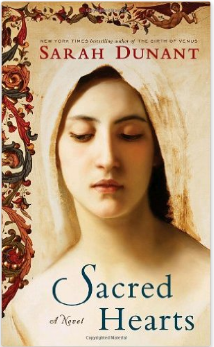
Day 948: Sacred Hearts

Cover for Sacred HeartsBest Book of the Week!
Sacred Hearts is another book I read for my Walter Scott Prize project. Although Sarah Dunant is an author I’ve read in the past with moderate enjoyment, I very much enjoyed her novel about the Borgias, Blood & Beauty.

This novel is also set in Renaissance Italy, in 1570 Ferrara. Dunant begins the book by telling us that in the second half of the 16th century, dowries had become so expensive that roughly half the daughters of noble families were consigned to convents, whether willingly or unwillingly.

Suora Zuana is one of that number. When her professor father died years before, she had nowhere to go and her dowry was small. Yes, dowries had to be paid to convents as well, but they were much smaller than those paid with brides.

Her small dowry has not earned Zuana very many comforts in the convent of Santa Caterina, but she has created a valuable role for herself as a healer and dispenser of remedies. She has managed to bring along many of her father’s books, although some of the most valuable were stolen at his death by his students and peers, and she has greatly expanded the convent’s herb garden. Aside from caring for the convent’s ill, she makes medicines for the bishop and others.

At the opening of the novel, she is on her way to drug Serafina, a novice who has been screaming for days, ever since she was forcibly ensconced in the convent by her family. She is a girl from Milan, so no one in the convent is familiar with her family. Suora Zuana is able to calm her, and later they find she has an angelic voice, which delights the convent choir director.

For the sake of everyone’s peace, the abbess, Madonna Chiara, asks Suora Zuana to take Serafina under her wing rather than handing her over to the novice mistress, Suora Umiliana. So, Zuana begins teach Serafina how to prepare medications. None of the sisters know that Serafina has hatched a plot to escape from the convent with her lover, the musician Jacopo.

What Serafina doesn’t understand, although she probably wouldn’t care, is that this is a politically delicate time for Santa Caterina and for all convents in general. Reforms on the heels of the Counter-Reformation have resulted in a cracking down on convents in some cities. Madonna Chiara fears that the convent’s few liberties will be lost, especially if they have a scandal. Their means of making a living will be removed, their orchestras disbanded and performances disallowed, their books will be confiscated, and they will no longer be allowed outside in the garden. Visitors will only be able to see them behind a grating. This is what has been happening throughout Italy.

On the local front, some of the sisters, led by Suora Umiliana, would like the convent to become stricter in its observances, even though it is already strict. Suora Umiliana is a religious zealot who is fascinated by Suora Magdalena, the convent’s “living saint.” Although Suora Magdalena has long been close to death, when she was younger she had fits of ecstasy and suffered from stigmata. Shortly after Serafina arrives at the convent, Magdalena has the first of her fits in years and speaks to Serafina. Later, when Serafina becomes ill, Umiliana thinks she can use her condition to take over control of the convent from Chiara.

Although I was interested in this novel, it took me some time to become really involved in it. I am revealing more about the plot than I usually would, because the description of the book from the blurb about how Suora Zuana comes to care for Serafina does little to convey the depths and power of this novel. For quite a while I had no idea where it was going and wondered how interested I was, but the novel turned out to be very much worth reading. This is one that really sneaks up on you.

Related Posts

Blood & Beauty

The Malice of Fortune

The Chalice


Day 354: Worldly Goods: A New History of the Renaissance

Cover for Worldly GoodsWorldly Goods promises a new look at the European Renaissance from a different point of view. Lisa Jardine, a professor of English at the University of London, proposes an interpretation of the period in terms of the growth of commerce and a new consumerism and multiculturalism.

However, the information offered does not seem new. Rulers and wealthy men have always been conspicuous consumers. Jardine attempts, for example, to turn around our view of the flowering of art as merely a series of demonstrations of the wealth of patrons who commissioned the works, a sort of competition to show who is most wealthy or powerful. But simply providing examples of patrons who specified expensive materials or the inclusion of their goods in pictures doesn’t prove this point.

Jardine does a better job of showing how the development of printing made the exchange of ideas easier, thus affecting the advances in many different fields, including the arts and the sciences. However, her argument that the policy decisions of the period were all driven by the dictates of commerce is taking things too far, I think.

The book is well written and lively. It does not back up its assertions with footnotes or a bibliography, however, indicating that it is written for the general public but frustrating those who would like to look further. At some point, I felt that the examples were becoming too repetitive and no new points were being made. For example, Chapter Three is about the proliferation of books and printing, but Jardine continues to make the same points about printing and the sharing of scientific and technical information repeatedly throughout the rest of the book.

Although the history provides an interesting discussion of commerce during the Renaissance, it is oversold as a complete history of the period.