Day 241: True Grit

Cover for True GritBest Book of the Week!
After the Coen brothers version of True Grit came out a couple of years ago, I became curious about the book. If you have seen that version of the movie, it is almost identical to the book and is much more faithful to it than the version from 1969 starring John Wayne.

For those who are not familiar with the plot, 14-year-old Mattie Ross travels into Indian Territory intending to track down her father’s murderer, Tom Chaney, a hired man who killed Mr. Ross for his extra horse. She looks for the U.S. marshall with the most grit and is pointed to the drunken Rooster Cogburn, who is reluctant to take on the job. She also meets a Texas Ranger named LaBeouf who is after Chaney for the murder of a Texas judge. Mattie is determined that the villain will hang for the murder of her father.

What makes True Grit unusual is the portrait of Mattie through her own words. She is indeed a unique character in fiction, scrappy, opinionated, tight with her money, not to be cheated, not to be turned from her self-imposed task, and tough as nails. Her narration drags us into the story and won’t let us go until it is over. This will be a quick read, because you won’t be able to put the book down.

The characters also speak in a stylized way using old-fashioned dialect that seems oddly formal and elaborate to our ears. It is expertly reproduced in the more recent movie.

If I can combine a book review and movie reviews, I have to say, “Sorry, John Wayne fans.” The Coen brothers movie starring Jeff Bridges is much better. I rented the 1969 version shortly after seeing the other movie and was surprised to see the contrast. Not only has the 1969 version been bowdlerized a bit, but the difference lies principally in the atmosphere created and the acting. The older movie is shot in standard western territory, probably in the hills of California, while the newer one is shot in a bleak landscape that makes us feel the danger and solitude.

As far as acting is concerned, Glenn Campbell as LaBeouf is pathetic as an actor, stiff and awkward. LaBeouf in the more recent version is played by Matt Damon, and I didn’t even recognize him for quite some time, so much does he submerge himself in his role. Although years ago I thought Kim Darby was good as Mattie, Hailee Steinfeld, acting at a younger age, is amazing. The older movie also minimizes but still fails to carry off the unusual style of dialog, coming off as stilted, whereas the newer movie embraces it.
Day 161: Peony in Love

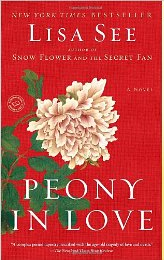
Cover for Peony in LoveI’ll start out right away by saying that after reading the touching and engrossing Snow Flower and the Secret Fan, I was disappointed by Lisa See’s Peony in Love. The innocuous description on the back of the book gives you no warning of the subject of the novel. I think that is unfortunate, because not very many readers of See’s other books will be prepared for it.

Peony’s sixteenth birthday is approaching. In six months she will “marry out” to the man who has been her fiancé since she was a child, although she only knows his name. She is excited because that night her family will begin hosting an epic opera by Tang Xianzu that she loves, and the secluded women will be allowed to watch it through a screen.

The story of the opera is important to the novel. It is about a girl who dies for love and haunts her lover until she is eventually brought back to life in honor of her steadfastness.

That evening, Peony peeps out from behind the screen and spots a handsome young man, with whom she falls instantly in love. Later in a brief absence from the performance she encounters him accidentally, and he begs her to meet him the next night. Such behavior is strictly forbidden. She has never been alone with a man outside her family, but she meets him anyway.

I usually try not to give away important plot points, but I will tell you one thing that happens in the first third of the book because I don’t think you can make a fair decision about reading it without knowing. So, this is my spoiler warning. Unfortunately, I don’t see any way to impart my objections without revealing this key plot point.

Convinced that she will be forced to marry a man she does not love even though she doesn’t know who her fiancé is, Peony starves herself to death, like the heroine in the opera. Just before she dies, when it is too late to save her, she finds out that her beloved actually is Ren, her fiancé (a twist that I found predictable). Presumably, she spends the rest of the novel as a ghost. I say presumably because after another 100 pages or so I quit reading.

I was already fed up with Peony because she wastes two opportunities to avoid the misunderstanding that causes her death. As in many movies, a few words could have cleared things up. That is, she and her lover never bother to exchange names. In addition, after the opera, when she is still in the audience, her father introduces her fiancé to the company. She is so convinced he is a stranger that she shuts her eyes. How likely is that?

Peony is already an extremely foolish girl even before she begins starving herself. I continued reading out of interest in Chinese beliefs about the afterlife, but when Peony begins manipulating Ren’s wife, I found this development too distasteful to continue. I regret that I cannot recommend this book, although I am still eager to try other books by Lisa See.

Day 121: Gone Girl

Cover for Gone GirlBest Book of the Week!

A lot of people are reading Gone Girl by Gillian Flynn, and no wonder! Usually, I would wait awhile to present another Flynn book after just having reviewed one last week, but I couldn’t wait to do this one! If you like dark, twisted plots, and great psychological thrillers with a smidgen of evil humor, this is the book for you.

Nick and Amy Dunne are having some marriage problems. When they met, they were both cool young Manhattanites. He was a magazine journalist and she a quiz writer and the model for a series of Amazing Amy children’s books written by her psychologist parents. Five years later, they have both lost their jobs and moved to a dying small town in Missouri to help his mother take care of his ailing father. With the rest of Amy’s money, Nick has bought a bar to keep himself and his twin sister Go busy. Their relationship has been deteriorating ever since.

On their fifth wedding anniversary, Amy disappears, leaving evidence of violence. Of course, Nick is the police’s prime suspect, and it doesn’t help that he hasn’t been altogether truthful with them. The public, galvanized by the Amazing Amy connection, almost immediately turns against him. The investigation turns up money problems and worse. Secrets are flushed out.

Most of the first part of the novel is narrated alternately by Nick and by diary entries written by Amy. Amy seems disingenuous and appealing, almost giddy, reminding me sometimes of Bridget Jones. Nick commits many lies of omission. Here’s a hint. Both Nick and Amy are liars.

Just when we think we know what’s next, the plot twists. The book is completely engrossing and very darkly funny, suspenseful and chilling. Think psychopath, but guessing who that person may be is just one of the book’s pleasures. In the reviews, I’ve seen several comparisons to Patricia Highsmith, and I think that’s about right.

Day 84: Bring Up the Bodies

Cover for Bring Up the BodiesBest Book of the Week! Year!

If Wolf Hall was a wonderful historical novel, Bring Up the Bodies is masterly. In this second of a trilogy, Hilary Mantel continues the story of Thomas Cromwell. Bring Up the Bodies is more focused than the last book, because it deals with a much shorter time period and defined subject–the downfall of Anne Boleyn.

The writing is elegant and impeccable. I have read a few comments that Wolf Hall was sometimes difficult to follow because the readers could not always tell who was meant by “him” or “he.” Mantel has written both books using a strict third person limited point of view, from that of Cromwell, and people don’t think of themselves by their first names. Hence, the difficulty, which I did not notice as a problem in Bring Up the Bodies. This technique is very difficult to employ successfully–we are much more used to a third person that changes from character to character or even to third person omniscient. But Mantel uses it effortlessly to create a memorable character in Cromwell–kind but implacable, one who fosters the growth of others but does not forget the crimes and indignities committed against Cardinal Wolsey, whom he loved as as a father.

Henry VIII has already decided he wants to rid himself of Anne Boleyn and marry Jane Seymour, but Anne has one more chance. She is carrying a child, and if it is born alive and is a boy, she is safe. Henry must have an heir, and he has decided that if he hasn’t been given one, God must have found some fault with his marriage to Anne just as there was one for his marriage to Katherine of Aragon. Thomas Cromwell must find him some way out of his difficulties.

Of course, Cromwell helped Anne to her position in the first place, but the Boleyns have made many enemies in their enjoyment of power, and they have treated him with disdain. More importantly, Anne Boleyn destroyed the Cardinal, and her brother mocked him in his downfall.

From the moment you begin reading, you find yourself plunged into the Tudor world of shifting politics and intrigue. Of course, we know what happens to Anne Boleyn, yet the novel maintains its suspense. The Boleyn and Howard families are going to suffer a huge defeat, but they will go down fighting.

Day Two: The Cold Dish

Cover for The Cold DishMy intention is to review a book a day. Of course, I don’t read a book a day, but I have a book journal, so I am cribbing my reviews from that.

Today’s book is a great mystery set in present-day Wyoming, The Cold Dish by Craig Johnson. I have been loving this series, which is full of interesting characters. The setting is almost a character in itself.

The main character is Walt Longmire, the sheriff of a rural Wyoming county, who is a widower nearing retirement. (I understand that A&E will be broadcasting a series based on these books, called Longmire, sometime this year, something to look forward to.) I often tire of series mysteries, principally because of the secondary characters, who are often one-dimensional. Johnson’s characters seem more like the actual inhabitants of a smallish western town.

In The Cold Dish, Cody Pritchard is shot to death at long range by someone using an unusual rifle. Two years before, he and some other high school boys participated in a brutal rape of a young Cheyenne girl, and he and his co-defendents got off lightly. Despite his abhorrence of their crime, Walt is worried that the other boys may be at risk, so he must try to keep them safe. He is also worried about what his best friend, Henry Standing Bear, might know, since Henry is the girl’s uncle.

The book features a good mystery, some exciting action, characters that you really care about, and perhaps even the ghosts of long-dead Cheyenne warriors (although Walt doesn’t think so).