Review 2330: Somebody’s Fool

Somebody’s Fool is the third of Richard Russo’s North Bath novels. The first two (Nobody’s Fool and Everybody’s Fool) centered around the character of Donald “Sully” Sullivan. Sully is now dead, but he is certainly not forgotten, and in a way, you could say that this novel also centers around him.

These books of Russo’s are equivalent to ensemble cast programs. There are lots of characters, and the novel moves among them.

Peter Sullivan, Sully’s son, is one of the main characters. He is a college professor who spends his weekends fixing up, first, the house his grandmother left him and now, the one Sully left him. He enjoys this work, but his plan is to leave North Bath as soon as he finishes and sells the second house. On the other hand, he’s always planned to leave but doesn’t seem to do it.

Peter is surprised to receive a visit from his son, Thomas, whom he hasn’t seen since he and his wife split up when Thomas was a boy. Thomas doesn’t seem to mean well, even though he is friendly, and we learn later that he has a plan but not right away what it is. Thomas, we learn from letters to his brother, is eaten up with resentment against Peter for deserting them (even though his mother didn’t want to have anything to do with Peter) and with jealousy against Will, the oldest brother, for getting to go with Peter.

(Just as a side note, I can’t be sure, but I think this is the first time we ever hear that Peter has two other sons besides Will. They are certainly convenient for this plot but make Peter’s lingering resentment against Sully for deserting him and his mother even harder to understand.)

Another important character is Doug Raymer, the ex-Chief of Police of North Bath. North Bath has recently been dissolved as a political entity and absorbed by nearby Schuyler. Raymer was offered the job of Chief of Police there but decided to retire. He is mostly missing Clarice, his girlfriend and ex-officer, who wanted to take a break and has accepted the Chief of Police job. When he meets up with Clarice, he finds she is dealing with a breakdown on the part of her twin brother, Jerome, and the misogyny and bigotry (she is Black) of her new staff, led by Lieutenant Delgado.

Raymer gets involved with a case of identifying a badly decomposed suicide at an abandoned estate when his old officer, Miller, calls him for help. Clarice hires him as a consultant and asks him to take Jerome as a housemate.

Another main character is Janey, a woman with a history of poor choices in men. Although a lot of her space is occupied with her relationships with her mother (whom she resented for years for carrying on with Sully outside her marriage) and her daughter, she ends up being key because of her relationship with Delgado.

Russo’s characters tend to be self-doubting and over-think things. Usually I enjoy him, but in this novel some of these tropes became a little repetitive. And at times they slowed the action to a halt. For example, Peter hears someone moving around in his supposedly vacant house. He grabs a baseball bat but then Russo takes two pages to have him wonder who it is (including Sully’s ghost) before going up to see. Eventually, the plot gets going but before that, there were times that I got impatient.

Russo is a really good writer, though, who creates complicated and mostly likable characters. It seems like he wanted to use this novel to wind up the fates of his sometimes comic North Bath characters. If that was his intent, he succeeded.
Related Posts

Everybody’s Fool

Empire Falls

Mohawk

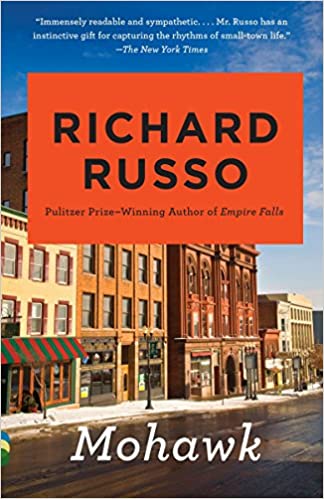
Review 2012: Mohawk

The town of Mohawk, New York, seems very similar to Empire Falls, the setting of another Russo novel. It’s another rustbelt town on the skids supported by the leather industry, which is now being found responsible for polluting the town. Of Russo’s works, it is these tales of ordinary people in rustbelt towns that I think are best.

This novel centers mostly around one extended family but with plenty of auxiliary characters. Dallas Younger is a feckless, unreliable but kind mechanic divorced from Anne, who has moved back to Mohawk from New York largely because she’s in love with Dan Wood, the wheelchair-bound husband of her cousin. Anne’s father, Mather Grouse, is known for his upright life, but he has a secret involving Wild Bill Gaffney, a mentally handicapped young man who was in love with Anne when they were in high school.

Russo’s characters are flawed but mostly likable and fully realized. This novel has a complex plot that is masterfully handled. The novel skips from 1967, when Anne’s son Randall is unhappily attending middle school in Mohawk, trying to avoid a group of bullies and purposefully scoring a bit low on his homework because it doesn’t do to be so smart, to 1971 when he is 18, has quit college, and is avoiding the draft.

For a long time, I avoided reading Russo’s novels because they sounded depressing. They are not. Instead, they demonstrate a warm understanding of and fondness for human nature. This novel sustains me in my belief that his rustbelt novels are his best.

Related Posts

Empire Falls

Everybody’s Fool

Bridge of Sighs

Review 1518: Chances Are

When Lincoln decides to sell the cottage on Martha’s Vineyard that has long been in his mother’s family, he thinks it’s a good opportunity to reunite with his friends from college, Mickey and Teddy. Although it’s more than 40 years since they spent Memorial Day weekend at this cottage, they’ve kept in touch all these years. Back in the day, they were the three students at an elite college who did not share their classmates’ blue-blooded, wealthy backgrounds.

Being on the island brings back memories of Jacey, the girl all three of them loved. She also shared that last Memorial Day weekend with them. Then she left and apparently disappeared from the face of the earth.

Lincoln, a successful real estate dealer who’s had some difficulties since 2008, begins looking into Jacey’s disappearance. Teddy, an editor who sometimes suffers from mental illness, is troubled by his memories of that weekend.

This novel explores friendship, difficult relationships, and even muses on fate. It is well written, as Russo’s novels always are, and engaging. I haven’t had as much enjoyment from Russo’s latest efforts as I did for his earlier ones, but this one comes close to being as good as, say, Empire Falls or Nobody’s Fool.

Related Posts

Empire Falls

Everybody’s Fool

Bridge of Sighs

Day 1083: Everybody’s Fool

Cover for Everybody's FoolBest Book of the Week!
I don’t think I am the only one to be delighted when I learned that Richard Russo was returning to the familiar ground of North Bath, New York, and Sully, of Nobody’s Fool. Sully has been diagnosed with a heart condition and has less than two years to live unless he undergoes a procedure he’s been avoiding. This situation leads him to consider a little more deeply some fundamental questions.

Sully’s friend Rab has felt a change in their relationship since Sully came into money. They no longer work together, and Rab feels that Sully neglects him. Rab is ridiculously dependent on him.

Sully is concerned for Ruth, his long-time lover, and her daughter, Janey. Janey’s abusive ex-husband is back in town, fresh out of jail.

A major character of the novel is Douglas Raymer. Once the rookie who waved his gun at Sully for driving on the sidewalk, Raymer is now the chief of police.  He has always been obsessively self-conscious and unsure of himself. His self-esteem has not been improved by finding out on the day of his beloved wife Becka’s death that she was leaving him for someone else. The problem is, he doesn’t know who, but he has found the remote for someone else’s garage door under the seat of Becka’s car.

Raymer is already considering quitting his job when he begins one of the worst days of his life. While attending the funeral of a judge, he passes out from the heat and falls into the grave. Later he realizes that he must have dropped the remote, which he planned to use to find Becka’s lover, in the grave.

Russo is great at creating flawed but lovable and believable characters, and he specializes in settings of beaten-down working class towns in the rust belt. He also doesn’t flinch from pushing his characters to the heights of absurdity, in a sort of tongue-in-cheek style. Sometimes he goes too far with this, but other times it works perfectly to produce a serio-comic effect. This is one of those times. Empire Falls remains my favorite Russo novel, but this one is right up there.

Related Posts

Empire Falls

Bridge of Sighs

Straight Man

Day 660: Straight Man

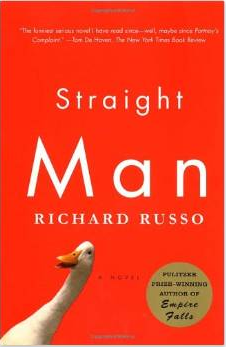
Cover for Straight ManSo far, I have enjoyed Empire Falls the most of Richard Russo’s novels, and Straight Man is at least also set in the rust belt, which he depicts so well. However, rather than being a depiction of small-town life, it is a rich spoof of academia. My husband, formerly the spouse of an academic, tells a joke, probably an old one, that the reason politics in academia is so vicious is that the stakes are so low. That these battles are being fought not on the campus of a great university but of an obscure college in a small Pennsylvania industrial town makes it more ironic.

William Henry Devereux, Jr., (Hank) sees himself as a bit of a rebel, although his rebelliousness mostly confines itself to snarky comments in faculty meetings and satiric opinion pieces on academic life in the local paper. He was once the author of a decently reviewed novel, but now he finds himself the interim head of the English department at a small Pennsylvania college.

Hank has been ignoring rumors that the college is to undergo stringent cuts on the grounds that the same rumors make the rounds every April. The faculty members in his department are constantly embattled, most recently over the job search for a new department head. Hank is better at enraging them than smoothing things over, and at the beginning of the novel suffers a wound to his nose when a professor hits him with her spiral notebook.

Maybe Hank wouldn’t have gotten himself into quite so much trouble, but his wife Lily is out of town on a job interview, and he is preoccupied by a possible kidney stone when he begins taking the rumors seriously. One of the reasons he has discounted them is that the college is breaking ground on an expensive new technology center and he can hardly believe they could claim financial problems requiring layoffs at the same time.

Such is the case, he finds, and with his department members all worried about their jobs, he chooses the groundbreaking ceremony to stage a protest, claiming he will kill a duck (which is in reality a goose) from the campus pond for every day he doesn’t get his budget. Soon he finds himself a minor media celebrity and a suspect of campus security when someone actually does kill a goose. In the meantime, his daughter’s marriage is imploding, he keeps imagining his wife is having an affair with the dean, his scholar father who years before deserted him and his mother for a graduate student is returning, and an attractive daughter of a colleague might be trying to seduce him. The events of this week force him to examine his relationship to his own life.

I found this novel both a bit over the top and amusing, as well as true. If I have a criticism, it is to wonder about some modern male authors’ fascination with bodily functions, and why they seem to think they’re funny. But I guess I can’t constrain this complaint to just novelists, because I’ve been staying away from comic movies for years for the same reason.

Related Posts

That Old Cape Cod Magic

Lucky Jim

The Bridge of Sighs

Day 386: Bridge of Sighs

Cover for Bridge of SighsOne of my favorite books from recent years is Richard Russo’s Empire Falls. Unfortunately, the problem with reading your favorite book of an author’s first is that the others may not quite live up to it. But Bridge of Sighs comes a little closer than some other Russo novels to my initial delighted feelings about Empire Falls. (I know, I’m a bit behind the times with this one.) This novel shares some of the same themes as Empire Falls and is set in a similar working-class, industrial small town, this time in upstate New York.

The novel is narrated principally by Lou Lynch, one of three main characters. Lou is writing a novel about his life, even though he admits it will probably be boring. The son of Lou, an optimistic, cheerful if not very bright milk man turned convenience store owner, and Tessa, a sharp, insightful bookkeeper, Lou has always felt as if his parents are in conflict, and he is on his dad’s side. We understand, though, that Tessa is not really in conflict with her husband and son, she just wants them to see reality as it is, not as they would like it to be.

Seeing things as they are is also a problem for Lou’s best friend Bobby. At least, Lou thinks of Bobby as his best friend, but that is one more thing Lou doesn’t see clearly. Bobby’s father bullies his mother, who is eternally pregnant. She runs away every time she gets pregnant, but he always finds her and brings her back. It isn’t until late in the book that we find there is more than one way to look at their relationship.

The book begins when Lou is sixty and traces back through his childhood and adolescence through the device of his novel. The adult Lou is married to his high school sweetheart Sarah, and they are soon to take a trip to Italy, hoping to visit Bobby, now Robert Noonan, a famous American painter who lives in Venice. But Robert isn’t answering Lou’s letters letting him know they are coming. This trip is an anxious one for both Lou and Sarah, Lou because he has hardly ever left his home town, and Sarah because she once had to decide between Lou and Bobby.

In the background is the story of the small town of Thomaston, an industrial backwater dominated by a tannery, the dyes of which used to color the river waters differently each day and resulted in high levels of cancer in the community. The town is dying. The tannery has finally closed.

The town is divided into three areas that are widely separated by class, even though Thomaston’s richest citizens are probably big fish in a small pond. As the story moves into the present time, the wealthier citizens begin moving away. But Lou doesn’t see any reason not to love his town or his life. Sarah has always wanted to travel and experience more, but they have stayed put.

The Lynch family, as Russo creates it, is a warm and welcoming one. Both Bobby and Sarah are attracted as youngsters to the little store by the promise of a substitute family, Sarah’s own being particularly bizarre. In the modern-time story, Lou’s father is dead, and his uncle Declan has gone away, but Lou’s son works in the store, and his mother still lives above it.

As the story moves back and forth in time, I felt myself occasionally tiring of Lou’s reminiscences, especially of junior high, where he spends an inordinate amount of time. As Bobby reflects when he returns to town during his senior year after being sent off to military school, he doesn’t understand why Lou continues to bring up those years as if they were good times when actually they were horrible and Lou was not treated well at school. I personally was much more interested in the current-time story, of which there is much less, even though I understood that its seeds are in the past. But then again, the fact that Lou dwells on the past is part of the point of the novel.

This novel possesses a few characteristics of postmodernism, without being exactly postmodern. Here perhaps Russo is dabbling in some of the techniques without going full-thrust for its inventiveness and irony. The alternating point of view among Lou, Bobby, and Sarah, the alternating time streams, the metafiction, and Lou’s essential untrustworthiness as a narrator, not because he is not truthful to us, but because he is not truthful to himself, all are postmodern techniques. Within the time and narrator changes, though, Russo proceeds with a traditional narrative style.

Russo’s writing is leisurely, and he likes to muse. Still, he creates some complex and attractive characters and makes you want to contemplate their lives with them. He is also one of the few writers willing to explore the theme of class in America, a theme that is very important to this novel.

Day 247: That Old Cape Magic

Cover for That Old Cape MagicI was so excited by discovering Empire Falls earlier this year that I went right out and bought a more recent book by Richard Russo, That Old Cape Magic. This novel observes the thoughts of Jack Griffin as his marriage implodes and again a year later as he tries to make amends.

Griffin is obsessed with not becoming his parents, a couple of academic snobs who have spent their lifetimes criticizing everything, willfully ruining other people’s possessions, and making enemies in their Midwest university departments. Yet he has given up a successful screen-writing career to teach at a New England college that his parents always aspired to, and bought an old, charming house. These decisions make him feel like he is living the lives they wanted.

As Griffin carts around his father’s ashes on the way to a wedding on Cape Cod, he behaves spitefully to his wife Joy, whom he blames for the changes in his life. In his drives around the Cape, where he and his family spent all their summers, he thinks about his past, his parents, and his marriage.

In the second part of the novel, he returns to the Cape for his daughter’s wedding with his father’s ashes still in the car, along with his mother’s. He has come with a date but his real desire is to win back his wife.

I think several things hampered me from enjoying this novel as much as I did the other. First, Griffin isn’t very likeable and his parents seem repellant, although we have some evidence that his memories may not all be accurate. One of the difficulties in Griffin’s marriage is his dislike of Joy’s family, but Joy’s family is almost stereotypically drawn as wacky, loud, and obnoxious, so it’s hard to appreciate why Joy cares for them as much as she does. Aside from being uncaring about his wife’s family and her needs, Griffin seems to be clueless about many things in his own life. Generally, since I usually need to relate to at least one character and only Griffin is fully realized, I found the novel a little unsatisfying.

Day 157: Empire Falls

Cover for Empire FallsBest Book of the Week!

I’ve been picking up Richard Russo novels at the bookstore for years and putting them back down because I wasn’t sure I’d like the subject matter, but now that I’ve read Empire Falls, I wish I’d been reading them all along.

Miles Roby’s life hasn’t been going too well. He quit college to run a diner in his dying home town in Maine when his mother was ill, and 20 years later he’s still flipping burgers. His wife Janine has left him for her dim-witted personal trainer. He has been in love with one of his waitresses, Charlene, since high school but sees no sign that she returns his feelings. He has an uneasy relationship with the owner of the diner, Mrs. Whiting. The only thing that seems right in his life is his teenage daughter Tick, and she is having problems at school.

Miles’s father is an alcoholic ne’er-do-well who was hardly ever around when he was a child. He comes around when he wants to earn a few dollars or hit up Miles for money. The mill has been shut down for years, and most of the townspeople don’t feel like they have much of a future.

Miles’s brother David is recovering from a drug habit, but his cooking and new ideas have recently been responsible for an increase in the diner’s business, and he wants Miles to move the business to a larger restaurant. Miles has been avoiding a decision. He has only been hanging on because he doesn’t know what else to do and because Mrs. Whiting long ago promised to leave him the diner in her will. She owns most of the town and behaves as if she owns him, too.

Miles doesn’t realize it, but his fortunes have been stymied for years because of events in the past. His only clue to these events is his recollection of a summer spent with his mother on Martha’s Vineyard when he was a small boy.

A pleasure of this book is its myriad of small-town characters and the warm, witty way that Russo depicts them. Russo is skilled at involving you in the fortunes of Miles, his friends, his family, and even his town. This novel is delightful.