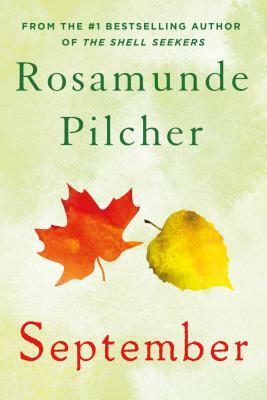
I think Rosamunde Pilcher is considered a romance novelist. Judging from this book, though, I wouldn’t call her that. Although there are some romantic situations in it, this book, in its focus on family and the beauties of Scotland, reminds me more of something by Molly Clavering’s or D. E. Stevenson’s family-oriented novels, although much more recently written.
The novel is about two families in small-town Scotland and particularly what happens when a neighbor decides to hold a ball for her daughter in September.
Violet Aird is a mother and grandmother. Her son Edmund is a businessman who spends a lot of time traveling. His daughter Alexa is a shy young woman living in a house she inherited from her other grandmother in London. His second wife, Virginia, is an American who loves being home and taking care of their eight-year-old son, Henry.
The other family is the Balmerinos. Archie Balmerino is the local laird, and although he owns a lot of land, the family isn’t as prosperous as it was, especially since Archie lost a leg in Northern Ireland. His wife Isobel has arranged to take paying guests in the summer as a result. Archie’s sister Pandora ran off with a married man when she was 18 and hasn’t returned. Archie and Isobel have children, twelve-year-old Hamish and much older Lucille, who has been living in Europe.
Lucille is traveling around Europe with her Australian friend, Jeff, when she decides to go to Majorca to visit her Aunt Pandora, whom she has never met. Pandora is beautiful, rich, and generous. Lucille hadn’t been planning to return home for the ball, but Pandora decides they should all drive back together for the party.
Trouble is brewing between Edmund and Virginia, because Edmund has signed Henry up to go to boarding school in the fall without consulting Virginia. When Virginia objects that he is too young, Edmund thinks she is babying Henry and is coldly insistent. About then, she meets a man Alexa has invited home, who turns out to be an old friend.
Alexa herself has become involved with a man for the first time. He is Noel Keeling, up to now a lady’s man who usually dates women a lot more attractive than Alexa.
I said this novel isn’t exactly a romance, but it unfortunately employs some romance conventions. One is to describe almost everything everyone wears. The other is to describe almost every room people enter. Pilcher also tells us the contents of almost every meal, no matter how commonplace. In fact, I found the book to be about two hundred pages longer than it needed to be.
Another issue I had with it was that although it was published in 1990 and gave no clear indication of its time setting, it seemed so horribly out of date for then that I wondered if it wasn’t an old manuscript that had been set aside until the success of The Shell Seekers. One example is that the American Virginia spots an American across a room and wonders why you can always tell an American. He doesn’t even wear a crew cut. What? I haven’t seen a crew cut on anyone except the military since about 1961!
And then there is Archie with his false leg made out of either tin or aluminum. In the 1970s-90s, legs were being made out of such things as polymers, and I think I can safely say that no one has ever made an artificial leg out of tin or aluminum, neither of which would support the weight. (Oh, I see now that artificial legs were made out of Duralumin, a hard, lightweight alloy of aluminum, during World War I. Well, the time setting may not be specified, but the novel is set a lot later than that, at least in the 1960s or 70s and I suspect later.)
I was interested enough in the story to finish it, even though Pandora’s big secret was pretty obvious from near the beginning of the book, but thought the novel was only a middling effort.
Related Posts
Because of Sam
Love Comes Home
Family Roundabout


 What? Me Read?