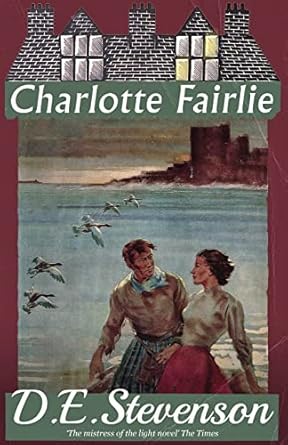
Review 2661: Dean Street December! Charlotte Fairlie

When Charlotte Fairlie was a girl her relationship with her widowed father was close. Then he met someone, and she seemed to be nice, but as soon as they were married, she became jealous of Charlotte. In the end, he sent Charlotte to his brother, and she never saw him again. (Oddly, she reflects later that it was the only thing he could do, but I think not.)

Now Charlotte has achieved her goal since she was in school. She has been appointed head of St. Elizabeth’s, her old school. She is young for such a position but has been wearing a stodgy hat to board meetings to disguise that fact. The only thorn in her side is Miss Pinkerton, who thinks she should have had the position and is a real troublemaker.

A new girl starts at the school, Tessa MacRyne. She is an unusual child, self-possessed but homesick for her island home in Western Scotland. Charlotte catches her running away one day and learns that a letter from her mother has informed her that her parents are divorcing and her mother has returned to her parents in the U. S. Tessa feels she must return home to comfort her father. Charlotte’s handling of the situation earns her Tessa’s affection and an invitation to the island of Targ during summer break.

A friendship begins between Charlotte and Lawrence Swayne, the headmaster of the boys’ school. Unexpectedly, her proposes marriage to her, thinking they would make a great partnership.

I found this novel to be deeply touching and involving. I generally think of Stevenson’s books as very light romance, but I felt this book was a little deeper.
Related Posts

Music in the Hills

Winter and Rough Weather

Kate Hardy

Review 2611: Romantic Comedy

For some reason, I thought I had read at least one book by Curtis Sittenfeld. It turns out, though, that I was confusing her with someone else. (Correction: I just looked, and I have read one other book by her. I thought I looked that up before I wrote this.)

Romances are not usually my genre, but I can sometimes enjoy them. Romantic Comedy was so popular that I decided to give it a try.

Sally is a comedy writer for a TV program called The Night Owls, a thinly disguised Saturday Night Live. She loves her job but after an embarrassing incident with a co-worker, has given up on romance.

Her spots usually have something to do with feminism, and for the week in question, she is working on one sketch called “The Danny Hurst Rule,” named after her office mate and friend, who is engaged to a famous, beautiful actress. The idea is that beautiful celebrity women might date average-looking men, but the reverse never happens.

For that show, the guest host and musical guest is Noah Brewster, a popular musician. Sally finds herself terrifically attracted to Noah as she helps him write a sketch, but since she considers her looks average, she can’t believe he would be interested in her. He obviously is, but at the after party she makes a crack that drives him away.

Two years later during quarantine from Covid, Noah sends her an email. This starts a chain of correspondence.

I think Sittenfeld was attempting to write a smart, witty romantic novel. I have realized I am out of step with modern humor (proved by the fact that I haven’t considered SNL funny since the 80s, and I’m waiting for younger folks to realize that fart jokes are not funny), and I did find some of the lines witty, but I found the rest of the novel only moderately interesting and was a bit bored by the string of long, heart-felt texts.

The most interesting to me was the research Sittenfeld put into the operation of SNL, the preparation and behind-the-scenes stuff. Otherwise, I was kind of meh. Although I did find both main characters sympathetic, Sally is so hung up on her preconceptions that she creates a lot of problems, and Noah is too perfect.

Also, I have an objection. Why do most modern romances involve a woman ending up with someone wealthy? Although there is certainly a long history of that, it used to be that sometimes two ordinary people could make a romance.

Related Posts

Eligible

Beautiful Ruins

Wonder Cruise

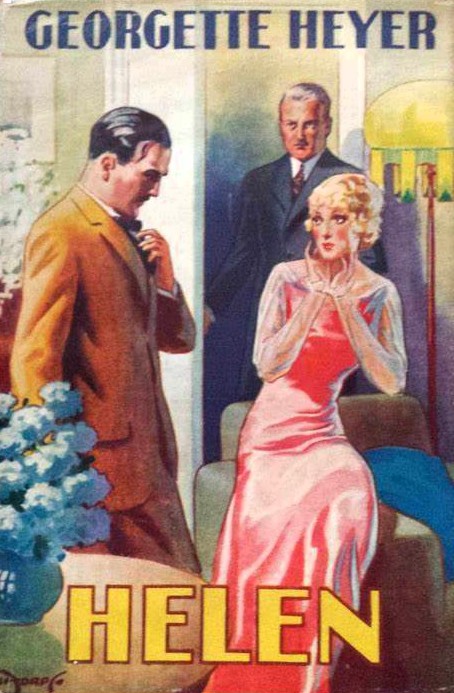
Review 2600: Helen

I thought I had read all of Georgette Heyer’s books, but when I looked up something recently, Amazon showed me that there were several I’d never heard of. So, I got a Conservatory Press print-on-demand copy of this one. It is one of her very few contemporary novels that are not mysteries, published in 1928.

Helen’s mother dies in childbirth, and although her aunt offers to take her, her father insists on keeping her. She is brought up in wealth on a country estate enjoying riding, hunting, and sports. She has old-fashioned values when she becomes an attractive young woman. Then everything is upended with World War I.

This novel spends a lot of time with the bright young things that emerged after the war. Helen is drawn into the set by some friendships, but her older friends are dismayed. She also attracts a young artist who may be a dangerous type.

There are long conversations in this novel meant to show how the younger generation is changing its attitudes from their Edwardian parents. It seemed to me that both sides had intolerant viewpoints, but the younger people, meant to be witty, seemed silly. In any case, I hate to say it, but I found this focus as well as Helen’s relationships to be a little tedious after a while. I didn’t think that this more serious romantic novel was Heyer’s forte. And both generations expressed attitudes about women that we find objectionable now.

As with most machine-read books, I found lots of wrong words. Not typos, but the wrong word replacing a correct one. I thought perhaps no human had read the book between machine-reading and publishing, but maybe someone read the beginning. I say this because the errors increased so much in the last third of the novel that sometimes it was difficult to guess what was meant. Helen is fairly consistently called “he” instead of “she,” and at one point, she is called “Heaven” instead of “Helen.” So, you can imagine how several errors could mount up to make the text unintelligible at times.

Related Posts

The Unfinished Clue

They Found Him Dead

Death in the Stocks

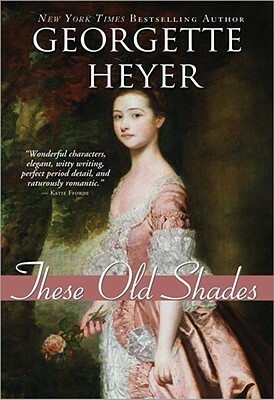
Review 2482: These Old Shades

In trying to fill some of the holes in my Century of Books project, I noticed that These Old Shades, which I haven’t read for many years, would help. This novel is Heyer’s first, and it is also the first of four about the Alastair/Audley family. (The others are The Devil’s Cub, Regency Buck, and An Infamous Army.)

Late on a mid-18th century night, His Grace of Avon Justin Alastair is walking through a Paris slum when a boy collides with him. The boy is fleeing his brutish brother. On impulse, the Duke buys the boy, but it is clear he is up to something. He takes the boy home and makes him his page.

The boy, Léon, has fiery red hair and dark eyebrows. The Duke has noticed this resemblance to his enemy, the Comte Saint-Vire, and takes Léon around to embarrass him. However, he begins to have other thoughts about the resemblance because of Saint-Vire’s reaction.

Soon, though, it is revealed that Léon is really Léonie, disguised as a boy since she was 12. The Duke takes her to England and leaves her with his sister while he arranges a chaperone, announcing that he intends to adopt her as his ward. Léonie is starting to enjoy being a girl when she is kidnapped by Saint-Vire.

This is an adventurous, amusing romantic novel. The Duke is enigmatic and Léonie is charming and feisty. Although the Duke has a bad reputation and is known as Satanas, as his relationship with Léonie develops, he becomes more human. Some of the interviews between Saint-Vire and Avon struck me this time as a little unsubtle, but overall, it is a great start to Heyer’s career and I enjoyed it very much.

Related Posts

Regency Buck

An Infamous Army

The Nonesuch

Review 2286: #DeanStreetDecember! Because of Sam

I could fairly easily guess the main plot of Because of Sam from about page 3, but that didn’t make it any less enjoyable to read.

Mild-mannered Millie Maitland has not had an easy life. Her feckless husband died leaving her badly off when her daughter Amabel was a child, and she has had a financial struggle ever since. When a relative died and left money for the use of Amabel, Millie was only delighted that she could provide for her daughter. Even though her lawyer believed she could fairly spend some of the money for her own benefit, or rather for the benefit of both of them, she refused. She has done everything for Amabel, so that her daughter has no idea of how hard Millie has worked. The result is that Amabel, now in her late twenties, is a little spoiled, plain-spoken, used to being waited on, and inconsiderate.

The farmer Martin Heriot catches sight of Millie looking young and pretty at a wedding and decides he wants to get to know her better. She makes a little money taking care of people’s dogs, so he soon makes arrangements for her to board Sam, a Labrador puppy he says belongs to his cousin. This gives him an excuse to visit Millie. But Millie, with no idea of her own attractions, gets it into her head that he is coming to see Amabel.

On another front, a new arrival to this small post-World War II Scottish village is causing problems. Mrs. Noble is a predatory blond whose husband is stationed abroad. She first goes after Martin and then after a young husband of a new mother.

Although Clavering’s books are similar to those of D. E. Stevenson, her friend and neighbor, I think that without becoming at all heavy reading, they go a little more below the surface. I enjoy them very much.

Related Posts

Mrs. Lorimer’s Quiet Summer

Near Neighbors

Dear Hugo

Review 2239: Love Comes Home

Jane Cranstoun is enjoying her stay in London with friends George and Kitty Mariner when she is summoned home by her mother because of the return from finishing school of her sister, Love. Jane is not really looking forward to going home, where she is expected to take charge of numerous commitments made by her mother, but also because she has begun to hope for a proposal of marriage from John Marsh, a young naval officer.

At her farewell party, Jane gets her proposal and accepts it but asks John to keep it a secret until her parents get to know him better. He has recently accepted a post that is nearer to her parents’ house in Scotland, so he agrees.

On the train north Jane meets Peregrine Gilbert, whom she takes to be shy and uninteresting, not realize he has become her neighbor. Then she meets him again the next morning and tries to send him off for trespassing.

When John appears, Love begins monopolizing him and throwing Jane together with Peregrine. In fact, there was a scene before he appears when I was certain Love already knew John. But that turns out not to be the case, even though it’s clear Love means to marry him before she even meets him. Silly misunderstandings lead to a broken engagement, and this situation was clumsily handled, I thought. In fact, although Love explains later that she thinks Jane and John are not well suited, she has decided this before she ever meets John.

I have enjoyed reading Clavering, but this one, I think, is the closest to a standard pattern romance than the others. I didn’t like Love, who takes over the story gradually until it is more about her. I also didn’t like John or later Kitty when she reappears. The only characters I liked were Jane and Peregrine and the girls’ brother, Meggie. Love is supposed to be 19, but she acts more like 14. I was a little disappointed in this one.

Related Posts

Susan Settles Down

Touch Not the Nettle

Yoked with a Lamb

Review 2210: It Ends with Revelations

It’s going to be hard to convey a sense of this book without revealing a side to it that doesn’t arise until well into the novel. I will say that for 1967 the novel deals with a key issue in a surprisingly enlightened way, even though it may make modern readers cringe a few times.

Jill Quentin is the wife of Miles Quentin, a distinguished actor. Miles is opening a new play in a spa town during a summer festival. This play was already produced on television, but adapting it for the stage is proving difficult. In particular, Cyril, the actor playing the boy in the play, is not doing well despite having played the part on television.

Smith’s descriptions of the details of the play production as well as Jill and Miles’s relationship are interesting. However, the plot gets going when she befriends two teenage girls, Robin and Kit Thornton, who are staying with their widowed father in the same hotel.

I don’t want to say more, really, except that the novel involves a choice for Jill between romantic love and the love of a deep friendship and asks how important loyalty is in marriage.

I generally liked this book, but there was a point before some revelations when I felt that if it was a more modern book, it could be going somewhere creepy. However, it was not.

Related Posts

Which Way?

Shadowplay

Nightingale Wood

Review 2164: Classics Club Spin Result! The Moorland Cottage

When I selected The Moorland Cottage for my Classics Club list, I didn’t really read what it was about. Then when it arrived—a print-on-demand novella without any extraneous information—I thought maybe it was a gothic story, since most Victorian writers wrote some early in their careers. However, it is a romance with a strongly moralistic ending.

The Brownes live in an isolated cottage on the moor. Mrs. Browne is the widow of the respected curate of Combehurst. She dotes upon and spoils her son Edward while scolding and nagging at her daughter Maggie. As a result, Edward is selfish and unheeding, while Maggie is loving and giving.

When the local squire, Mr. Buxton, who was friends with Mr. Browne, decides to send Edward to school, the Browne children meet Frank Buxton and his cousin Erminia, both about their same ages, with Frank being a little older. Both Buxton children are impressed by Maggie but dislike Edward, and Maggie and Erminia become good friends.

As young men and women, Edward has not improved his character, while Maggie is good and beautiful, used to thinking of everyone but herself. Frank falls in love with Maggie, but Mr. Buxton is strongly opposed to their engagement. Then Edward’s misdeeds complicate the situation.

I had to laugh when I saw this novel described as “feminist” on Goodreads. When I was a little girl, I detested a fairy tale called “Patient Griselda.” It was about a prince who subjects the girl he loves to a series of painful tests to see if she is worthy of him. I wanted the girl to tell the prince to buzz off. This novel is going in the direction of Griselda except it is Edward, not Frank, who is always making demands. Thankfully, the ending was a little better than I expected. The novel has a strong religious message but one that seemed wrong-headed to me.

Related Posts

The Grey Woman

Tales of Mystery and the Macabre

Dolly: A Love Story

Review 2158: Half-Blown Rose

Vincent (a woman named after Vincent Van Gogh) is living in Paris, separated from Cillian, her husband, after his latest book revealed that when he left Ireland at 15, he left behind a pregnant girlfriend. Vincent and Cillian have been married for more than 20 years, but he had never told her about this.

While Vincent is teaching writing and creativity classes in Paris and considering having an affair with Loup, who is half her age, Cillian calls constantly trying to reconcile.

I don’t usually do this, but very soon after starting this novel I tried to figure out how old Cross-Smith is. This was because at about page 2, Vincent wonders if Loup is still looking at her and thinks, if he isn’t I’ll die. I thought, is this woman 12 years old? The character is 44, by the way.

Nevertheless, I continued reading, because the situation started to come out and it seemed intriguing, even though I was dreading the hot affair that I could see coming.

Then, at about page 75 begins a series of emails between Vincent and her husband’s illegitimate son and his mother. They are unbelievably juvenile, including lots of exclamation points.

Vincent is hanging around with artists and academics, and their conversation is absolutely unconvincing. And don’t get me started on the playlists (really?) and the number of references to Vincent’s menstrual blood. This was a DNF for me.

Related Posts

The Other Daughter

The Light of Paris

Alien Hearts

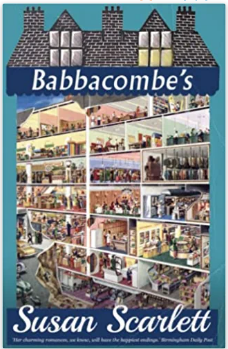
Review 2084: Babbacombe’s

I asked Dean Street Press to rush me some books so that I could participate in Dean Street Press in December, and they have responded beautifully. Here’s a review of a book I received on Tuesday.

Beth Carson is a little disappointed after leaving school with high honors to take the job her father has arranged at Babbacombe’s, the large department store where he’s been employed for 30 years, instead of going to secretarial school. However, money has always been tight in the Carson household, and she is eager to help contribute.

Despite things being tight, the family is reluctant to take on a paying guest—George’s orphaned niece, Dulcie. But George feels guilty about neglecting her even though he didn’t like her father. When Beth goes to the railway station to collect her, she meets a nice young man after she is tripped up by his dog.

Dulcie turns out to be an unpleasant surprise for the family, but Beth finds herself enjoying her job in the dress department, even though it is at first exhausting. Then one day she is stuck in the elevator with the man from the railway station and finds out he is David Babbcombe, the boss’s son. When Beth learns he doesn’t work but collects an allowance from his father, she says she’d be ashamed to take money she didn’t earn.

Smarting from this, David, who threw away an opportunity at Babbacombe’s once already, goes to his father’s office and asks for a position. His delighted father starts him at the bottom this time instead of the top—in the meat department. He also has a secret from his father, he has submitted plans for a plane he designed to the government.

As David pursues Beth, her scruples interfere. Her father believes people should stay in their places, and she is sure Mr. Babbacombe wouldn’t approve of David dating one of his shop girls. Also not helping is Dulcie, who has decided she wants to marry David.

I’m having an inconsistent reaction to Scarlett’s work, probably because I don’t read too many straight romances. Although I liked another of her Cinderella stories, Clothes-Pegs, I often find the devices meant to keep the couple apart until the end are a little clumsy. In this case, Beth is almost stupidly obsessed by what their fathers will think, and Mr. Babbacombe’s confusion of the two girls doesn’t seem like him at all. Also, it seems to be a trope with Scarlett’s plots to involve a jealous, mischief-making other woman, which is a 50’s cliché. Still, this is pleasant light reading.

I received this book from the publishers in exchange for a free and fair review.

Related Posts

Clothes-Pegs

Summer Pudding

Begin Again