Day 822: Miss Pettigrew Lives for a Day

Cover for Miss PettigrewBest book of the week!
This novel is a confection. It is absolutely delightful.

Miss Pettigrew is a poor, middle-aged governess with no family who has been haunting an employment agency hoping for a job. This morning she is in luck. The agency has two openings, one for a maid and one for a nursery maid. The agency sends her off to interview with Miss La Fosse (by mistake).

Miss Pettigrew is received by a beautiful young woman in a negligee. She is clearly entertaining a young man. Miss Pettigrew has been brought up to be a proper lady, but instead of being shocked, she is entranced by this glimpse of an exotic lifestyle.

Without even inquiring who Miss Pettigrew is, Miss La Fosse asks her to find a way of getting her friend Phil to leave before her other friend Nick arrives. Miss Pettigrew is successful in doing this and begins to discover in herself an untapped capacity for organization. Soon, she is responding to Miss La Fosse’s pleas to stay with her during Nick’s visit. Miss Pettigrew sees that Nick is an attractive but dangerous man.

Over the period of a day, Miss La Fosse and her friends involve Miss Pettigrew deeper in their affairs. She is fascinated by this view into a more Bohemian existence, even though her mother would have considered her new friends vulgar. Attracted by their affectionate natures and their colorful lives, she decides that for one day she will enjoy herself and worry about the future tomorrow.

I thoroughly enjoyed this lovely novel about a timid spinster who learns to unfurl her petals. It is a Cinderella story with a 1930’s edge.

Related Posts

The Making of a Marchioness

Nightingale Wood

Love in a Cold Climate

Day 818: The Making of a Marchioness

Cover for The Making of a MarchionessBest book of the week!
Although The Secret Garden was one of my favorite childhood books, I had no idea that Frances Hodgson Burnett also wrote novels for adults until I read a review of The Making of a Marchioness. The Preface points out that Polly references it in Love in a Cold Climate, but there Burnett’s name isn’t mentioned. In any case, I’m happy to report that it is a delightful novel.

The Making of a Marchioness combines a Cinderella story with a realistic description of an evolving marriage. It has been called “a romance between two unromantic people.” It also has a bit of peril mixed in.

Emily Fox-Seton is a woman in her 30’s of good birth but very poor. When her parents died, her more fortunate relatives made it clear they couldn’t be bothered with her. So, she has created a business of doing small tasks and running errands for her wealthy clients. She has the happy characteristic, though, of being a positive person who perceives kindness everywhere.

Lady Maria Bayne enjoys both Emily’s company and her utility, so she invites her to Mallowe for a house party in August, thinking Emily can help with the arrangements for her annual féte. Emily is delighted to leave the city in summer and soon becomes interested in the competition among three guests to snare Lord Walderhurst, a 50-year-old widower who is also a marquis. She finds herself rooting for Lady Agatha, a beautiful girl from a poor family that has several daughters to marry off.

Lord Walderhurst, though, likes the open expression in Emily’s eyes and her happy, busy ways. To Emily’s astonishment, he proposes, and she gladly accepts.

But that is only the beginning of the novel, about how gratitude and love can provoke love in its turn. Some piquancy is added by a plot development that puts Emily in danger from her husband’s heir, who has always considered Walderhurst’s vast estates as almost his.

This is a lovely novel that brought tears to my eyes. Its characters are prosaic but nice (except the heir). Even selfish Lady Maria is quite lovable. The writing is beautiful, and Emily’s story is touching.

By the way, a recent television adaptation of this novel, titled The Making of a Lady, follows the plot with some changes, but it wildly miscasts the two main characters, making them both younger and more attractive than they’re supposed to be in the novel. Still, I marginally enjoyed it.

Related Posts

Persuasion

Love in a Cold Climate

Major Pettigrew’s Last Stand

Day 608: The Convenient Marriage

Cover for The Convenient MarriageThe Winwood sisters are in turmoil. Miss Winwood has gained a spectacular suitor in the Earl of Rule, who has finally decided to marry. He is wealthy, and his generous settlement will save the family from ruin. The only problem is that Miss Winwood is in love with Edward Heron, a mere army lieutenant and a second son with no fortune.

Young Horatia Winwood, not yet out of the schoolroom, thinks she has the solution. Rule wants to marry a Winwood, and it should not matter to him which one. So, she goes to his house and proposes herself as an alternative. She forthrightly points out her unfortunate eyebrows and her stammer and hopes that Rule won’t mind them. Rule is enchanted.

So, Horry gets married without realizing she has made a love match. Since Rule is afraid he may be too old for her, he treats her with a little too much care. She has told him she won’t interfere with him, so she says nothing when she learns about his mistress, Caroline Massey.

Rule has broken with Massey, though, who is jealous and angry. Crosby Drelincourt, Rule’s foppish heir, is eager to make trouble, as is Rule’s enemy, Robert Lethbridge.

Horry soon finds herself very popular. But her efforts to make Rule jealous and the plots of Rule’s enemies land her in trouble, and her scapegrace brother Pelham’s schemes to get her out of it only make things worse.

In Horry, Heyer has created another engaging and feisty heroine. Heyer is an expert on the Regency period, as well as the master of warm and funny romantic escapades, and The Convenient Marriage is one of her best.

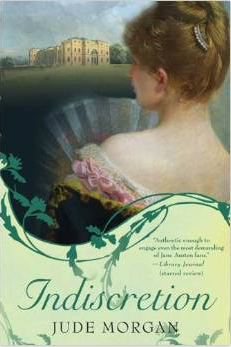
Day 576: Indiscretion

Cover for IndiscretionIn Regency London, Caroline Fortune and her ex-soldier father have been surviving at the edge of poverty for a long time. When her father reports that he has lost all his money in a bad investment, Caroline decides to look for work as a governess.

Soon, her father tells her he has found her a better situation, as companion to Mrs. Catling, the widow of her father’s former colonel. In his ebulliant way, he assumes Caroline could easily be left Mrs. Catling’s fortune. Caroline is not pleased with the situation, nor does she have any hopes of Mrs. Catling’s generosity, but seeing no other option, she takes the position. With no relatives other than her father to fall back on, as her mother’s relatives disowned her mother after her marriage, Caroline moves to Brighton to wait on Mrs. Catling.

Caroline soon learns that Mrs. Catling is demanding and petulant. She treats her servants harshly. When Mrs. Catling’s niece and nephew, the Downings, come to call, Caroline witnesses how her employer manipulates Matthew Downing with the promise of her fortune. Still, Caroline manages to get along with the Downings and Mrs. Catling fairly well, even receiving unwanted confidences from Matthew. However, her dependent position unexpectedly leaves her open to an insult from an unscrupulous man.

Re-opened contact with her relatives eventually removes her to an entirely new neighborhood and life, and she makes some new friends. After awhile, though, her experiences in Brighton return to haunt her.

I don’t often read romance novels and tend to stick to the older authors I love when I do. I have found no writer who can surpass Georgette Heyer in Regency romances. But a friend recommended this novel to me, and I found it quite entertaining. It does not seem simply a copy of Heyer as some other Regency novels have. The dialogue is witty. Once Caroline leaves Brighton she meets some endearing characters, and the plot is both complex and interesting. Caroline is an intelligent and engaging heroine. For some light, escapist reading, I recommend Indiscretion.

Day 540: Empire Girls

Cover for Empire GirlsRose and Ivy Adams are stunned by the death of their father, but his will astonishes them. He has left the house that Rose loves to a brother the girls did not know existed. He has also left them in heavy debt. His attorney, Mr. Lawrence, explains that if they can’t find their brother Asher to clear up the will and pay off the taxes within three weeks, the bank will repossess their beautiful house in upstate New York. All the sisters have to go on is a postcard from a place called Empire House in New York City.

The two sisters make an uncomfortable team. Rose has always been the caretaker, treated by their father as the plain sister who takes care of the house. Ivy he thought beautiful and talented. Ivy is thrilled to go to New York, envisioning a brilliant future for herself as an actress. Rose, who is a homebody, only goes to save the house. The two are almost always at odds—Rose prim and disapproving, Ivy spoiled and childishly complaining that Rose ruins everything.

The girls go to stay at Empire House, a rooming house in Greenwich Village, hoping to find Asher. No one there admits to knowing him, but the girls think they are all lying.

After some initial coolness, Rose begins to fit into the household. She accepts a job doing housework from Nell, the owner of Empire House, and sews for Cat LeGrand, who owns a dress shop and speakeasy. She also almost immediately falls in love with the Empire House cook, Sonny Santino. Although Ivy at first seems to be in her element of 1920’s gaiety and gets a job as a waitress at Cat’s, she does not adjust as easily.

Written in alternating chapters by each sister, the novel doesn’t really evoke a colorful picture of the 20’s. Only the amount of drinking seems to reflect the time period.

The characters of the two sisters are almost cartoonish at first—they are so polarized. Yet at the same time their voices are indistinct enough that when I was reading a chapter, I would often forget which sister was speaking.

http://www.netgalley.comThe reasons the inhabitants are lying to the girls and what they are lying about seem contrived. The timeline of the novel is absurdly short and yet the girls only make a few feeble attempts to find Asher. Although Asher’s situation has some secrets, too, the ultimate fate of the  sisters is perfectly predictable. I found this novel lightweight and silly.


Day 519: Northanger Abbey

Cover for Northanger AbbeyNorthanger Abbey seems to be the Austen novel people like least. Perhaps this is because Catherine Morland is an ordinary girl, naive and not overly bright, so the opportunity for witty conversation is lost. But Austen has some fun with the fad for Gothic novels at the time. One of young Catherine’s misadventures results from her dreaming up a lurid past for her new friends’ family, her imagination influenced by her choice of reading. Austen also creates some broadly comic characters in the greedy and crass Isabella and John Thorpe.

When I learned that Val McDermid was attempting an update, I was intrigued, because McDermid is better known for her chilling thrillers. She places her updated version of the novel in Edinburgh during the festival. This could have been an inspired choice if she had made more use of the setting.

Cat Morland is attending the festival as the guest of her neighbors, the wealthy Allens. She meets Bella Thorpe, who befriends her because she likes Cat’s brother James (although this is not of course obvious to Cat). Bella’s brother John in turn begins pursuing Cat. Cat, though, is already interested in Henry Tilney, son of General Tilney, the owner of Northanger Abbey.

Much of the plot of Austen’s original book rides on the Thorpes’ assumption that Catherine is the Allens’ heir. McDermid implies a similar motive for their friendliness.

McDermid has not changed the plot of Austen’s novel in any major respect, except for the reason why General Tilney throws Cat out of the house in the middle of the night. In that instance, she chooses to pursue a theme that has been cropping up a lot in her later fiction, and the choice is unfortunate. She has set us up to expect something else, and the motive she chooses doesn’t fit in well with anything that has already happened. It is clear that General Tilney is unusually friendly with Cat because he thinks she is wealthy, so to alter the reason for this dramatic scene at the last moment throws us off.

Although the novel seems promising at first, with some witty observations about the festival attendees, we soon fall into the banalities of conversation and texts between vapid young women. Cat just loves vampire fiction and actually believes vampires might exist. You can see where this might lead in terms of the original novel, if McDermid had given it a bit of a twist. I am sick of vampire fiction, but I was almost hoping one would appear in the darkness of an Edinburgh street.

http://www.netgalley.comCat and the Tilney siblings are likable, but Cat doesn’t capture my sympathy as much in her current guise. Again, I’ll stick with Austen.

Just as a side note, those wily internet marketers must have noticed my searches for Northanger Abbey, because I got an email about the Complete Northanger Horrid Novel Collection. This collection includes all of the gothic novels referred to in Austen’s novel. All mine on my iPad for a mere $.99! Well, why not? I’ll be reporting back later.


Day 467: Queen Sugar

Cover for Queen SugarMany of the outcomes of Queen Sugar are foreseeable from the beginning. Charley Bordelon, an African-American widowed school teacher from California who has inherited a Louisiana sugar cane farm, will face multiple problems in an industry dominated by white men but will prevail. Charley, a suburbanite from Los Angeles, will create a place for herself among her relatives in the small rural community. Charley will have problems with her tween daughter Micah but will work them out. Charley will find love. And Charley may be able to mend her relationship with her estranged brother Ralph Angel.

Well, almost right. The fact is that Queen Sugar is predictable, but it still makes an enjoyable and interesting reading experience.

Charley and her daughter arrive in Louisiana a little late for the start of the sugar season, but she’s hired a manager, who supposedly has gotten started on his own. When she arrives at her farm, though, the manager has done nothing and hands in his resignation. With a late start and a bedraggled looking acreage, Charley must find a manager to teach her the sugar business. She just barely has the money to make it through the first year.

Charley and her daughter Micah are living squeezed into a small room in the home of Miss Honey, Charley’s grandmother. Miss Honey throws a party for Charley to meet all her Louisiana and Texas family, but everyone is dismayed when Charley’s half-brother Ralph Angel arrives with his little boy. Charley has not met Ralph Angel since she was a girl, but the rest of the family is angry because he pushed Miss Honey down and broke her arm the last time he was there. Still, Miss Honey wants the family to accept him.

Baszile does a good job of making Ralph Angel understandable. He bears a grudge against Charley, believing that she has been spoiled all her life and has had all the advantages due to him. He is also a criminal. He is not a villain, but his behavior is almost invariably self-defeating. He considers himself too educated for manual labor, consistently exaggerating his accomplishments, and works his way out of several jobs, cheats, lies, and steals. Still, Baszile is able to evoke in us a modicum of sympathy for him without magically providing him a happy ending.

http://www.netgalley.comCharley battles bad weather, difficulties finding a manager or affordable equipment, attempts to cheat her, and her own feelings of inadequacy trying to get her first crop to the mill. During the battle we learn interesting facts about the sugar industry. Baszile also creates a lively picture of this colorful area of the country, with its mix of cultures.

Charley’s courtship by a sugar grower named Remy Newell adds some piquancy without taking over the story. If you are looking for something light with a likable, determined heroine, you’ll probably enjoy Queen Sugar.

Day 433: Black Sheep

Cover for Black SheepI hadn’t read this Georgette Heyer novel in some years. Although it is not one of my absolute favorites, reading it is still a relaxing, amusing way to spend a few hours.

When Abigail Wendover is away from her home of Bath visiting her family, she hears disturbing rumors that her niece Fanny, an heiress, is being courted by a fortune hunter named Stacy Calverleigh. Returning home, she finds that her 17-year-old headstrong niece believes they are madly in love, and she is not ready to listen to arguments that Calverleigh, a much older man, has not behaved as he should. He has also worked his way into the good graces of Abigail’s foolish sister Selina.

Abigail encounters a man named Calverleigh in a hotel parlor, and she is shocked to find him neither of good looks nor address and much older than she is herself. He is further prone to uttering the most shocking remarks that unfortunately make her laugh. Soon Abigail finds that this Calverleigh is not Stacy but his uncle Miles, the black sheep of the family, who was sent away to India after a youthful scandal and has now returned. However, he is unwilling to interest himself in the situation between her niece and his nephew. He is only interested in Abigail herself.

Although Abigail knows she shouldn’t encourage his attentions and finds some of his views about family and duty shocking, he never fails to make her laugh. Soon she discovers that he is even more unsuitable a companion than she thought, for his youthful indiscretion was to run off with Fanny’s own mother, who later married Abigail’s older brother!

Abigail is one of Heyer’s more mature heroines, an intelligent, sensible woman with a sense of humor some of her relatives consider unfortunate. Of course, the journey out of the tangle her niece is in will be enjoyable and entertaining. Although this novel is not as funny as some of my favorites, it is always a pleasure to spend time with Heyer’s creations.

Day 397: Sylvester, or the Wicked Uncle

Cover for SylvesterOn occasion, I reread a few of Georgette Heyer’s Regency romances, which have been some of my favorite reading for many years. Just recently, I reread Sylvester, which in some editions is titled Sylvester, or the Wicked Uncle.

The extremely eligible bachelor Sylvester, Duke of Salford, has decided to take a wife. His only difficulty is in deciding which of five eligible girls to marry. When his beloved mama mentions that she and her best friend made a plan for their children to marry many years before, he decides to go inspect the girl, his godmother’s granddaughter, to see if he might like her. Although he is warm and thoughtful to those he cares for, since his twin brother’s death, he has been aloof to others and comes off as haughty.

Sylvester’s visit is disguised as a hunting party, but Phoebe Marlow is informed by her detestable stepmother that the duke is coming to make her an offer. Unfortunately, Phoebe has already met Sylvester and took such a dislike to him that she used him as the villain in a novel she wrote. That novel is going to be published, despite all expectation. Normally, she would not expect him to recognize himself in a silly gothic romance that pokes fun at various society figures, but for the mention of Sylvester’s very distinctive eyebrows.

Fearful of her stepmother’s pressure and not understanding that Sylvester has no intention of proposing, Phoebe talks her childhood friend Tom into escorting her to her grandmother’s house. However, an accident and a snowstorm strand her and Tom with Sylvester in a small country inn.

After Phoebe gets to know and like Sylvester, she is horrified to find out that he has a nephew, since in her silly romance his character is a wicked uncle who wants to steal his nephew’s fortune. Another horror lurks, because Phoebe’s book proves to be a smashing success, much read by society members, who are all trying to identify their friends. Since Phoebe has never brought herself to admit to Sylvester that she wrote a book, she soon fears that people will find out she is the author.

Heyer creates delightful, engaging characters and puts them into silly and unbelievable situations, which is part of the pleasure of reading her novels. They are very well written, with entertaining and sparkling dialogue and a complete understanding of the customs, dress, and speech of the period. If you decide to read Sylvester, get ready for some fun. Many of Heyer’s novels have been re-released in the past few years, so they should not be hard to find.

Day 382: Touch Not the Cat

Cover for Touch Not the CatI was surprised by how many people were interested in my review of Mary Stewart’s This Rough Magic, so I decided to post a review of another Stewart novel, one of my favorites of her later romantic suspense novels, about family secrets, published in 1976. Touch Not the Cat is the only Stewart book, aside from her Merlin novels, that includes a touch of the supernatural.

Bryony Ashley is awakened on Madeira, where she works, by a message from her father. She has always had a telepathic link with one of her cousins—she doesn’t know which one—but he unexpectedly relays a garbled message from her father. So, she is not altogether surprised when she learns that her father has been severely injured after a hit and run accident. Before she can go to him, he dies, leaving behind a warning of danger. She returns to England to settle his estate.

Bryony’s family owns Ashley Court, an ancient stately home that the family has not been able to afford for some time. It is entailed to her cousin Howard and after him to his sons, her identical twin cousins Emory and James.  Bryony has always assumed that her “lover,” as she calls her telepathic friend, is one of these two cousins, since telepathy is said to run in her family and she was never very close to her third cousin, Francis.

The only part of the estate that passes to Bryony is the small cottage where she lives on a patch of land surrounded by a system of canals. The rest of Ashley Court is currently being rented by a rich American family, the Underhills.

Almost as soon as Bryony gets home, odd things begin happening. Someone steals an old book of records from the church. She goes on the tour of Ashley Court and notices that small, valuable objects of art are missing, including some of her own possessions. Then Emory and James arrive on the scene and immediately begin pressuring her to wind up the estate affairs and sell her own property to them.

As she pokes around in the library, Bryony figures out that her father was worried about something he discovered about the ancient property and is reluctant to sell it until she determines just what his discovery was. Calmly helping around the estate is her childhood friend, Rob Granger. It was to Mrs. Granger and her son that Bryony always turned in times of trouble as a child, so she confides some of her concerns to him.

Interspersed with Bryony’s story are a few paragraphs in each chapter from the point of view of an ancestor, the black sheep of the family, Nick Ashley. It was Nick’s father who selected the puzzling family motto “Touch not the cat, but [without] a glove” (an actual motto of the Clan MacPherson). Eventually, the two stories converge to reveal the secrets of the house and the reason for Bryony’s father’s death.

From a more innocent time, Mary Stewart’s novels are among those I turn to periodically for a bit of light reading, and I find them unfailingly entertaining. As usual with Stewart, her heroine is appealing and she slowly builds a feeling of suspense. Her plotting in this novel is complicated and the mystery engrossing. Although we are accustomed these days to narratives that move back and forth between two periods of time, this was a more unusual technique for the 1970’s.