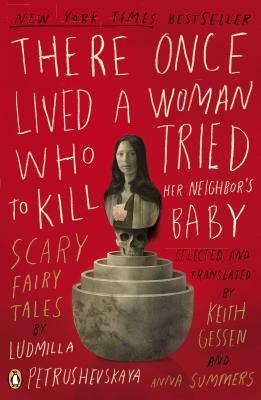
I’ve always been interested in Russian literature but have read mostly 19th century books. Ludmilla Petrushevskaya was a writer whose books were banned in the Soviet Union, even though they were not political and her plays were allowed. The introduction to my Penguin edition says that in 1973 because Lithuania was more open, she took a difficult trip to Vilnius to try to get something published and indeed got two stories published, but she was out of favor in her own country for years.
The first thing you notice when you look at this volume of stories is that it is backwards. You start with the back cover. Then, I guess, read the introduction, which I didn’t, because the translators explain the concept of nekyia from Ancient Greek literature. The word means “night journey,” which often includes visits to the underworld or the dead. The introduction states that every story in the book is a form of nekyia.
Lots of the stories involve people being dead without knowing it or people visiting the dead. The stories seem to belong to magical realism. That genre isn’t my favorite, but I have to admit that most of the stories are fascinating even though I didn’t always get the point. If there was one.
There is no characterization, really, because these are fairy tales, but the characters often live grim or dangerous lives. People are beaten up or have everything stolen from them. In one story, a family keeps moving farther and farther from civilization in places more and more hidden to keep people from stealing their potatoes and goat.
People also change forms, become different physically. In one story two sisters are united by a spell into one very fat woman, but this is probably the most extreme example. Petrushevskaya’s characters are mostly not nice.
This is certainly an unusual book. It’s not for everyone, but even though it wasn’t my preference, I found it oddly fascinating.
It wasn’t until I was getting ready to post this review that I realized that at 152 pages it qualifies forNovellas in November!
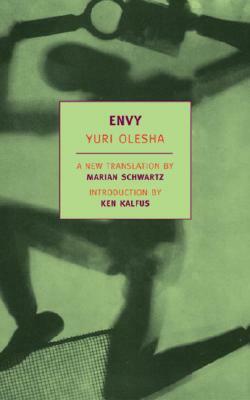
I read Envy right after Dostoevsky’s The Gambler, and perhaps that was too much for me. The two short Russian novels have a lot in common even though they were written more than 60 years apart. They both feature young male narrators in a frenzy and easily offended. They both have long philosophical speeches that doesn’t seem to mean much. Olesha leans more into Absurdism, but Dostoevsky can be pretty absurdist himself.
Andrei Petrovich Babichev is a model Soviet citizen, a trust director in charge of food. He has literally picked our narrator, Nikolai Kavalerov, up from the gutter and given him a bed on his sofa. Andrei Petrovich is fat and self-satisfied, true, but Nikolai hates everything about him.
Then he meets Andrei’s brother, Ivan, a sort of buffoon who makes up ridiculous stories and also hates Andrei.
Andrei’s claim to fame is a huge communal dining hall he’s building, where food is supposed to be good and cheap. He has also produced a good, inexpensive sausage that he’s proud of. Olesha is clearly making fun of these accomplishments, and I don’t know how he got away with it in 1927 Soviet Union.
There is lots of talk about the New Man that Communism is going to produce but no sign of one. (Coincidentally, I am reading The Possessed by Dostoevsky right now, and there’s lots of talk about the New Man in it, too; only apparently he’s supposed to be produced by Nihilism.)
Thanks to the publisher for sending me this book in exchange for a free and fair review.
I haven’t felt as if I had the time to fully participate in Russophile Reads’ Dostoevsky Read-a-Thon, but my original plan was to read some of the shorter works. (That’s boiling down to The Gambler.) I have already read all the long ones and reviewed a couple of them already, and I didn’t think I had time to read any more. Well, that was the plan.
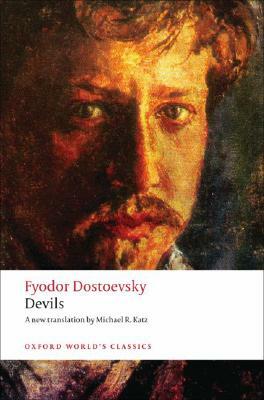
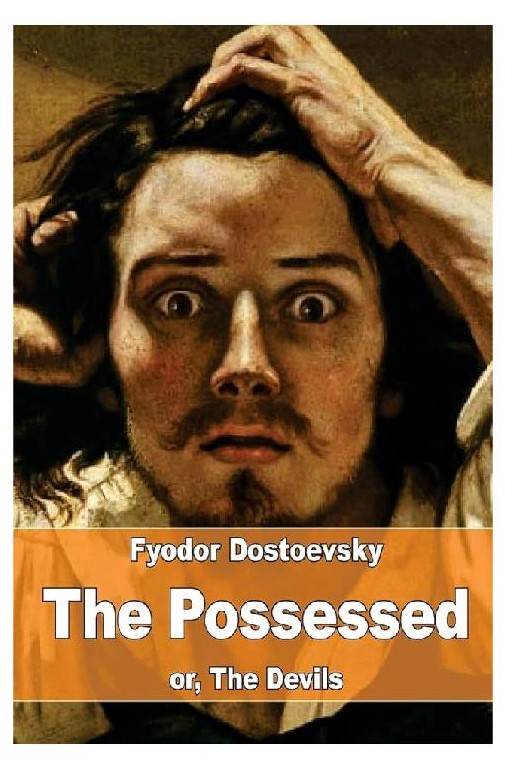
I could not remember Devils at all. For some reason, I got it into my head that it was about the same length as Notes from Underground, a relatively short work. So, I put a hold on it at the library. It already had four holds on it, which is unusual for my local library, and surprising. After a while, when only one hold had been released, I realized I wasn’t going to get it in time to read it for the project, so I began looking for a copy of it. That was when I discovered that Devils was once known as The Possessed, which I had in my own library (which means I have actually read it. I don’t put books on the shelves until I’ve read them). The newer editions of this book are all called Devils or Demons, apparently a preferred version of Dostoevsky’s title. And I have a Modern Library edition of the old Constance Garnett translation, which was all that was available years ago for most of the classic Russian translations (now considered inferior). And, of course, it’s more than 700 pages long with very small type. But I plunged in.
So, finally I get to my review. Let me say first that my spelling of names might seem eccentric now (especially Nikolay instead of Nikolai, which is much closer to the correct pronunciation), but since I reread the Constance Garnett translation, I am using her spelling.
The Introduction to my Modern Library edition of The Possessed says that although Dostoevsky thought he was a progressive, he wrote the book out of fear of nihilism and revolution. Until some events toward the end of the book, though, it’s hard to take the activities of the radical characters seriously.
The novel starts with two respected members of a provincial town. Stepan Trofimovich Verhovensky is a highly regarded scholar. However, for 20 years he’s been living under the patronage of wealthy and forceful Varvara Petrovna Stavrogin, supposedly writing a book but accomplishing nothing. He’s not exactly a parasite but rather an impractical, unworldly intellectual who has never had to take care of himself. He does manage to spend a lot of her money, but lately she’s been drawing in the expenses.
The action gets started (sort of) by the not quite simultaneous arrival of these two characters’ respective sons, Nikolay Vsyevolodovich Stavrogin (usually referred to just as Stavrogin) and Pyotr Stepanovich Verhovensky. Stavrogin is a sulky, charismatic young man who left years ago as a student and may be involved with a group of nihilists in town. He is also quite the womanizer, for we learn that both of Varvara Petrovna’s young friends, Liziveta Nikolaevna and the more dependent Darya Pavlovna, were involved with him during a visit to Switzerland. Pyotr Stepanovich has been gone even longer, as his father took no interest in him when he was a child and sent him away to be raised. He doesn’t seem important at first but turns out to be the catalyst for most of the action. He seems frivolous but is madly lying to and manipulating people for his own ends.
Both Stavrogin and another character named Shatov have become disillusioned with the revolutionary group that a group of the characters belong to, but Shatov, who has been running an illegal printing press, has asked to quit. Pytor Stepanovich has as one his goals, aside from sowing general confusion, to convince his group of five cell members that Shatov means to betray them, because he wants them to kill him. Pyotr Stepanovich, we learn, is an informer himself but also wants to avenge an insult by Shatov, who spat in his face back in Switzerland. Stavrogin doesn’t seem any more devoted to the cause, but Pyotr Stepanovich has secret plans for him. (There’s another character Pyotr Stepanovich wants vengeance against, and that’s his foolish father, Stepan Trofimovich.)
For quite a while, Dostoevsky seems to be setting us a farce, Stepan Trofimovich’s behavior is so clueless and absurd, the social machinations and gossip in the town are so ridiculous, and the radicals’ attempts to sow confusion are so silly. But violence kicks off thanks to the activities of Pytor Stepanovich.
Frankly, although I believe that Dostoevsky had a radical youth, his depictions of their meetings and their statements of belief seemed absurd. But I am no expert on on 19th century radicalism.
Everyone is in a frenzy at usual with Dostoevsky, and frankly, I had a hard time tolerating the many long, rambling speeches, whether of a religious or nihilistic subject. (And the nihilists, as well as others, sure seem to spend a lot of time talking about God.) This book was so long that by the end, when Dostoevsky has knocked off half the main characters, I was just skimming. Not my favorite of his works.
However, I was lucky enough, while poking around on the web, to find a multi-part article by Elif Batuman (author of The Possessed: Adventures with Russian Books and the People Who Read Them) about attending a 12-hour-long production of The Possessed in Italian on Governor’s Island. The first part is called “My 12-Hour Blind Date, with Dostoevsky,” and if you want to read all the parts, there are links to them, published by The Paris Review. It’s hilarious.
In 1950s Soviet Union, Antonina has a child out of wedlock. She is lucky to be allotted a room in a house with three old ladies, making a deal with them to cook and clean if they’ll take care of the baby while she’s at work at the factory. The deal becomes even more important when they realize Suzanna isn’t talking at the right time. They all become terrified that the girl will be institutionalized or at least that Antonina will be forced to take her from one doctor to another.
So, Suzanna stays out of school and the grannies teach her to read and write and even to understand French. She imbibes Russian fairy tales as well as some strange beliefs and superstitions, and the grannies sneak her to church to have her baptized.
All goes well until a man at work, Nicholai, starts paying attention to Antonina. Although they have done nothing but have tea, the union people at work assume they are having an affair and begin pressuring them to get married.
Then the situation turns serious. Antonina has cancer. How will the grannies be able to arrange to keep Suzanna after Antonina dies?
This novel effectively depicts the poor living conditions and the uncertainty of life in Soviet Russia, where the state can become involved in the details of anyone’s private life. The narration moves from person to person, and a lot of action is conveyed in somewhat elliptical dialogue, so I wasn’t always sure what was going on. Dreams and stories are also given a lot of importance.
I found the ending, which is another story, fairly unsatisfying, though.
Published in 1848, A Double Life is the only novel written by the Russian poet Karolina Pavlova, who was well known in her time but forgotten by the time of her death. Almost more interesting to me than the novel was the biographical information about Pavlova, who was reviled as a Russian woman for daring to consider herself a poet. I read this novel for my Classics Club list.
Cecily is a young, innocent girl in the top levels of Russian society. Her mother, Vera Vladomirovna, has brought her up strictly to be submissive and ignorant of life. Vera Vladomirovna has noticed Prince Viktor’s interest in Cecily and hopes to marry her to him. But she doesn’t realize that her friend, Madame Volitskaia, intends him for her daughter Olga, Cecily’s best friend.
Upon hearing of the death of a man she never met, Cecily dreams about him that night. These dreams, related in poetry, end each chapter.
The prose narrative is full of satire against polite society, although Cecily doesn’t understand any of it. The poetry is more romantic and mystical, and I didn’t always get the point of it except the end result of it is to awaken Cecily to what life is really like.
The novel is very short, with a strong feminist message for the times. The dream sections are written with a romantic floridity that reminded me of the works of George Sand.
Finished in 1960, Russian author Vassily Grossman’s Life and Fate was confiscated by the NKVD (predecessor of the KGB) and had to be smuggled out to be published in Europe. Taking War and Peace as its model, it is about the pressures of totalitarian governments during the siege of Stalingrad. It centers around one extended family, the Shaposhnikovs, but it also includes some of the German officers and others, visiting a variety of wartime settings: a besieged plant in Stalingrad, a German concentration camp, a scientific institute in Moscow, a Russian tank corps, and so on.
Because of its broad scope and length (more than 800 pages), it has a lot of characters, maybe a dozen of whom we visit and revisit, but others whom we see only once or twice. Some of the ones we revisit are Krymov, a commisar who is the ex-husband of Yevgenia Shaposhnikova; Viktor Shtrum, a famous physicist married to Lyudmila Shaposhnikova; Pyotr Novikov, a tank commander in love with Yevgenia; Yevgenia herself, who is worried about both Krymov and Novikov; Sofya Levinton, a doctor and friend of Yevgenia on her way to a German gas chamber. There is an appendix to the book listing hundreds of characters, but it doesn’t list most of the male characters’ first names or patronymics, so at times I wasn’t sure who the characters were talking about.
Although the Russian characters are uniformly patriotic, almost all of them live in fear, remembering the Terror of 1937 when many people were disappeared or deported to labor camps. Those times aren’t really over, as several characters run into trouble for minor infractions or no infraction at all, resulting in imprisonment and torture for some, demotions or exile for others. One character is labeled an enemy of the state for reporting that a soldier on his own side shot at him. In addition, bureaucracy gets in the way of people trying to do their war work.
This novel is powerful at times, but because of its structure, I didn’t really feel much connection to any of the characters except maybe Novikov, who spends hundreds of pages yearning for Yevgenia, not knowing she has returned to Krymov. It wasn’t until I was well into the book that I realized it was a sequel to Grossman’s Stalingrad, and it refers back to events that presumably occurred in that book, but it’s hard to know whether reading it first would have helped.
Also, Grossman occasionally takes a paragraph or two, sometimes a whole chapter, to philosophize on some subject. That’s a kind of polemic writing I don’t appreciate.
A Train to Moscow is Elena Gorokhova’s first novel, coming after two memoirs. Although its story is similar to that of A Mountain of Crumbs, including where it ends (which I found frustrating both times), I still found it affecting.
Sasha grows up in a small Russian village with a nose and disdain for mendacity, which, as it is the Stalin years, is dangerous for her. Her best friends are boys—Marik, who is her same age and shares her interests, and Andrei, who is two years older and disapproved of by her mother. When she is a pre-teen, she discovers her Uncle Kolya’s diary hidden away in the attic. Her uncle never returned from World War II, and the family has heard nothing from him, but his diary describes a war unlike the patriotic and courageous venture she learned about in school. Periodically, the novel includes excerpts from this diary.
When Sasha hears a play on the radio, she realizes she wants to become an actress. As she nears graduation from secondary school, she knows her family won’t approve her decision to try out for drama school in Moscow. Nor will Andrei, who is now her boyfriend and has just lost his parents and home in a fire.
This is a strong novel about family and hidden secrets, about being true to oneself, and about an abiding love.
I thought Yulia Yakovleva’s Punishment of a Hunter was an excellent 1930’s-era Russian mystery, so I looked for more. But all I could find was The Raven’s Children, a children’s book.
In Stalinist Soviet Union, seven-year-old Shura lives with his older sister Tanya, his baby brother Bobka, and his parents. All of them are patriots, but one night his father disappears. The next day, their mother behaves oddly, packing a suitcase, saying she quit her job, but she doesn’t tell them anything. The family unusually has a two-room apartment with Shura and Tanya’s bedroom accessed by a wardrobe so the second room is not obvious. That night Shura is awakened to see someone being taken away in a black car. The next morning, their mother and Bobka are gone, and Shura overhears a neighbor saying that they were taken away by the Black Raven. Their neighbors won’t speak to them except the timid old lady down the hall, who gives them a purse of money from their mother with instructions to go to their aunt.
Neither child wants to go to the aunt, so they spend the day wandering around talking to the birds (who talk back), trying to find the Black Raven. Gradually, they understand that their parents are thought to be spies and traitors. They think there must be some mistake and if they find the Black Raven they can tell him so. Then when they arrive home at their apartment that night, they find their neighbor living in it.
I always go under an assumption that the age of the protagonist in a children’s book is roughly the age of its intended audience. That being said, I think that children that age would understand very little of this book and be terrified by some of it. And I’m not a person who thinks children shouldn’t be scared by books.
For one thing, Yakovleva slowly brings in an element of magical realism. The talking animals and even Shura becoming invisible and having people walk through him was okay. But Yakovleva makes metaphors become real, so ears and eyes appearing in the walls are really creepy. But the worms are the worst. And I don’t want to spoil anything, but some characters, once disappeared, stay disappeared.
Yakovleva wrote this novel because her grandfather had similar experiences as a child during Stalin’s Reign of Terror. This novel might work as a teaching tool, but I would advise it to be with discussions with an adult who has read up on the period. Otherwise, I don’t think children are going to understand this novel.
By the way, several adult Goodreads readers complained that they didn’t understand what was going on, and at least one of them said she was from a former Soviet country.
I am pretty well up on the 19th century Russian novelists, so when I was making my Classics Club list, I asked my husband to recommend someone more recent. He mentioned We.
The introduction calls Zamyatin an inconvenient citizen of both the czarist and Communist regimes, because he believed in complete freedom for the individual. His novel We is the granddaddy of dystopian novels and an inspiration to Orwell.
D-50 is a good citizen of the OneWorld, where everyone eats, sleeps, and works in unison. He is also the creator of INTEGRAL, which is going to be shot off into space to make the entire universe uniformly happy. He is writing a record to explain to the citizens of the universe why they should want to be uniform.
He thinks he is happy with O-90, whom he periodically requests for sex (the one time when they’re allowed to close the blinds of their glass apartments) until he meets I-330. There’s something mocking about her, and he thinks she’s up to something. Then she begins dragging him into situations that he should report her for to the Guardians. But he doesn’t, and soon he is madly in love with her and behaving strangely.
This novel is both dystopian fiction and a satire of some of the beliefs of Communism. At times, it is quite fevered in tone, and I wasn’t always sure what was going on. Characterization doesn’t even make sense in such a novel, so Zamyatin picks out weird facial features to identify people. Not my genre, but interesting.
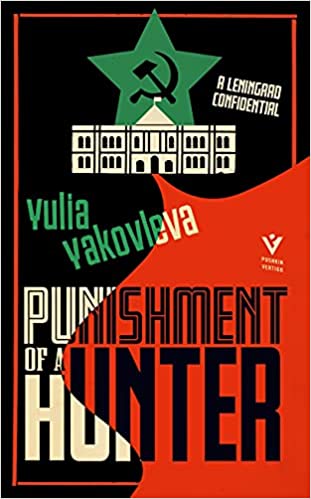
When Zaitsev and his homicide team in 1930 Leningrad investigate the death of Faina Baranova, he knows there is something odd about it. Although all her clothing is practical, she is dressed in velvet and posed before red curtains the neighbors in her communal apartment say are not hers. There is something theatrical in the scene. However, after months, the team finds no clues.
In a meeting at work of the OGPU, Zaitsev is accused of hiding bourgeois origins. He claims he knows nothing about his father, having grown up in an orphanage. Pasha, his building janitor, shows up in support and claims to have known his mother; nevertheless, some days later he is arrested.
After a few months, he is released without explanation. Zaitsev soon figures out he is to solve another murder, this time of a group of people on the site of a new park planned by Kirov, head of the party in Leningrad. The unspoken message is solve the case or go back to jail. However, because he’s been released, his colleagues no longer trust him and won’t speak to him about work.
Aside from presenting an intriguing mystery, Punishment of a Hunter evokes 1930 Leningrad, beautiful but gray and tired, the atmosphere paranoid, citizens poorly clad and fed. I was convinced by this post-revolutionary world as I was not by the popular A Gentleman in Moscow. I hope Pushkin Press will be publishing more books by Yakovlevna.




 What? Me Read?