Day 486: Empress of the Night

Cover of Empress of the NightIn early November 1796, Catherine the Great of Russia suffered a stroke and lay on her deathbed for 36 hours before she finally succumbed. Eva Stachniak’s second novel about Catherine imagines her spontaneous flashbacks of her life, interrupted by moments of fleeting awareness, as she lies there helplessly.

Empress of the Night covers some of the same ground as Stachniak’s The Winter Palace, only the previous novel is told from the point of view of Varvara Nikoleyeva, Catherine’s spy turned confidante, and concentrates mostly on the time before Catherine was Russia’s ruler. Varvara is only a fleeting presence in Empress of the Night, and I wonder if readers who had not read The Winter Palace would be confused by references to her.

Stachniak’s deathbed approach for this novel by definition causes it to be disjointed in narrative style and sometimes difficult to follow chronologically. The novel portrays Catherine as a figure more sympathetic than otherwise, but other characters are left relatively undeveloped.

Catherine’s memories go all the way back to her arrival in Russia as Sophie von Anhalt-Zerbst-Dornburg, a prospective bride for the Empress Elizabeth’s spoiled and childish heir Peter. We follow her struggles to be accepted as a future wife, to conceive, and to maintain some kind of standing in Elizabeth’s court, although that subject is covered more thoroughly in the first novel. The narrative carries us through the coup against her husband after Elizabeth’s death and the most important events of Catherine’s reign, ending with her attempts to marry her granddaughter Alexandrine to the king of Sweden and to leave her office to her grandson Alexander instead of her foolish and tyrannical son Paul.

Although this novel is interesting, I was not as drawn in as I was by the first book. The parts of the novel dealing with Catherine’s stroke and its aftermath interrupt the flow of the narrative too often. I was also taken aback by the preponderance of attention given in the novel to Catherine’s favorites, especially to the annoying Zubov, versus the actual events of her rule. The emphasis seems to lie with her personal attachments, which I frankly think is unlikely for a world ruler. I also find it hard to believe that Catherine had so much patience with some of her relatives and lovers, most of whom are characterized as being annoyingly selfish.

Since I have read a fair amount about Catherine’s life, I was able to follow the references to important events with little difficulty, but I am left wondering how easy it would be for someone who is unfamiliar to form a good understanding of what is going on. Still, I think this novel draws an appealing portrait of a complex and difficult person.

http://www.netgalley.comMy original understanding of The Winter Palace was that it was the first in a trilogy about Catherine the Great. I am left wondering if I was mistaken, because this novel does not seem to leave anywhere for the writer to go in a third novel. Empress of the Night is ultimately much less satisfying than The Winter Palace in the depth it applies to its subject, which makes me wonder if Stachniak simply lost interest.

Day 476: The House of Special Purpose

Cover for The House of Special PurposeThe House of Special Purpose is an alternative history novel that looks at the end of the Russian monarchy with just a slightly different twist. It’s a familiar one, though, that Grand Duchess Anastasia escaped the execution of the royal family. Why is it always Anastasia, I wonder? This information is not a spoiler, for it is evident early on.

Most alternative histories start with the change to history and show how things would be different. This one is the portrait of Anastasia’s relationship with the main character, Georgy Danilovich Jachmenev. In fact, history isn’t changed in this novel except for that of a couple of people.

Unfortunately for my enjoyment of this novel, I could not suspend my disbelief for two of the foundations of the plot. The first is that the Tsar would appoint a peasant’s son, Georgy, to guard the Tsarevich Alexei on the basis of one incident, misunderstood as bravery. The second, even more vitally, is that Anastasia would give a boy with this background, and presumably no education (although oddly well spoken), the time of day. That she would throw herself into a love affair with him almost at first sight is utterly unbelievable. It is unlikely that he would even have been allowed to talk to her.

I’m not sure why Boyne had to stretch our disbelief so far. He could have made our hero a minor member of nobility or even a middle class boy and I would have bought it. Think me elitist if you will, but I don’t believe Boyne has any idea what life was like in the Russian peasantry.

With this problem always in mind, it was difficult for me to enjoy the novel, which, except for journeys back to the past, is about a fairly complex marriage. But again, it doesn’t deal with, for example, any difficulties Anastasia—or Zoya as she is called through most of the novel—might have had coping with the problems of a normal, even impoverished life. We skim over things like that, as well as how effortlessly Georgy seems to adjust to life in the Winter Palace. Or whether in post-revolutionary Russia, any couple could just jump on a train and travel to Paris without identity papers.

So, on the one hand I was absorbed by the novel at times, on the other it seemed too unrealistic. It is well written, and Georgy and Zoya are appealing characters, but it does not, in the end, constitute a convincing story.

Day 351: The Fixer

Cover for The FixerBest Book of the Week!

In 1911 Russia, Yakov Bok is tired of his difficult life in the shtetl. So, after his wife leaves him for another man, Yakov travels to Kiev in hopes of making a better living. When he helps a drunken man who is passed out in the snow, Yakov is offered a job supervising a brick yard. However, in order to take this job, Yakov must live in a part of the city forbidden to Jews.

It is this circumstance followed by a series of mishaps that ends up with Yakov being accused of murdering a boy he chased away from the brick yard. As the case continues, it becomes clear that the murder is being used by authorities an an excuse to trump up charges of ritual murder against the Jewish community.

The novel becomes more and more difficult to read as literally everything that happens to Yakov makes things worse for him. The gentiles he knows in Kiev tell lies about him. Once he is in prison, the jailers do everything they can to incriminate him, including trying to entrap him into breaking the rules or admitting his guilt.

Yakov goes into jail a nonpolitical, irreligious, naive man who hopes for justice, and the novel is partially about his development into an angry man who refuses to be beaten. Although almost nothing in the way of plot or action happens from the time he goes to jail, I was absolutely compelled to finish reading.

Written in a storytelling fashion that I associate with the tales of Sholem Aleichem or Isaac Bashevis Singer, this novel is more grim than most of the stories I’ve read by these other writers. However, both The Fixer and The Bloody Hoax, by Aleichem, are based on a true event from 1911 Kiev, called the Beiliss blood libel case.

Day 294: Death on the Nevskii Prospekt

Cover for Death on the Nevskii ProspektGiven my interest in Russia and the time period, this novel should have been a slam-dunk for me, but I was disappointed. Lord Francis Powerscourt is asked to investigate the death of a British diplomat in Russia, who was discovered with his throat cut on a bridge across the Nevskii Prospekt. No one in the British government knows why the victim was in Russia, and the Russians, having reported his death, pretend that they know nothing about it.

Powerscourt’s investigations seem to be pointing to the victim having had a secret meeting with the Tsar. In addition, Powerscourt may be running up against the Russian secret police, the Okhrana.

The book begins with a completely unnecessary chapter or two devoted to efforts to try to persuade Lord Powerscourt’s wife to release him from his promise not to take any more investigations. In addition, the real circumstances of the death seem completely unlikely. Characterization was minimal, and the plot had several unlikely points.

Dickinson’s historical research is commented on in the blurbs, but there was little in the novel that anyone doing the most cursory reading about Tsarist Russia’s last days wouldn’t know.

Day 292: Russia Against Napoleon: The True Story of the Campaigns of War and Peace

Cover for Russia Against NapoleonDominic Lieven explains in the introduction to Russia Against Napoleon that the popular conception of Russia’s role in the battles with Napoleon in 1812-14 is mostly derived from Tolstoy’s War and Peace. Tolstoy posited that the fate of Napoleon’s army was mostly a result of luck on the part of the Russians and the brutality of the Russian winter. Lieven also explains the reasons why most scholarship on this subject has been done from French, German, Austrian, or British records.

However, Lieven is able to convincingly show that the Russian victories, although of course partially due to luck, were mostly because of the understanding of Russia’s Emperor Alexander I and his field marshall, Mikhail Barclay de Tolly, of the kind of war Napoleon was good at and their refusal to give it to him. That is, Alexander and Barclay de Tolly planned from the beginning for a long, drawn-out war that would lure Napoleon deep into Russia, to be followed by a second campaign in Germany and France.

Lieven is a professor of history with the London School of Economics and an acknowledged expert on Russian history. Interestingly, he is also the descendent of three of the generals at the Battle of Leipzig.

Lieven’s book explains in the clearest terms the details of every campaign in those three years, taken from the Russian letters, diaries, and records that have not been readily available until recent years, as well as from the records of British observers and others of the combatants. He provides insight into the political jealousy and maneuverings and even to the details of staffing and provisioning the armies and maintaining the long supply lines needed when the Russian army entered western Europe.

Lieven’s analysis of war is comprehensive, and even though it is very detailed, it never seems to get bogged down in minutia. It introduces us to some colorful characters and vividly and suspensefully describes the battles.

The book’s only weakness for me was that it assumed a little more knowledge of the events immediately preceding these years than I had and knowledge also of the functions of the vast numbers of different types of troops. However, that lack of knowledge on my part did not really impede my understanding or detract from this very interesting history.

Day 278: Gentlemen of the Road

Cover for Gentlemen of the RoadGentlemen of the Road is like a boy’s adventure story for adults. Before 1000 AD, Zelikman and Amram are two adventurers travelling in the Caucasus Mountains. They make money by faking fights to be wagered on. Zelikman is a thin, gawky physician from Regensburg who has broken with his family, while Amram is a giant of an ex-soldier looking for his daughter, who was stolen from his village.

An old man hires the men to escort an unwilling young boy named Filaq to his grandfather. The boy’s father was a bek in Khazaria, a legendary Jewish country on the Caspian Sea, when he was murdered by a rival. The boy wants to return to take his revenge, but the rival is having his entire family murdered and enslaved. Filaq eventually persuades Zelikman and Amram to return to Khazaria and help him retake his father’s position.

Chabon originally published this novel as a serial in the New York Times Magazine, ending each chapter with a cliffhanger. He obviously had a great time writing it and it is lots of fun to read, with colorful characters, exotic settings, and deeds of derring-do.

Day 206: Special Assignments: The Further Adventures of Erast Fandorin

Cover for Special AssignmentsI have been following Boris Akunin’s Erast Fandorin series for several years. At first I liked Akunin’s shy, skinny, intellectual young hero. But then Fandorin transformed himself into a muscle-bound Putinesque superhero wannabe, so I lost most of my affection for him.

Set in Tsarist Russia, Special Assignments is actually two novelettes about Fandorin cases. The first, “Jack of Spades,” is a silly case where Fandorin is pursuing a clever con artist. It is supposed to be funny, I think, but I mostly missed the humor and found it ridiculously overcomplicated.

The second story I did not finish once I grasped where it was going. Called “The Decorator,” it is about Jack the Ripper moving his operations to Moscow. However, it becomes quickly obvious that Jack is supposed to be not only a woman but one who is murdering prostitutes because they are defiling their bodies. The whole idea was so abhorrent to me that I refused to read any more of it.

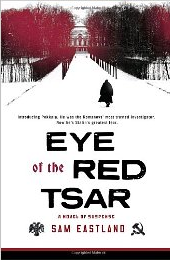
Day 171: Eye of the Red Tsar

Cover for Eye of the Red TsarI had a strange reaction to Eye of the Red Tsar by Sam Eastland. I felt as if the author had researched the time and place without actually grasping anything about it. The novel is placed in post-revolutionary USSR with flashbacks to pre-revolutionary Russia. Tsar Nicholas II and Stalin are both characters in the book, in their different time periods, but you do not get any feeling that the author understands what kind of people they were or anything about the politics involved. Given my fascination with Russia, this novel would seem to be a great fit for me, but I have nothing but objections to it.

Pekkala, a Finnish soldier, is a prisoner in a labor camp in Siberia at the beginning of the novel. He was Nicholas II’s private investigator before the revolution, when he became known as The Emerald Eye. He remained completely faithful to the Romanovs, so when the family was captured by the Bolsheviks, he was exiled to Siberia. But at the beginning of the novel, he is released because Stalin wants him to find out exactly what happened the night the Tsar and his family were executed. Of course, this question has remained a mystery to the western world until recently, but I did not buy at all that Stalin and his predecessors would not have already known perfectly well what happened to the Romanovs.

My first objection is about how Stalin is characterized. The book takes place partly in 1929, when Stalin is only a few years away from his reign of terror. Yet he is depicted as quiet and thoughtful, not exactly true to the historical consensus. As a kind of extension of that thought, even though the book is about a time and place when everything is politicized, the novel provides no political context for the reader.

Another problem I have is with the narrative style. As Pekkala conducts his investigation, he remembers his past, in order. When I compare Eastland’s technique with that used in The Darkest Room, where characters have fleeting thoughts or disjointed memories that eventually add up to something, this novel seems incomparably clumsy in execution.

Finally (somewhat of a spoiler), I found it completely unbelievable, given the loyalty of the main character to the Romanovs, that he would willingly agree to work for Stalin at the end of the book. I forgive myself for revealing this turn of events, as it is easy to see it coming. Readers are told at the beginning of the book that Stalin is known as the Red Tsar. Obviously, since Pekkala was the Emerald Eye under the Nicholas, he will become the Eye of the Red Tsar under Stalin.

Day 156: Winter Garden

Cover for Winter GardenI want to start out this review by saying that I usually avoid reading tearjerker fiction (by the way, that’s different from being brought to tears by emotion that is evoked honestly in fiction) and I don’t like things that are too heartfelt, if that makes any sense. Having misgivings, I read Winter Garden by Kristin Hannah upon the recommendation of a friend because I have always been interested in Russia. This decision was a mistake for me because I found this novel too corny, contrived, and predictable.

Meredith is a caregiver. She takes care of her father’s business and tries to take care of everything else for everyone. She has also tried to love her cold, withdrawn mother all her life, but her mother remains unknowable. Meredith’s sister Nina, on the other hand, is a photojournalist who seems unreliable to Meredith and hardly ever comes home. This, Meredith resents.

Their father has a heart attack, which brings Nina home. During his illness, he insists that the girls force their mother to tell them a fairy tale she used to tell them as children, only this time, she is to finish it. Then he dies, and Nina returns for the funeral.

It is obvious from the beginning, even before we hear a word of the tale, that it isn’t a fairy tale but a true story about their mother’s difficult life in Stalinist Russia. Of course, you immediately know that by listening to the story, the women will grow to love and understand their mother. By the way, they will also figure out how to reconcile their relationships with each other and solve their other life problems. A review I read says “Although this book starts off fairly maudlin, it evolves into a gripping read.” I have to disagree. I think it starts out maudlin and stays that way.

Day 83: Travels in Siberia

Cover for Travels in SiberiaIn Travels in Siberia, Ian Frazier relates the incidents and observations of several trips to Siberia over the course of 10 or so years. Frazier explains his fascination with Siberia as a sort of embarrassing infection and makes repeated trips to visit it, first crossing the Bering Strait, then traveling along the entire breadth of the region from the west to the Pacific, and finally journeying from Yakutsk to the “coldest place on earth outside Antarctica.” In doing so, he tells us about what happens to him and relates a lot of interesting history and facts.

The book is quirky and not what you would expect from a travelogue. For one thing, he seems strangely reluctant to take part in the adventure himself but often sits aside. He is sometimes an insensitive traveller–he often stays apart from his guides; he is not always grateful or gracious to his hosts, refusing to drink any vodka; insisting on viewing things that his Russian guide would rather avoid, to the point of rudeness (although maybe you had to do that in Soviet times); and actually treating his principal Russian guide at times as a menial when I believe he is a university professor trying to earn extra money.

Another fault of the book from my own point of view is that he often concentrates on his own philosophical musings. I am much more interested in the sights and people of the area. Frankly, he often doesn’t seem very interested in interacting with the people, even though he has the opportunity for some unique experiences, for example, being stopped along the highway by a wedding party and invited to attend the wedding (and contribute money to the bride and groom). This could have been an entertaining social occasion but he seems to view it more as a delay. He also sticks pretty much to the highways instead of investigating any of the byways and wilderness parks.

The book contains no photographs, but it has quite a few good little drawings that Frazier made of what he saw, like the one on the cover. It is most interesting when it is reporting the results of his research rather than his travels, however. Travels in Siberia is written about a fascinating subject, but I couldn’t help feeling that Frazier was almost the wrong person to make the trips!