Day 79: A Mountain of Crumbs

Cover for A Mountain of CrumbsIn A Mountain of Crumbs, Elena Gorokhova has written an engrossing memoir about growing up in Soviet Russia during the Cold War. What makes it most interesting, besides the details of life in such a different environment from our own, is how, while misunderstanding many things about Western culture and not being brought up with an accurate understanding of history, even of her own country, she still learns to doubt what she is taught.

Gorokhova’s upbringing is fairly ordinary, although she is both slightly privileged (her family has its own two-room apartment instead of sharing with other families) and disadvantaged (she has to earn her own way by merit since she is not the child of a peasant). However, from an early age her interest in learning English makes her fascinated with the world outside the Soviet Union. At the same time, her cynicism and disillusionment with her country grows.

Most of the book is about Gorokhova’s inability to live in lock-step, both with the state and with her own mother, so that she always feels like she is lying. As she says, “they (the state) lie to us, we know they’re lying, they know we know.”

The book is beautifully written in the first person as if Gorokhova is currently of that particular age rather than as if she were recalling her memories. (For example, when she is telling about when she is five, she narrates it as if she is five.) I can’t completely accept this style of narration for sections about her childhood, because the thoughts she claims to have are too sophisticated for a small child. In particular, I am struck by one comment she makes about thinking something is ironic. Five-year-old children don’t have thoughts about irony–it’s hard enough to get teenagers to understand what it is. However, the same narrative style works very well when she recalls her thoughts as an older child and young adult.

(As a side note, I have to contrast the chapters narrated by herself as a child with Jennifer Lauck’s wonderful memoir Blackbird, which at the beginning employs a narrative style that is absolutely convincing as the thoughts of a small child, allowing the reader to understand things that the child Jennifer doesn’t.)

I have one frustration with the book. Gorokhova describes so many misunderstandings about American life and so much anticipation and anxiety about going to live in the States that I would have liked a chapter about what it was like when she finally arrived. Instead, the book ends as she leaves Russia and contains a short epilogue about her life more than 20 years later.

Day 45: The Possessed: Adventures with Russian Books and the People Who Read Them

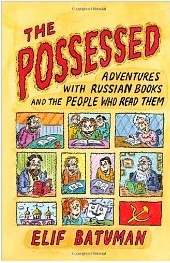
Cover for The PossessedMaybe not many of you would be interested in a book like The Possessed: Adventures with Russian Books and the People Who Read Them by Elif Batuman, but as a previous student of Russian and also a previous literature graduate student, I found it very funny.

Batuman has written a book about her years as a graduate student of Russian language and literature that skewers many things, but particularly academic conferences with their absurd presentation topics and academic thinking, with the oblique reasoning process that sometimes accompanies it. For example, on the way to a conference on Tolstoy’s estate, Batuman loses her luggage and is forced to dress in flip-flops, sweatpants, and a flannel shirt. Some of the scholars attending the conference assume she is a Tolstoyan and that she has taken a vow to walk around in sandals and a peasant shirt for days. When she calls a Russian clerk to find out about her luggage, the clerk replies, “Are you familiar with our Russian phrase resignation of the soul?”

While relating her adventures in studying, travelling in Russia, and living in Turkey, where she went because her grant was too small for her to afford a stay in Russia, Batuman muses on ideas from literature and compares the lives of the people she meets with the adventures of characters in Tolstoy, Dostoevsky, and Chekhov. Her observations are colored with her own peculiar view of life, which poses that “the riddle of human behavior and the nature of love appear bound up with Russian.” In Turkey, when she is challenged by scholars to study Turkish literature, particularly because of her Turkish heritage, she concludes that no one reads it, even the Turks.

Batuman expanded articles she wrote for Harper’s and The New Yorker into this book, which is named after one of Doestoevsky’s more enigmatic novels. Although her musings are occasionally a trifle too erudite for me to follow (and perhaps my memories of Russian literature too rusty), I found the book amusing and couldn’t put it down.

Day 38: The Winter Palace

Cover for The Winter PalaceBest Book of Week 8!

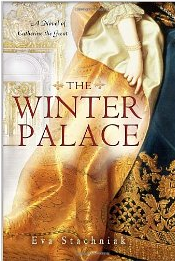
The Winter Palace by Eva Stachniak is an excellent, absorbing historical novel that captures the rise of Catherine the Great.

Barbara (Varvara) Nikoleyeva is the daughter of a Polish bookbinder who takes his family to St. Petersburg hoping for opportunity. It is the years of the reign of Empress Elizabeth, the daugher of Peter the Great, who has wrested the empire from her nephew, the rightful heir, Ivan, and placed him in prison. Years ago, Varvara’s father had bound a badly damaged book owned by Elizabeth, and Varvara’s mother, an artistocrat who has married beneath her, urges him to draw himself to the Empress’s attention. The family’s move is a success until both Varvara’s parents die, and as a young woman she begs a place at court from Elizabeth.

The court is full of secret passages and peepholes. Nothing is private, and many people are paid to listen, poke through others’ belongings, and inform. Varvara finds herself employed as a spy, or nose, for the Chancellor Bestuchev. She does not wish for this position but finds it a way to keep favor, as in the volatile atmosphere of the court, one needs to keep in with the right people. Even the position of princes and princesses can be precarious, and Varvara has no social status.

Varvara is new to court when the Empress imports Sophia Anhalt-Zerst to consider her as a possible bride for her heir, the childish Peter Fyodorovich. Varvara’s sympathies are caught immediately as she watches Sophia navigate the treacherous shoals of the temperamental Empress, Sophia’s own selfish and conniving mother, and the foolish Peter. Despite her mother’s plotting, which almost gets her thrown out of the country, Sophia converts to Russian orthodoxy, taking the name of Catherine, and eventually marries Peter.

Varbara becomes close to Catherine and supports her even as she is ignored and then cruelly treated by her husband and loses her status with the Empress and the court when, because of Peter’s impotence, she fails to conceive.

The life of the Russian court is vividly depicted in this enthralling novel, where Catherine’s rise to power is paralleled by the building of the magnificent Winter Palace.

Day 33: The Great Game: On Secret Service in High Asia

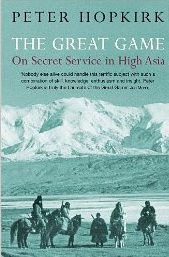
cover for The Great GameThe Great Game by Peter Hopkirk details the history of the 19th century shadow war for supremacy in Central Asia–that is, the spying, territory-grabbing, and general skullduggery accompanying the land grab of the Central Asian states and countries by Tsarist Russia and Victorian Great Britain. A great deal of the activity was centered around Afghanistan, which provides a lot of background about why the situation is so messed up today.

Investigations (exploring and snooping) were first begun in the area because of the British occupation of India. The greatest fear of the British occupiers was that the Russians would come swooping down on them through the Khyber Pass to take away what they had gained in India. So they sent small groups of men into the forbidding, wild regions to investigate the terrain, establish outposts, and try to make pacts with local war lords, khans, and other rulers.

This history is written by a Brit, so the Russians are the tacit bad guys. However, it would seem that often the Russians were more reliable partners to these states and countries than the British, who consistently let down their allies by doing nothing when the Russians invaded their territories. For their part, the Russians seemed often to be more brutal, but not always.

The book contains the enthralling stories of many young officers and civilians who took on dangerous missions into unknown, very wild territory with little or no backup from the British government, some of them simply to explore the areas but others to actively spy. Often these young men received no thanks from the British government for their efforts.

Note that a different edition of this same book is called The Great Game: The Struggle for Empire in Central Asia. I believe these are both the same book but that On Secret Service has been updated, taking into consideration recent events. I am not exactly sure which one I read because my edition was a special one from the Folio Society (just called The Great Game), but was published around the same time as the more recent book.