Day 473: The Immortal Life of Henrietta Lacks

Cover for The Immortal Life of Henrietta LacksIn 1951 an African-American woman died of cervical cancer in the colored ward of Johns Hopkins, founded as a hospital for the poor. Her doctors had routinely removed cells from her unusually virulent cancer. The cancer was fast acting and when the woman died, her body was riddled with tumors. Her name was Henrietta Lacks, and her cells have been used ever since for research and experimentation, resulting in many medical breakthroughs.

At that time, scientists had been trying to find a way to preserve cells, but all their attempts failed. None of the cells lived more than a few days. At Johns Hopkins the staff used their usual method of attempted preservation for Henrietta’s cells with little hope of success. Henrietta’s healthy cells died like the others, but not only did the cancerous cells survive, they reproduced dramatically.

Henrietta’s cells helped solve a fundamental problem in biological and medical research, that of having a supply of human cells readily available for use in various experimental studies. George Gey, the head of the department, immediately began shipping them to any scientist who needed them. Henrietta’s cells, called HeLa, are known and used throughout the world.

In the meantime, the Lacks family was completely unaware that Henrietta’s cells were in use. An impoverished family of little education, they had difficulty understanding the use the cells were put to when they did learn about them, which wasn’t until 1973. Even at that time, researchers at Johns Hopkins took further samples from the family without their informed consent. Deborah Lacks, Henrietta’s daughter, understood them to be performing a test for cancer, not medically available at the time. Even though the removal of Henrietta’s cells was commonplace in the 1950’s and did not break any medical code of ethics, at the later time that further samples were taken from the family, this was certainly not the case.

In clear prose, Rebecca Skloot tells the story of Henrietta Lacks’ cells and their uses in the biomedical industry but also the story that has hitherto been neglected, that of Henrietta herself and her family. The book brings up issues of racial discrimination, medical ethics, and other issues in biomedical research, such as cell contamination. It also affectingly tells the story of the Lacks family.

Day 449: The Signature of All Things

Cover for The Signature of All ThingsBest Book of the Week!

I was not really eager to read Elizabeth Gilbert’s memoir Eat, Pray, Love a few years ago for my book club, especially the pray part. But I discovered writing that was comic and intelligent and a story that was much more interesting than I expected.

In The Signature of All Things, Gilbert turns to fiction to tell the story of the life of a remarkable woman. Alma Whittaker is the daughter of a man born in poverty, the son of a frutier for Kew Gardens. Determined to become a wealthy gentleman, Henry Whittaker as a boy steals cuttings from the gardens to sell, and after he is caught, is dispatched by Sir Joseph Banks to gather plants on several voyages of discovery, including Captain Cook’s last.

Eventually, Henry breaks from Banks to start a pharmaceutical industry in Philadelphia. He marries a Dutch wife from a family of botanists and builds a series of greenhouses filled with plants from around the world.

Alma spends her childhood roaming the woods around her house and becomes a brilliant botanist but an unattractive girl and woman, tall and ungainly. She is much better with plants than with people, and when her mother Beatrix decides to adopt the beautiful orphaned daughter of a local prostitute, Alma is never able to develop a sisterly feeling for Prudence.

Although Alma spends much of her life there on her father’s estate, it is nonetheless an exceptional one, as she develops her own professional reputation, and eventually she ends up traveling farther than she ever expected she might. Gilbert takes time with her—time to develop her into a complex personality.

The course of her life takes a fateful turn when she encounters Ambrose Pike, an artist who has been living in South America and has painted the most beautiful pictures of orchids she has ever seen. Ambrose is of a spiritual turn of mind. He believes in the “signature of all things,” an old idea that god has left his imprint on everything on earth so that man will know its use. Although Alma, as a scientist, understands the fallacies in this notion, she finds she loves the man. But he has ideas about the pursuit of human perfection that she doesn’t comprehend.

This novel is beautifully written, completely different from Gilbert’s first book except for being a voyage through a human heart. I became fully engaged with Alma’s story. I grieved with her over her romantic disappointments and was impressed by how she snapped herself back into a productive life. This novel is an enthralling and satisfying story of an early woman scientist, about how a lonely but determined woman makes her own place in the world. Although Alma is not really a lovable person, Gilbert is able to make readers understand and care about her.

Day 445: Annals of the Former World: Crossing the Craton

Cover for Annals of the Former WorldIn the final short book of Annals of the Former World, John McPhee examines the craton, the flat land that lies in the central Midwest of the continental United States. If you have read my reviews of the other books, you might remember that McPhee wrote each one about a separate geologic area near I-80, along which he traveled with different geologists telling the story of the formation of the country. Each of those four books was published separately, but Crossing the Craton was added when the complete volume was published, perhaps for completeness. (I think it was published separately at a later time.)

Because there are few outcroppings in the Midwest, little can be seen of the rock underlying this area, a thin veneer over the basement rock that comprises 90% of geologic time.  McPhee explains that until very recently this basement, or Precambrian, rock was neglected in geology texts. Because Precambrian rock by definition has no carbon in it from living things, carbon dating was not available. Nothing was known about the rock.  For a long time it was thought to have been there since the creation of the earth, but that idea has been found to be incorrect.

Just in the last 40 years or so, new kinds of dating methods and other technological advances have allowed geologists more insight into what is going on beneath the surface in these older rocks. Gravity maps have revealed a huge tectonic rift, for example, that runs from eastern Nebraska through Iowa, Minnesota, and Wisconsin and under Lake Superior, where it joins one rift shooting north into Canada and another running right through Michigan. This three-pronged rift is similar to the one that runs down the Red Sea to meet the rift in the Gulf of Aden and the East African Rift, only that one is much younger.

In this book McPhee explains how the Canadian Shield and the central portion of North America were mostly likely created. He also looks at recent technologies such as zircon dating and aeromagnetic mapping, and speculates on the discoveries about the basement rock that could emerge in the future.

Although this is the shortest book in the volume, more the length of an essay, its emphasis on technology makes the subject matter of lesser interest to me than that of the previous books.

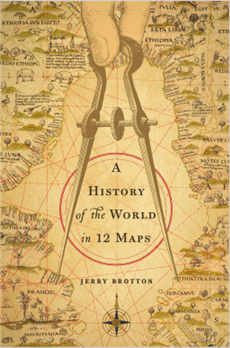
Day 437: A History of the World in 12 Maps

Cover for A History of the World in 12 MapsA History of the World in 12 Maps is an interesting look at the evolution of efforts to map the world, showing how each map is a reflection of the outlook of the culture that made it. The book is written by Jerry Brotton, a professor of Renaissance Studies at Queen Mary University and an expert in cartography.

Brotton begins by showing us a Babylonian map from the fifth century BC. Although crude and hardly recognizable to the modern eye as a map, it locates the major towns in this “known world” and the rivers. It places Babylon, divided by the Euphrates, in the direct center of the map. Clearly, Babylon was the center of the universe, or at least of the world.

Brotton takes us linearly through time, showing us such examples as the first world map using a projection, as described by Ptolemy; the Hereford Mappa Mundi from the 14th century, which places Jerusalem at the center of the world and locates the principal stories of the Bible; the Cassini maps, an attempt of the Age of Enlightenment to exactly map the entirety of France; and on to the ramifications of Google Earth. He discusses different types of map projections and why mapping an ovoid Earth on a flat surface will always involve distortions.

http://www.netgalley.comThis book is a serious effort rather than popular science, well documented and scholarly, but it is written in a clear and cogent style that should appeal to any reader, including interesting details about the different cartographers’ lives and work. The illustrations are beautiful, and the ideas thought-provoking. Brotton’s main point is that it will never be possible to create a world map that is completely accurate and unfreighted with the assumptions and attitudes of the people who created it.

Day 428: Annals of the Former World: Assembling California

Cover for Annals of the Former WorldAssembling California is the fourth volume of McPhee’s massive book about the geologic structure of the country. It dwells mostly on how the ideas of plate tectonics by themselves do not explain the geology of California.

As explained in my reviews of the previous volumes, McPhee spent years traveling along I-80 in the company of different geologists with the aim of describing the geologic formation of the country. In this volume, McPhee continues his travels along I-80, this time with geologist Eldridge Moores. They begin a series of journeys at the eastern border of California near Donner Pass, crossing to the Oakland/San Francisco area.

McPhee introduces the concept of the ophiolitic sequence, a sequence of rock strata that has been found to originate from ocean floor crusts. These crusts were ripped from the floor and mashed upward when an island arc, like that of Japan, collided with the western coast of the continent. Thus the ophiolites, which are the oldest rock, end up on top of mountains. The theory is that three such island arcs joined with the continent over the ages to form California.

McPhee also travels with Moores to Cyprus and Macedonia, two areas with similar rock. He introduces some other structures that are not completely explained by plate tectonics, such as the whole of Southeast Asia, which appears to be a part of the continent that was pushed sideways by the impact of India smashing into Asia and creating the Himalayas.

McPhee finishes this book with a dissection of the 1989 earthquake in San Francisco-Oakland (which occurred after his initial visits). He returns to examine the damage and explain how the shockwave spread and why some areas were more damaged than others.

As in the other volumes, McPhee imparts a great many concepts and theories in clear and interesting prose. This series of books (or the larger volume) makes for reading that can be a little difficult to grasp, as plates and continents seem to whirl and gyrate all over the earth (only, of course, very slowly), but it is nonetheless fascinating.

Day 417: Annals of the Former World: Rising from the Plains

Cover for Annals of the Former WorldRising from the Plains was my favorite book of Annals of the Former World. In this third book of the series (or third section of the complete book), John McPhee examines the geology of Wyoming along I-80 and makes a side trip to Jackson Hole.

McPhee travels with geologist David Love, and he enlivens the geological discussion with a discursion on the settling of Wyoming, particularly with the history of Love’s own family. He begins with Love’s mother, Ethel Waxham, a Wellesley graduate who arrived in the wintery landscape by stage to take up work as a schoolteacher. Waxham kept absorbing journals that describe the harsh conditions as well as the striking characters she encountered. Waxham was courted and won by a rancher, John Love, a nephew of John Muir, the great writer and naturalist. McPhee has tales to tell of Love’s adventures, including his acquaintance with Robert Leroy Parker and Harry Longabaugh (Butch Cassidy and the Sundance Kid).

This book continues to explore questions raised by too comprehensive an application of the theory of plate tectonics. It introduces the concepts of hot spots and plumes and their involvement in the formation of structures.

The book delves deeper into the story of the discovery of oil shales and uranium in the area. It touches on issues of ecology and preservation of natural areas.

Of all the parts of Annals, Rising from the Plains is the widest in scope. McPhee has a talent for making his subjects understandable and readable–and very interesting.

Day 406: Annals of the Former World: In Suspect Terrain

Cover for Annals of the Former WorldIn the second book of Annals of the Former World, John McPhee returns east to examine the geology of the Appalachians along I-80. Beginning with the Delaware Water Gap, he travels along the highway with geologist Anita Harris exploring the road cuts to see what can be determined about how the landscape developed. The two continue on this route through Pennsylvania and into Ohio, where they explore Kelley’s Island, travel along the Cuyahoga River for a spell, and end at the Indiana Dunes.

Having explained the basics of plate tectonics in Basin and Range, McPhee now travels with a geologist who is skeptical of the broad application the theory has found, particularly in relation to the Appalachians. Harris takes issue with the idea that the mountains were formed by the ramming of the African coast up against North America. She believes that a study of the rocks does not support this concept.

In Suspect Terrain is deeply concerned with glaciation. As well as explaining how glaciers could have formed this area of folded and complex geology, McPhee breaks off to expatiate on how the theory of the Ice Age came about, among other geological ideas. He also tells how Harris herself figured out how to use the color of conodonts, a kind of fossil, to make it easier to find the conditions for oil.

I find it fascinating to try to imagine the pictures of the earth that McPhee describes, how different they are from the continent as it is today. McPhee tells us how rivers ran to the west instead of to the east, huge tropical seas took up the middle of the continent, the glaciers shoved rock down from Canada to create places like Staten Island.

McPhee is an extremely interesting writer. To be sure, the subject matter, the ideas it evokes, and the language he uses demand full attention, but this series of books is involving.

Day 400: Annals of the Former World: Basin and Range

Cover for Annals of the Former WorldBest Book of the Week!

Beginning in 1978, John McPhee began a series of journeys across the United States along the length of I-80. His goal was to form a picture of how the geology of the country evolved over time. This project proved to be so large that he ended up breaking it into chunks, publishing four books that he finally combined into one (with an extra section). Basin and Range is the first book of Annals of the Former World, the combined volume, for which McPhee won the Pulitzer. Although I am reading the large volume, I have decided to break up my review by the original works, as reading this book has involved a lot of concentration.

Although the book begins with the genesis of the idea during an outing McPhee took with a geologist in New Jersey and briefly covers other areas of the world, Basin and Range concentrates on the Basin and Range area of western Utah and eastern Nevada. McPhee is a journalist who majored in English, but his interests lead him to take courses in geology, among other sciences. To supplement his basic knowledge and interests, he traveled with and interviewed noted geologists.

Basin and Range discusses changes in basic geological theory from the 17th century, providing readers with a primer on plate tectonics by using examples of various structures in the Basin and Range. In the course of these discussions, McPhee expatiates on some of the larger debates in the history of the science and tells us about some of the more colorful characters. All the while, he conveys his fascination with geology and his appreciation of language. He finds inventive ways of suggesting the vastness of the time he is discussing and the relative rapidity with which major geological forces can create change.

I have an interest in geology that is only basically informed, mostly from a couple of classes, science TV programs, and a former job in a related industry. I always considered myself a dunce at science and so never followed up this interest seriously. McPhee throws around geology terms without always explaining them, so I found myself looking up terms like “oolite” and “craton,” but in general he is gifted with the ability to make this topic abundantly clear. Although I was not sure at the beginning of the book that I would read all the parts, I am certainly planning on continuing. I am finding it fascinating to try to imagine the changes in the Earth that he describes.

Day 71: Thinking, Fast and Slow

Cover for Thinking, Fast and SlowEarly in his career, Daniel Kahneman got interesting in why people, even experts, do not seem to use statistics and follow economic models in making decisions and judgments. His research with his main collaborator Amos Tversky eventually ended in his winning the 2002 Nobel prize in economic science, which is unusual because he is a psychologist. Thinking, Fast and Slow explains the results of years of studies on understanding how the human brain makes decisions and judgments. His major theme in this extremely interesting, well-written book is human irrationality. His work with Tversky, he says, “challenges the idea that people are generally rational.”

For better understanding of the ideas explained in the book, Kahneman begins with the analogy that there are two systems employed in decision making: the fast-thinking, intuitive, unconscious system that keeps us safe and handles our day-to-day actions but is prone to error, and the deliberative system that reasons through more informed decisions but is lazy and has to be actively engaged.

Kahneman shows the evidence from experiments that many more of our decisions are controlled by our unconscious than by conscious decision-making, and therefore, we do not always make decisions the way that economic models have assumed. He makes his points using fairly simple experiments that you can try yourself, so that you recognize the faulty assumptions and cognitive biases underlying your own reasoning. In examining these experiments, he shows their profound implications. The result is an entertaining book full of intellectual surprises that was chosen as one of the New York Times Best Books for 2011.

Although Kahneman provides some ways of recognizing patterns that can result in bad decisions, he cautions that it may be impossible to teach yourself to always avoid these pitfalls and says that he is unable to do it consistently himself. He reminds us that all of us tend to have an exaggerated sense of our understanding of the world and shows that much more of what happens is random than we acknowledge or understand.