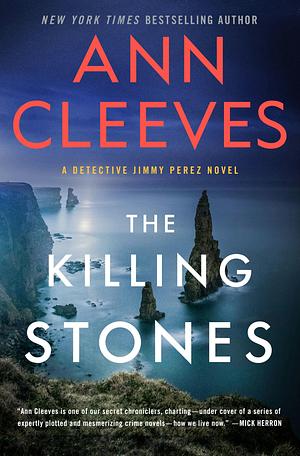
Review 2662: The Killing Stones

Ann Cleeves retired the Jimmy Perez series a while back, so I was delighted to hear she had brought him back. He has moved from the Shetland Islands to the Orkneys—with a milder climate and more pastoral scenery—and lives with his partner and boss, Willow, and their three-year-old son, James. Oh, and it’s the Christmas season. What better time for a mystery than Christmas?

Willow is away from their home on the mainland island when Jimmy gets an urgent call to Westray Island. His good friend Archie Stout, whom he was raised with, is missing. Archie’s wife Vaila says he was on his way to meet pals at the pub but never got there, a concern with Jimmy as there was a big storm that night. Jimmy finds Archie at an old archaeological dig, where his head has been mashed by one of the Westray story stones—two Neolithic stones with Viking inscriptions that Archie’s father helped discover and interpret. Unfortunately, because of the storm, evidence is thin.

Willow takes Jimmy off the lead because he’s too close to the victim and leads the case herself, even though she is on maternity leave and a few weeks out from having their baby. Jimmy returns home to follow up leads on the mainland. They find that Archie was upset because, since his father Magnus’s death, he has found his notebooks showing that Magnus, a self-educated farmer, did most of the work on the Westray stones even though Tony Johnson, a professor who visited occasionally, had taken all the credit, a discovery which launched Tony’s career. Tony and his wife were on the island the day of the murder. But there are other leads, including Archie’s possible affair with his wife’s ex-friend Rosalie Gruman.

Jimmy, following up on the mainland with anyone who had been on Westray the night Archie was killed, has been trying to talk to George Riley, a schoolteacher. But before he can meet him, George is also found dead, killed with the second stone. Jimmy finds out that George was writing a children’s book about the discovery of the stones that alleges Johnson stole Magnus Stout’s work.

If I have any criticism of this book, which moves right along and is certainly perplexing, it’s that Cleeves provides almost no information that could lead readers to the killer until the very end. However, she does a great job at misdirection. I’m not really sure what I think of Willow, who does a lot of the investigating in this one. She appeared in several previous books, but I still don’t have much sense of her.

Related Posts

Wild Fire

Cold Earth

Too Good to Be True

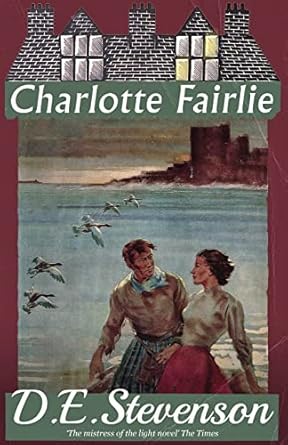
Review 2661: Dean Street December! Charlotte Fairlie

When Charlotte Fairlie was a girl her relationship with her widowed father was close. Then he met someone, and she seemed to be nice, but as soon as they were married, she became jealous of Charlotte. In the end, he sent Charlotte to his brother, and she never saw him again. (Oddly, she reflects later that it was the only thing he could do, but I think not.)

Now Charlotte has achieved her goal since she was in school. She has been appointed head of St. Elizabeth’s, her old school. She is young for such a position but has been wearing a stodgy hat to board meetings to disguise that fact. The only thorn in her side is Miss Pinkerton, who thinks she should have had the position and is a real troublemaker.

A new girl starts at the school, Tessa MacRyne. She is an unusual child, self-possessed but homesick for her island home in Western Scotland. Charlotte catches her running away one day and learns that a letter from her mother has informed her that her parents are divorcing and her mother has returned to her parents in the U. S. Tessa feels she must return home to comfort her father. Charlotte’s handling of the situation earns her Tessa’s affection and an invitation to the island of Targ during summer break.

A friendship begins between Charlotte and Lawrence Swayne, the headmaster of the boys’ school. Unexpectedly, her proposes marriage to her, thinking they would make a great partnership.

I found this novel to be deeply touching and involving. I generally think of Stevenson’s books as very light romance, but I felt this book was a little deeper.

Related Posts

Music in the Hills

Winter and Rough Weather

Kate Hardy

Review 2658: Rum Affair

The famous coloratura opera singer Tina Rossi has made a rendezvous with her lover, Kenneth Holmes, at the flat of one of his friends. When she arrives, though, Kenneth is not there, but a body is in the wardrobe. She has just discovered it when Johnson Johnson, the famous portrait painter, arrives with two policemen, saying there’d been a complaint. Reader of this series know that Johnson is a lot more than an artist. (Although I guess they don’t know at this point.)

Tina puts them off, but after they go outside, a man with a gold tooth bursts out of the wardrobe. Tina screams, but they miss him and he escapes.

Tina is now afraid for Kenneth, but acknowledging the affair could destroy her career. She decides to go to the island of Rum, where his laboratory is located. But she must do it without anyone suspecting, especially her agent, Michael Twiss, who has been trying to keep them apart. Later, she hears that Kenneth is suspected in the explosion aboard a nuclear submarine that was developed under his management. That makes her more eager to get to Rum.

Luckily, Johnson offers to paint her portrait if she will join him for a yacht race in Western Scotland that ends near Rum. Shortly after they leave, it becomes clear that someone is trying to kill Tina.

Dunnett’s Dolly series (Dolly is the name of the yacht) poses as mysteries but the books are really adventure novels with espionage at their core. They are fast moving with entertaining dialogue. All of them are narrated by a different woman, vividly drawn. The 60s yachting life seems to be pretty wild. These books make entertaining reads, even though it is generally impossible to guess what’s going on.

These books have not been republished in order, and I have not been reading them in order. This one, original name Dolly and the Singing Bird, was actually the first one in the series.

Related Posts

Ibiza Surprise

Tropical Issue

The Scottish Highlands

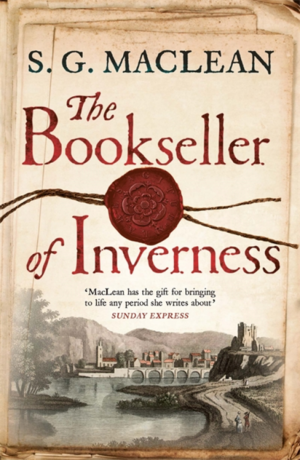
Review 2635: #RIPXX: The Bookseller of Inverness

Iain MacGillivray was badly injured at Culloden and shipped off to work in indentured servitude in the Americas. In 1752, six years later, he is back and running a bookshop in Inverness. The town is full of British soldiers.

One evening he sees a grubby man who looks vaguely familiar looking through some books that came from Lord Lovat’s estate. It’s closing time, so he forces him out.

Iain hasn’t seen his father, Hector MacGillivray, for years. Hector has been serving King James in France and Italy. He is proscribed, but Iain has believed his father is dead. Now he finds he is in town.

Hector is searching for a book that has been rumored to exist, one that contains a list of traitors to the Jacobite cause. King James is planning another attempt to take back the throne from the Hanoverian king, and they want to make sure they know it’s not going to be betrayed.

By looking through the remaining books from Lord Lovat, they figure out which book it was. Hearing that there is a copy, Iain goes to Lovat’s castle, now occupied by British soldiers, on the pretext of buying some of the books. There he has an unpleasant encounter with the cruel Captain Dunne, who burns part of the book, but Iain is able to get away with the rest.

Hector starts trying to decode the text for names, but before he figures out each of six names, that person is murdered. The killer could be someone getting revenge, or it could be a traitor trying to cover his back.

I found this to be an interesting, fast-moving adventure that seems well researched and steeped in its time. I enjoyed it quite a bit.

Related Posts

Kidnapped

Corrag

Waverley

Review 2606: The Episode at Toledo

I have read two books before by Ann Bridge, and although the second was more action-oriented, they were both about women discovering themselves. When I looked for another book by Bridge, I wasn’t aware that she had a series of books around the character of Julia Probyn. This is one of them, about the sixth or seventh in the series, but Julia is a fairly minor character.

Although not necessary, it might have helped me to have read the series in order. I say this mostly because of the beginning and ending of this book, where Julia is ensconced in Scotland among a throng of characters who are briefly introduced but who I couldn’t keep straight.

Julia receives a guarded letter from her Hungarian friend, Hetty, who has married Richard Atherley, British Counsellor in Madrid. Hetta has asked that Julia send either her husband or another friend in Intelligence out to Madrid but doesn’t explain why. However, her friends speculate that it might have to do with a visiting admiral from the U. S. Understand that this is definitely a Cold War novel, and that in an earlier novel Hetta was kidnapped and drugged by Hungarian Communists.

Hetta is worried because she thinks she has recognized the American ambassador’s chauffeur as a Hungarian Communist who years ago closed down the Catholic school that Hetta attended and took delight in harassing the nuns. However, when Hetta’s friends check into it, they find he has been vetted by American security, so they dismiss her fears.

Of course, he is a bad guy, so Hetta does her best to keep the American admiral out of the ambassador’s car. On a tour to Toledo, Hetta suffers a broken arm after she delays the car, which has an accident trying to get to a rendezvous in time to be blown up.

After that, Hetta’s husband arranges for her to go to Portugal to stay with friends, as she is pregnant. But danger follows her.

For a suspense novel, there is a lot more inactivity than activity. Somehow the balance wasn’t right. There is also a lot of repetition as one group after another discusses the same incidents. Frankly, the last 20 pages or so, in which Hetta’s husband arranges for her to return to Scotland and she does, seem to have no relevance except to return to Julia and her confusing pack of relatives and friends. I would estimate that 50-75 pages of this novel are unnecessary.

Was Bridge tired of writing this series? She seems to have been trying to replicate the kind of books Mary Stewart wrote, combining suspense with lovely descriptions of the country. But Stewart did it better. This book also reminds me of the Cold War books of Helen MacInnes, only they have more romance.

To really evaluate this series, I think I would have to start with the first one, which I plan to do. In the meantime, I prefer her other books.

Related Posts

Illyrian Spring

A Place to Stand

Station Wagon in Spain

Review 2594: Clear

I have read some excellent novellas lately, a form I don’t usually choose. That makes me glad I participated in Novellas in November last year. I think I read about this book during that event.

John Ferguson is a 19th century Scottish minister on a difficult mission. Because of the breakup of the Scottish church, in which he participated, he has left his church to join the Free Church and is thus unemployed, no new churches having actually been established. He and his wife are entirely without money, and he doesn’t want to borrow from his brother-in-law, so he takes a job of surveying a small island in the far north of Scotland for clearance. The island only has one inhabitant, who will be forced to leave, and part of John’s job is to tell him.

On the island, Ivar has been alone for many years. The rest of his family left years before, because the island couldn’t support them anymore after foolish decisions by the owner. Ivar thought it could support him, and the factor hasn’t even stopped by to collect rent in years. He lives with a goat, an old horse, a blind cow, and some chickens.

When John arrives, he promptly falls off a cliff and is badly injured. Ivar finds him and takes care of him. They don’t speak a word of each other’s language, but they begin to like each other. John, though, can’t bring himself to try to explain why he’s there.

In the meantime, Mary hears about other clearances being done by John’s employer that disturb her. She decides to go get John.

This is a little gem of a book with a surprising ending. In its few pages, it pulls you totally into the story. It’s a keeper.

Related Posts

Island

The Sea House

The House Between Tides

Review 2575: Lanark

I was going to start my review of Lanark, considered by many to be a landmark of literature, by saying it has nothing to offer women. Its female characters are either cardboard creatures or sex objects or both. Its male protagonist fantasizes as a boy about raping girls. Its cover, with drawings by Gray, has a total of six naked women and one clothed man. (The rest of the figures are heads.) I was going to start with this (in fact, I have) until I came across a review in The Guardian from 2019 by Sarah Detum that calls it superb and talks about how clearly it sees how men regard women. But was it looking at that or exhibiting it? I’m not sure. And I don’t think that was Gray’s purpose. And I hope Detum isn’t right, because if so, it’s a depressing thought for most women.

The novel is broken into four parts and starts with Part 3. Then it breaks off into an apparently unrelated (but it isn’t) story, Parts 1 and 2, before returning to the original story in Part 4.

The novel begins in a city that has no sunlight. The protagonist, Lanark, is told it’s because developers have built the buildings so high up that light can only be seen for a few minutes at dawn. The city, Unthank, is an allegory for hell. Lanark can’t remember his past, and everyone else seems to spend their time hanging out in bars. Lanark can’t even get laid, despite ogling every woman he sees. What fresh hell is this?

I haven’t mentioned much of the science fiction/fantasy spin that seemed to fascinate critics in 1981, but that’s not unusual now. Of course, there’s the no-sun, but also people are developing weird diseases. Lanark begins getting dragon skin, where his skin turns black and scaly. And a woman has a mouth that talks appearing on her arm. I have to confess that this stuff seemed childish to me or like Gray took too much LSD when he was younger.

Lanark finally decides to make an end of it and drown himself in the sea. When he wakes up, he’s in an institute in an entirely different world. There, a seer begins telling him a story, set in post-World War II Glasgow, about Duncan Thaw (Part 1!).

The two sections about Duncan follow him through boyhood to young manhood. He is a stubborn person with his own ideas about what he wants to do, so he’s always butting up against authority figures. He finally begins studying to be an artist.

None of the sci-fi/fantasy elements exist in these two parts, and I found them the most readable. But Duncan is also the character with no social skills who fantasizes about raping women and never gets laid. What fresh hell is this again? (He gets a girl in the end. I can only wonder about her taste.)

Although the writing is such that I felt the novel was clipping along fairly well, it was when the book gets to Part 4 and returns to Unthank that I suddenly realized I had no interest in continuing it, in fact was dreading the return to Unthank despite knowing that most of the plot was in the last part of the book. That made me look around a bit to see if there was even one critic who agreed with me instead of gushing about what a masterpiece it was. (I was thinking maybe it was too dated.) Thank god for Jim Crowley of The New York Times, who, although largely complimentary, says, “The longer the book goes on, the more rapidly its magic leaks away,” (I didn’t think it had any) and calls its structure a Mobius strip.

Frankly, by then I was done, 200 pages from the end. Yes, it didn’t seem right to repay the effort it took to get that far by not finishing, but that’s what I did.

Lots of reviews called this novel playful, but to me it seemed distasteful and heavy. As for any magic it may have, that was overwhelmed for me by its misogyny.

Related Posts

The Fishermen

Snow Country

The Man in the High Castle

Review 2553: September

I think Rosamunde Pilcher is considered a romance novelist. Judging from this book, though, I wouldn’t call her that. Although there are some romantic situations in it, this book, in its focus on family and the beauties of Scotland, reminds me more of something by Molly Clavering’s or D. E. Stevenson’s family-oriented novels, although much more recently written.

The novel is about two families in small-town Scotland and particularly what happens when a neighbor decides to hold a ball for her daughter in September.

Violet Aird is a mother and grandmother. Her son Edmund is a businessman who spends a lot of time traveling. His daughter Alexa is a shy young woman living in a house she inherited from her other grandmother in London. His second wife, Virginia, is an American who loves being home and taking care of their eight-year-old son, Henry.

The other family is the Balmerinos. Archie Balmerino is the local laird, and although he owns a lot of land, the family isn’t as prosperous as it was, especially since Archie lost a leg in Northern Ireland. His wife Isobel has arranged to take paying guests in the summer as a result. Archie’s sister Pandora ran off with a married man when she was 18 and hasn’t returned. Archie and Isobel have children, twelve-year-old Hamish and much older Lucille, who has been living in Europe.

Lucille is traveling around Europe with her Australian friend, Jeff, when she decides to go to Majorca to visit her Aunt Pandora, whom she has never met. Pandora is beautiful, rich, and generous. Lucille hadn’t been planning to return home for the ball, but Pandora decides they should all drive back together for the party.

Trouble is brewing between Edmund and Virginia, because Edmund has signed Henry up to go to boarding school in the fall without consulting Virginia. When Virginia objects that he is too young, Edmund thinks she is babying Henry and is coldly insistent. About then, she meets a man Alexa has invited home, who turns out to be an old friend.

Alexa herself has become involved with a man for the first time. He is Noel Keeling, up to now a lady’s man who usually dates women a lot more attractive than Alexa.

I said this novel isn’t exactly a romance, but it unfortunately employs some romance conventions. One is to describe almost everything everyone wears. The other is to describe almost every room people enter. Pilcher also tells us the contents of almost every meal, no matter how commonplace. In fact, I found the book to be about two hundred pages longer than it needed to be.

Another issue I had with it was that although it was published in 1990 and gave no clear indication of its time setting, it seemed so horribly out of date for then that I wondered if it wasn’t an old manuscript that had been set aside until the success of The Shell Seekers. One example is that the American Virginia spots an American across a room and wonders why you can always tell an American. He doesn’t even wear a crew cut. What? I haven’t seen a crew cut on anyone except the military since about 1961!

And then there is Archie with his false leg made out of either tin or aluminum. In the 1970s-90s, legs were being made out of such things as polymers, and I think I can safely say that no one has ever made an artificial leg out of tin or aluminum, neither of which would support the weight. (Oh, I see now that artificial legs were made out of Duralumin, a hard, lightweight alloy of aluminum, during World War I. Well, the time setting may not be specified, but the novel is set a lot later than that, at least in the 1960s or 70s and I suspect later.)

I was interested enough in the story to finish it, even though Pandora’s big secret was pretty obvious from near the beginning of the book, but thought the novel was only a middling effort.

Related Posts

Because of Sam

Love Comes Home

Family Roundabout

Review 2525: The Camomile

As Simon Thomas points out in the Afterword, The Camomile is a novel that “sets out to be distinct from the ‘marriage plot’.” This although its heroine, who says she strains for Reality, thinks sometimes that marriage is a way to achieve it.

That heroine is Ellen Carstairs, who has just returned to Glasgow after four years in Germany studying music. She knows herself not to be a prodigy, but she begins giving music lessons to contribute to the household, that of her religious Aunt Henry and her brother Ronald, an architecture student.

Apparently, Ellen’s mother wasted a lot of money publishing her writings, to the point where it seems to be considered a mental disease, so Aunt Henry dreads the possibility that Ellen may be writing. Yet, that’s exactly what she begins doing. She gets herself a room where she can practice the piano undisturbed, but she also spends a lot of time at a library, where she meets an impoverished scholar she calls Don John, who helps her with her writing.

The novel, which is related in letters to her friend Ruby and in diary entries, deals with fairly innocuous social engagements, but Ellen spends a lot of time pondering ideas and trying to understand people’s relationships with each other. First, there is the marriage of Laura, one of Ellen’s friends, who doesn’t seem to love her fiancé at all, while being determined that people think she does. Ellen herself doesn’t mind not being married but on the other hand seems to accept that it is a goal of a kind, a way to achieve Reality.

Ellen pretty much dissects every idea she comes across, and after a while, I felt it was too much, especially after she herself (spoiler!) becomes engaged. However, over all I found the novel engaging with Ellen a lively heroine.

Related Posts

The Fountain Overflows

The Pumpkin Eater

O, The Brave Music

Review 2499: Novellas in November! Highland Fling

I read Highland Fling to fill a hole in my Century of Books project but found it also qualifies for Novellas in November!

The novel begins with Albert Gates, who almost on a whim, moves to Paris to become a painter. There, he at least seems serious about it and actually arranges a showing at a gallery in London before returning home to arrange his show.

Now the point of view shifts to that of Jane Dacre. She has been spending time with her married friends, Walter and Sally Monteath, who are having difficulty living on their incomes, Walter, a poet, apparently being unable to hold a job. The Monteaths are asked to travel to Scotland to host a house party at Dulloch Castle, Lord and Lady Craigdulloch having been called out of the country. They are not excited about it but agree thinking it will be a good way to save money. They invite Jane and Albert.

The rest is a no-holds-barred satire of country house parties, sporting people, Scottish customs, and surprisingly, the young people themselves. In Scotland, Albert comes off as an intellectual snob, his remarks rude and his likings absurd, his outfits unsuitable and ridiculous. (He reminded me of an obnoxious artist character in Angela Thirkell’s series, but try as I might, I cannot figure out which book he appears in. If anyone knows who I’m talking about, please tell me.)

Nevertheless, Jane falls in love with him and everything he says is wonderful. This plot point may be explained because Mitford herself fell in love with a young man on a similar Scottish visit, and they eventually split, possibly because he was gay.

This novel seemed a lot less polished than Mitford’s later ones, but it is her first. The caricatures are very broad, and the supposedly bright banter seemed puerile. However, there are some funny moments here, the description of Albert’s art being one of them.

Related Posts

The Pursuit of Love

Love in a Cold Climate

Pigeon Pie