Day 987: Murder of a Lady

Cover for Murder of a LadyMurder of a Lady is a classic locked door mystery set in a castle in Scotland next to a loch. Amateur sleuth Dr. Eustace Hailey is visiting in the area when he hears of the death of Miss Mary Gregor, whom some regard as a saint, the respected sister of Duchlan, the castle owner. She was found dead in her bedroom of a stab would, but the bedroom door was locked. No one could have entered the window, because men were fishing in the loch, and the window was in plain sight of their boats. Miss Gregor is found to have an old wound in her chest that no one admits to knowing about.

When Dr. Hailey goes to investigate, he is not welcomed by Inspector Dundas, who wants to solve the case himself. An oddity of it was that a herring scale was found on the victim, and this and the report of a splash are enough to start rumors of a selkie among the Highland servants. Dundas is able to make no headway in the case at all, though, and finally asks for Dr. Hailey’s help. But shortly after the doctor arrives, Dundas is himself murdered, in similar circumstances to the original murder, within seconds of Hailey and Dr. McDonald leaving his room.

The new policeman, Inspector Barley, is quick to decide that Miss Gregor was murdered by Oonagh, Duchlan’s son’s wife, and Dr. McGregor, whom he thinks are lovers. He and Dr. Hailey have realized that Oonagh was trapped in a horrible situation at the castle, in a rivalry with Miss Gregor, who was not as saintly as people believe. But Dr. Hailey believes that Oonagh loves her husband Eoghan and is not having an affair. And soon there is another murder.

This novel is certainly a characteristic Golden Ager, focusing most of its attention on the locked room puzzle, although some attention also goes to understanding the psychology of the people living in the house. Still, Dr. Hailey is an enigma, and the story is wrapped up so abruptly after the solution of the murder that it is startling. Still, I mildly enjoyed this novel, especially for its Highland background.
Related Posts

The Hog’s Back Mystery

Thirteen Guests

Behold, Here’s Poison

Day 980: Guy Mannering

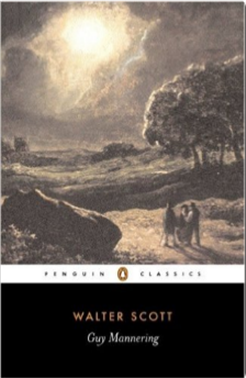
Cover for Guy ManneringGuy Mannering is the second of Sir Walter Scott’s Waverly novels, set in Scotland and featuring Scottish dialect and folklore. It is a romping adventure, with smugglers, hidden caves, a kidnapped child, a gypsy queen, a hidden identity, and murder.

The novel begins in the 1760’s with a visit by Mannering as a young man to Ellangowan, an estate on the southwest cost of Scotland. Mannering arrives there on a rambling tour in time for the birth of Harry Bertram, the son of the Laird of Ellangowan. Mannering is an amateur astrologer, and he casts the baby’s horoscope, revealing that he will encounter dangers at the ages of 5 and 21. Then Mannering disappears from the story for 21 years.

The tragedy of the household occurs when Harry is five. He disappears after being the inadvertent witness to the murder of a customs officer. The family assumes he has been murdered. His foolish father being overwrought by grief, the estate is plundered by his agent Glossin, and Bertram is bankrupted.

Mannering comes back on the scene after many years as an army officer in India. He arrives in time to witness the sale of the Bertram estate to Glossin. It cannot be saved from its debtors without a male heir, and there is only Lucy Bertram, born the day her brother disappeared. In his fury at Glossin, Bertram has a fit and dies, leaving Lucy without home or money. Since Mannering’s daughter will be joining him in a nearby manor, he offers Lucy a home.

Mannering has his own troubles with his daughter Julia. In India, he had reason to believe that a young officer, Vanbeest Brown, was courting his wife, so he challenged him to a duel and wounded him. But Brown was actually courting Mannering’s daughter, and her guardian has caught her meeting secretly with him. Mannering summons Julia to join him, but Brown soon follows.

It is when Brown arrives in the locality that the plot heats up, for he begins finding things familiar, and he meets a mysterious gypsy woman named Meg Merrilies who makes some mysterious pronouncements. Of course, it soon obvious that Brown is the long-lost heir to Ellangowan. But he has the enmity of local villains, who are afraid he can accuse them of murder and malfeasance against him, as well as circumstances that appear to convict him of a crime. Moreover, he doesn’t know who he is, and once he knows, how will he prove it?

This is an entertaining adventure novel about the wild borderlands of Scotland. It has some fine villains, upright heroes, and an amusing couple of comic characters, one being the farmer Dandy Dinmont, a terrier breeder, whose name has since been taken for a breed of terriers.

Related Posts

Waverly

The Candlemass Road

Christowell: A Dartmoor Tale

Day 972: The Scottish Highlands

Cover for The Scottish HighlandsI will frankly admit here that I am a massive Dorothy Dunnett fan, and as such, I am eager to read anything she wrote. In this case, it’s an homage to the Scottish Highlands that she wrote with her husband Alastair, illustrated by photographer David Paterson. Alastair Dunnett was a journalist, novelist, and man of many talents. Dorothy Dunnett was an internationally known historical novelist and portrait painter.

This book is beautifully written and has gorgeous photographs. It is oddly organized for this type of work, though. The photographs and the text are presented independently, even though some overlap occurs. First, there is a section of text by Dorothy Dunnett, divided into areas of the Highlands. After that, the rest of the book is divided into the same areas, with Alastair’s text followed by Paterson’s photos. No attempt has been made to integrate the two Dunnetts’ text with each other, and little attempt has been made to integrate Alastair’s text with the photos.

A contrast to this book’s approach is James Herriot’s Yorkshire, where Herriot’s text and photos about the same places appear together. It’s almost as if the editors of The Scottish Highlands were putting together three different books. Still, it does make me want to visit the Highlands. Of course, I already wanted to.

Related Posts

King Hereafter

The Game of Kings

The Disorderly Knights

Day 944: Checkmate

Cover for CheckmateBest Book of the Week!
I thought I finished reviewing Dorothy Dunnett’s Lymond Chronicles series ages ago, so it was with some surprise that I discovered I never reviewed the last book. Here it is!

* * *

In this last book of the Lymond Chronicles, Francis Crawford of Lymond has returned from Russia to France. Although I have concentrated in my previous reviews on the swashbuckling and intrigue of the novels, I have not mentioned the shadows that haunt Lymond, particularly the question of his parentage. This question was brought forward in an earlier book by the appearance of the mysterious Marthé, who looks exactly like him. These shadows have put him under tremendous pressure in the last couple of novels, culminating in horrendous migraines and even temporary blindness.

Another problem is his marriage to Philippa Somerville in a previous novel. He married her to save her reputation when they were travelling together, but both of them have since found that they are in love with the other. However, he considers his reputation and lineage to be too besmirched to keep her as his wife, so he has not told her of his feelings, and they have been trying to get an annulment. Their marriage has been in name only.

In any case, Lymond is now fighting the English for France in the Hapsburg-Valois war, a position he has taken on to hurry along his annulment from Philippa. As the wife of a Scottish nobleman, Philippa has been ordered to attend Mary Queen of Scots in France as Mary prepares for her marriage to the French Dauphin.

In trying to help Lymond find out the truth about his past, Philippa places herself in horrible danger and subsequently has a breakdown. Lymond leaves his post to care for her, and they discover their feelings for each other. But the result of her trauma is that Philippa feels unable to be more intimate with him, so Lymond eventually asks leave to go back to battle and preferably his own death.

It is much more difficult to review this final book without giving away spoilers. Suffice it to say that Lymond’s questions about the Dame of Doubtance prophecies and his own heritage are answered, there is plenty of action, and a satisfying conclusion. All the tangled knots that appeared in the previous books are untied. In any case, if you’ve been reading the series, you are already hooked, and will be unhappy, like me, to see the series end.

Related Posts

The Disorderly Knights

Pawn in Frankincense

The Ringed Castle

Day 940: Passages in the Life of Mrs. Margaret Maitland, of Sunnyside

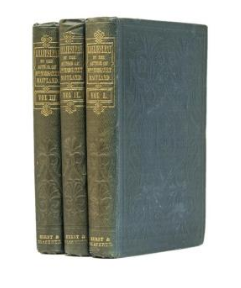
Cover for Passages in the LifeI have mentioned before that Margaret Oliphant was one of the most popular novelists of her time, but only a few of her novels are easily available except in print by demand. So, her complete works was one of the collections I selected from Delphi Classics in e-book form.

I decided to read the works in order of their appearance in the collection, and this novel is the first, published in 1849. Like the others I have read, it is a domestic novel, about events in the lives of ordinary people. It has a few light overtones of a more sensational genre, however.

Margaret Maitland is a spinster when she takes on the charge of raising a young orphan, Grace Maitland. Since her mother’s death, Grace has been in charge of an aunt, but Margaret’s friend thinks she will do better with Margaret, and Grace’s aunt has no objection. So, Margaret takes young Grace and frankly loves her at first sight. Grace lives happily at Mistress Maitland’s home of Sunnyside and spends a lot of her time with Margaret’s niece Mary and nephew Claud. Margaret’s brother Claud is a minister, and Margaret and her family are strict Scottish Presbyterians.

When Grace is a young woman, though, her aunt, Mrs. Lennox, demands that she return to live with her in Edinburgh. Grace does not have fond memories of Mrs. Lennox and does not want to go, but Margaret urges her toward obedience and hopes that things will be better for her than Grace expects. There have been rumors that Grace is an heiress, but no one at Sunnyside has put much store in them.

For some time, all we hear from Grace are her letters. Her family keeps her isolated from other people, never letting her attend events but telling others she is an invalid. When Claud, who is at school in Edinburgh, calls on her, he is first told she is not at home and later treated shamefully.

There is other drama closer to home, because Margaret’s niece Mary is being courted by Allan Elphinstone, young Lilliesleaf. His mother is looking higher for him than Mary, though, and encourages him to associate with the nearby gentry, where he gets into bad company. Mary won’t have him, therefore, and Margaret can only agree, for a similar situation in her youth brought her to her solitary state. Margaret thinks Allan can improve, though, and he sets out to try to do so. A subtitle on some editions of “Lilliesleaf” leads me to suppose that the plot about Mary and Allan was supposed to be the main story, but I was more interested in Grace’s predicament.

This is an enjoyable novel with likable characters, even though some of its attitudes seem very dated. One difficulty I had with it, though, is that it is written in Scots dialect. The narration by Mistress Maitland isn’t difficult to understand, but some of the country folk use expressions with which I am unfamiliar, so I think I missed most of the humor of the novel. In addition, this e-book was almost certainly machine read from an old manuscript and there are many mistakes, especially in words where old-style typography had ligatures, or connected letters. The combination of the dialect, which had words I didn’t understand, with the many typos made the text difficult. If you want to read this, you might try finding an old used book instead of an e-book or print on demand edition (which I assume would have the same problems).

Related Posts

The Rector and The Doctor’s Family

Salem Chapel

Waverly

Day 928: The View from Castle Rock

Cover for The View from Castle RockThe View from Castle Rock is an earlier Munro collection of short stories than Family Furnishings, which I previously reviewed. Since Family Furnishings is an anthology of Munro’s stories over the course of her career, I had already read several of the stories in The View from Castle Rock.

All of these stories have to do with the history of Munro’s family. In “No Advantages,” she has traveled to the area of Scotland where the Laidlaws came from. This story incorporates excerpts from other writings and quotes the epitaphs of some of her ancestors. It explains their hard life and the kinds of people her 18th century ancestors were.

In “The View from Castle Rock” Munro relates a family legend about how their drunken great-great-great grandfather James Laidlaw took his son Andrew up onto Castle Rock in Edinburgh to view America, probably as a joke, since they were looking at Fife. Although he talks of emigration throughout his life, he is unhappy when some of his sons finally take him and their families to America. This story is about their voyage and the fates of some of the family on board.

Other stories are more recent. “Hired Girl” is about a summer when Munro worked as a hired girl at a beach house on an island. For that summer, she had to learn that her employers did not consider her an equal. This was a tough lesson, as her mother especially had always had some pretensions of superiority even though they were poor.

In “Home” she revisits home after living away for some years. Her father has remarried after her mother’s death, and her old house has changed almost completely.

Cover for The View from Castle RockThe stories in this collection are powerful, relating the hard life of her family farming and raising fur, their close-mouthed quality, pride, and stubbornness. She is courageous in her ability to look at everything with honesty, even her own foibles.
One comment I have to make is on the cover of my Vintage International edition, shown here. It has absolutely nothing to do with the contents of the book and gives an entirely misleading idea of the stories. The only story that even faintly is about a beach is “Hired Girl,” and the girl is not exactly lying around in the sand. Sometimes I wonder what publishers are thinking. The cover that I used at top is much better.

Related Posts

Family Furnishings

Olive Kitteridge

The Empty Family


Day 923: The Road to Little Dribbling

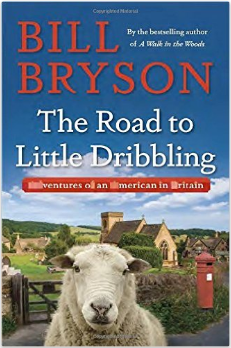
Cover for The Road to Little DribblingBest Book of the Week!
The Road to Little Dribbling is only the third book I’ve read by Bill Bryson, but it is the one I’ve most enjoyed. It is a follow-up to one of Bryson’s most popular books, Notes from a Small Island (which I have intended to read but have not), upon its 20-year anniversary. Both are about travels in Britain.

In The Road to Little Dribbling, Bryson draws an imaginary line between the two farthest points on mainland Britain and takes expeditions to some of the places on either side of the line. His line begins in a minor southern seaside town named Bognor Regis (where, oddly, I began my first visit to that country) and ends in northern Scotland at Cape Wrath.

The things that make Bryson’s books stand out are that he has many humorous observations to make and he is endlessly curious about everything. So, he has lots of stories to tell about the places he passes through, some of them personal, some historic, some scientific. He is also skillfully descriptive of beautiful scenery.

A recurring theme in the book is the impact of austerity measures on national landmarks and scenery. Also related to the economy is the growing dereliction of some of the towns he passes through. But he makes it clear that there is still much of charm and beauty to be seen and that many places are thriving.

I always enjoy Bryson’s comments about the lack of basic knowledge among some of the general public, because I have observed indications of that with dismay. I just recently viewed a video of Texas college students who were unable to answer basic history and political questions such as “Who won the Civil War?” or “Who did we get our freedom from?” but could answer every question about celebrities. I suppose this should not be surprising, since for the past couple of years my husband and I have observed that watching “NBC Nightly News” is now more like watching “Entertainment Tonight” than actually watching news.

Related Posts

A Walk in the Woods

The Life and Times of the Thunderbolt Kid

A Time of Gifts: On Foot to Constantinople

Day 915: Come to Harm

Cover for Come to HarmKeiko is a Japanese exchange student working on her doctorate who has accepted a grant from an association in Painchton, Scotland, near Edinburgh University. Her grant comes with a free flat that has even been stocked with food. Keiko is overwhelmed by everyone’s hospitality, particularly with their propensity for stuffing her with food, much of which she finds unappetizing.

Not everyone is welcoming, though. Her landlady Mrs. Poole is the proprietor of the butcher shop below Keiko’s flat. She is a recent widow, but her unfriendly behavior seems to indicate more than grief. She has two sons, Malcolm and Murray, and she certainly isn’t encouraging them to befriend Keiko. She also spends every morning cleaning the seldom-used slaughterhouse in the yard.

Early on, Keiko finds a note behind the radiator in her flat. It is clearly from a blackmailer, perhaps to the previous occupant of the flat. She also notices that several women have vanished from town. As Keiko tries to figure out what is going on in town, she also has quite a few misunderstandings with people through not understanding exactly what they’ve said.

I had a few problems with this novel that I haven’t had with other McPherson thrillers. For one thing, the reasoning behind the Painchton Trading Association’s grant to Keiko seems so flimsy that I had a hard time imagining even a child would believe it, let alone the entire town. The town committee seems to be up to something illegal, which lends to the atmosphere of the novel.

And then there is the resolution of the plot. First, Keiko’s suppositions run so berserk that I started to think the novel was an elaborate joke and that maybe I was reading an updated version of Northanger Abbey. But I won’t say whether I was right or not.

So, I wasn’t as happy with this novel as with others by McPherson, particularly as compared to the wonderful Quiet Neighbors. I thought it was obvious fairly early on that one character was dangerous, but Keiko doesn’t realize this until very late in the novel. Still, the novel is atmospheric and the ending is suspenseful, and parts of it are funny, so all that will probably keep most readers happy.

Related Posts

Quiet Neighbors

The Child Garden

The Day She Died

Day 887: Fair Helen

Cover for Fair HelenBest Book of the Week!
I was completely entranced by Fair Helen from the first moments of reading it. It’s based on a 16th century ballad, “Fair Helen of Kirkconnel Lea.” Since one of my interests (although sadly not pursued for years) is early ballads of Great Britain, Ireland, and Appalachia, this is a good fit for me.

Harry Langdon is a city man, a scrivener from Edinburgh, the son of a craftsman, so the Borderlands seem wild to him when he answers the summons of his good friend Adam Fleming. Adam feels he needs his friend’s support. He fears his stepfather, his father’s brother, might be trying to kill him. And Harry is surprised to find Adam’s stepfather in the role of Heidsman instead of Adam after the recent death of Adam’s father. (If this sounds familiar, it’s supposed to.)

But Adam is more concerned about the disposition of his love affair. He has fallen madly in love with Helen Irvine, a beautiful and vivacious girl. But the Irvines and the Flemings have been feuding for years. (If this sounds familiar in a different way, it’s supposed to.) Helen’s parents want her to marry Robert Bell, a man with more prospects than a member of an unmade family.

We know from the beginning of the novel that none of this will end well, for we have the text of the ballad before us. And Harry in his old age is telling this story of the most important event in his life and the two people he loved most. For Helen is his cousin, and the two of them were very close as children.

The situation is complicated by the politics of the Borderlands. Harry finds himself summoned by Walter Scott of Buccleuch, a lord who frankly terrifies him (a very different Wat Scott of Buccleuch than the one depicted by Dorothy Dunnet), and is forced to spy on his friends. It becomes clear to him that there have been attempts at murder, if not of Adam, but who is behind them and why?

The novel is written in a mix of Scots and English, with a glossary provided. It is a strong style that goes well with its subject matter. At first, I was thrown off by the footnotes, which are all in the wrong places. I didn’t realize what was going on and thought they were simply non sequiturs. When I figured it out, I spent a lot of time flipping pages, trying to match them up. I honestly wasn’t sure if it was a printing error until I ran across the following passage:

I had aimed to set down plainly only what I witnessed concerning the events at Kirkconnel, to correct the folk haivers and bring some understanding. Yet already I find footnotes, asides and addenda have begun to run wild down the margins and among the lines. I like to think of them as bright wildflowers that border and run through the acres of turnip and kale by which we feed ourselves.

So, Greig is having some fun with us and in more ways than one, although this is in general not a light-hearted novel. It is lovely, though, full of yearning and regret, with a backbone of history for those who are interested.

In my recurring theme of quality printing, I have to say that this is the first modern book with properly bound signatures that I’ve seen in a long while, as opposed to the signatures being hacked off and glued. That’s great, and it means my book will stay together longer. However, the end papers were pasted down carelessly. They have creases, and some of the pages of the book stick out beyond the cover. So, Quercus Books, one big step forward and a few small ones back.

Related Posts

The Candlemass Road

The Disorderly Knights

Turn of the Tide

Day 881: Quiet Neighbors

Cover for Quiet NeighborsBest Book of the Week!
Jude is in trouble, thinking of fleeing the country. But when she gets to the train station, she remembers a kind face, so on an impulse she takes a train to Glasgow. In a nearby village, she walks into Lowland Glen Books. There she is taken under the wing of the owner, Lowell Glen, and sent to his house for an exhausted rest.

Jude’s trouble involves her ex-husband Max, but we don’t learn what it is for a while. She is afraid to read the online articles about whatever happened but just sees that they have thousands of hits. Then she destroys her phone.

Jude is a library cataloger with a bit of a phobia about disorder. She finds the squalor of Lowell’s home disturbing but is pleased when he offers her the attic apartment to live in and a job helping him catalog the books in his store. She is just settling in when another orphan of the storm arrives, a pregnant Irish teenager who announces that she is Lowell’s daughter, a person Lowell didn’t know existed.

Lowell immediately accepts Eddy, but Jude is skeptical. Eddy claims that her mother, Miranda, only told her about Lowell on her death bed, but Jude thinks she is lying about something. She is also upset when Lowell lets her know that Eddy would like her apartment. Lowell has a place for Jude, though, a cottage he owns next to a graveyard.

The cottage is so isolated that Jude is happy to accept it, figuring that no one will find her there. She is also enchanted to find that the cottage once belonged to T. Jolly, someone whose brief reviews in the backs of some of the books in Lowell’s store have delighted her. She starts making a collection of his books, but the notes in the later books in his collection take on a different, more ominous tone.

With Quiet Neighbors, Catriona McPherson moves away from contemporary thrillers back toward the mystery genre. Aside from the question of why Jude is hiding, there is a mystery connected with Lowell’s “summer of love” back in the 80’s that engendered Eddy, a mystery of what Eddy’s mother Miranda told her versus the facts they can determine about the time. And then there is the mystery of T. Jolly’s notes.

link to NetgalleyThere does turn out to be a murderer, and to me that person’s identity was obvious as soon as murder was suspected. But this did not interfere with my enjoyment of the novel. I loved most of the characters and the warm, unusual household that Lowell, Eddy, and Jude begin to build. I loved what McPherson does with two apparently menacing characters. I absolutely loved this novel.

Related Posts

The Child Garden

The Day She Died

Haunt Me Still