Day 519: Northanger Abbey

Cover for Northanger AbbeyNorthanger Abbey seems to be the Austen novel people like least. Perhaps this is because Catherine Morland is an ordinary girl, naive and not overly bright, so the opportunity for witty conversation is lost. But Austen has some fun with the fad for Gothic novels at the time. One of young Catherine’s misadventures results from her dreaming up a lurid past for her new friends’ family, her imagination influenced by her choice of reading. Austen also creates some broadly comic characters in the greedy and crass Isabella and John Thorpe.

When I learned that Val McDermid was attempting an update, I was intrigued, because McDermid is better known for her chilling thrillers. She places her updated version of the novel in Edinburgh during the festival. This could have been an inspired choice if she had made more use of the setting.

Cat Morland is attending the festival as the guest of her neighbors, the wealthy Allens. She meets Bella Thorpe, who befriends her because she likes Cat’s brother James (although this is not of course obvious to Cat). Bella’s brother John in turn begins pursuing Cat. Cat, though, is already interested in Henry Tilney, son of General Tilney, the owner of Northanger Abbey.

Much of the plot of Austen’s original book rides on the Thorpes’ assumption that Catherine is the Allens’ heir. McDermid implies a similar motive for their friendliness.

McDermid has not changed the plot of Austen’s novel in any major respect, except for the reason why General Tilney throws Cat out of the house in the middle of the night. In that instance, she chooses to pursue a theme that has been cropping up a lot in her later fiction, and the choice is unfortunate. She has set us up to expect something else, and the motive she chooses doesn’t fit in well with anything that has already happened. It is clear that General Tilney is unusually friendly with Cat because he thinks she is wealthy, so to alter the reason for this dramatic scene at the last moment throws us off.

Although the novel seems promising at first, with some witty observations about the festival attendees, we soon fall into the banalities of conversation and texts between vapid young women. Cat just loves vampire fiction and actually believes vampires might exist. You can see where this might lead in terms of the original novel, if McDermid had given it a bit of a twist. I am sick of vampire fiction, but I was almost hoping one would appear in the darkness of an Edinburgh street.

http://www.netgalley.comCat and the Tilney siblings are likable, but Cat doesn’t capture my sympathy as much in her current guise. Again, I’ll stick with Austen.

Just as a side note, those wily internet marketers must have noticed my searches for Northanger Abbey, because I got an email about the Complete Northanger Horrid Novel Collection. This collection includes all of the gothic novels referred to in Austen’s novel. All mine on my iPad for a mere $.99! Well, why not? I’ll be reporting back later.


Day 505: The Red Road

Cover for The Red RoadIt is 1997. Young Rose Wilson is waiting for her pimp Sammie one night when Pinkie Brown, a young man she knows, asks her to hide a knife for him. Although she has had a crush on him, she suddenly understands he is attempting to use her. She tries to push him away and ends up accidentally stabbing him to death. Terrified about what Sammie will do to her, she attempts to hide from him that she is covered in blood as they drive away from the area. But he finally sees the blood, so she attacks him in panic, killing him. Then she realizes she has nowhere to go and no way to hide her crime, so she sits in the car and waits for the police.

In the present time, Detective Inspector Alex Morrow is set to testify against Michael Brown. He was found guilty years ago of the murder of his older brother Pinkie. Now he is up on weapons charges, as caches of guns with his fingerprints on them were found buried in his back yard. But Alex soon learns something puzzling. Brown’s fingerprints were found at the scene of a murder that happened three days before in an abandoned building on the Red Road, when Brown was in custody. Although Alex is inclined to believe this is some ploy by Brown’s defense, Anton Atholl, she can’t figure out what they have to gain from it. In any case, court is dismissed because of news of the death of another defense attorney, Julius McMillan.

Back in the past, it is Julius McMillan who saves Rose. After Rose admits everything she did, he figures out a way for her to serve minimal time for Sammie’s death, as long as no one connects her to the killing of Pinkie Brown. To save her, he is forced to make a deal with some powerful but unscrupulous men.

Alex’s investigation is taking some unexpected detours, and eventually she figures out that there was a conspiracy to pin Pinkie’s murder on Michael years ago. Michael’s fingerprints were switched for those of the real murderer, who has just killed again. Although Alex begins to realize she will be up against some powerful people, she just can’t let something like that go.

Denise Mina’s mysteries are set in a gritty Glasgow. Alex is an abrasive and stubborn heroine whose career keeps being dead-ended because she insists on going up against corrupt politicians and police. The novels are smart and interesting, with convincingly drawn characters.

Day 474: The Travelling Hornplayer

Cover for The Travelling HornplayerThe Travelling Hornplayer revisits some of the characters I loved in Brother of the More Famous Jack. But first it starts with Ellen. Ellen has always had a close relationship with her sister Lydia, and the two girls’ adolescent silliness and charm is vividly depicted early in the novel in lively dialogue. But Lydia dies at age 17 while Ellen is away at university. She runs unexpectedly out into the street from the home of the man Ellen and Lydia call The Novelist and is hit by a car. Lydia has been consulting him about (well, actually cribbing from him) her essay for her A levels on Wilhelm Müller’s Seventy-Seven Poems from the Posthumous Papers of a Travelling Hornplayer. It takes awhile before we find out the cause of her death.

The Novelist is Jonathan Goldman, whose family so charmed Katherine, the heroine of Brother of the More Famous Jack, now his wife. Jonathan and Katherine have only one child, Stella, whose childhood illnesses and learning disabilities have led Katherine to do everything for her. Finally almost on her own at university in Edinburgh, where she becomes Ellen’s roommate (almost on her own because her mother arrives periodically to do the cleaning), Stella makes a series of spectacularly poor decisions that result in tragedy for herself and others and a separation from her family.

This sounds like a sad tale, and in some ways it is, but it is told lovingly and movingly, with intelligent characters and witty dialogue. Trapido depicts characters of surprising depth and complexity. She is a really beautiful writer, and I love her work.

My cover of The Travelling HornplayerA word about this cover. I was unable to find a good-sized picture of my book’s cover without the Amazon Look Inside logo on it. That cover, which shows two young girls comparing their identical outfits, conveys the feel of the novel much more successfully than the one above, which looks like children’s fiction or chick lit to me. Here it is in a smaller size.

Day 452: Under the Wide and Starry Sky

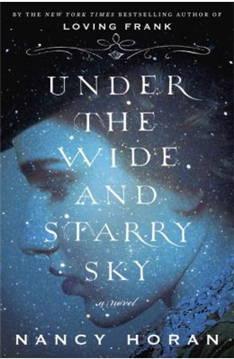
Cover for Under the Wide and Starry SkyUnder the Wide and Starry Sky traces the relationship between Robert Louis Stevenson and his wife Fanny from shortly before the two meet. At that time, he was a young man still trying to decide his profession and she was a married woman, although separated from her husband, ten years his senior and with children.

Fanny Osbourne has a great creative urge, and she has moved to Paris for art lessons for both herself and her grown daughter Belle, leaving her philandering husband in America. Fanny meets Stevenson while on a recuperative visit to southern France after the death of her youngest son.

The novel follows closely the entirety of their relationship from courtship to his death and her life afterwards, mostly from Fanny’s point of view. They separate because Fanny wants to give her marriage another chance, but they finally come together again. Stevenson, called Louis by his friends, is a sickly man, and his health often requires them to move to climates that are better for his lungs. When it seems as though he cannot live much longer, they find that his health revives on ocean voyages, so they go to sea and finally settle in Samoa until his death.

Although Horan appears to follow faithfully the course and events of the couple’s life together, and the novel is interesting from that standpoint, she never really brings the characters or settings to life. Aside from Fanny’s devotion to Louis, Horan concentrates on her frustration at not being able to live her own creative life. The characters seem relatively flat.

http://www.netgalley.comI was struck also by how, on the original voyage to the South Seas, Horan describes almost nothing but one chieftain until they get to Samoa. If she was working from journals or letters, surely she could have researched further to find out or even imagine what the islands would have been like for Louis and Fanny, seeing them the first time. Instead, we come into their voyage toward the end, as if all the sights and experiences are routine. I’m missing the sense of wonder. Although this novel should have been fascinating in its focus on some amazing lives, it generally does not fulfill its promise.

Day 395: Macbeth

Cover for MacbethAs with Hamlet and King Lear, the succession is a theme in Macbeth, even more so as the play was written in response to the Gunpowder Plot, in which Guy Fawkes and others attempted to blow up Parliament with King James I in it. This event was extremely traumatic for the British, as we can clearly imagine. Macbeth is, of course, Shakespeare’s famous tragedy about Macbeth’s attempt to usurp the throne of Scotland.

One theme of the play that harks back to the Gunpowder Plot is equivocation. Many of the statements in the play seem as if they mean one thing when they actually mean something else, from the witches’ predictions to Macbeth’s assurances. Equivocation was a Jesuitical doctrine that said that under examination, the truth could be substituted with “mental reservation,” in which one makes deceptive utterances but thinks the truth. It was used by Henry Garnet, the Jesuit Provincial, who learned of the plot as part of a confession. Edward Coke, a member of the Privy Council, which interrogated Garnet, called it “open and broad lying and forswearing.”

In fact, there are other references within the play that refer to James and demonstrate that the play was written in his support. Most obvious is James’s interest in witchcraft. He attended witch trials and in 1597 wrote Daemonologie, which Shakespeare used as source material for his scenes with the witches.

Banquo, Macbeth’s friend, whom Macbeth has murdered because of the witches’ prediction that Banquo will be the father of kings, was purportedly an ancestor of James I. Finally, there is the reference in the play to the healing of the king’s evil, a practice James observed that was followed after him by the British monarchy up to the Hanovers.

So, the play was written in honor of James I, to demonstrate the havoc wrought by breaking the succession. In the service of what is essentially historical propaganda, Duncan is made purer than he actually was and Macbeth more evil. The facts that Macbeth had a claim to the throne of Scotland and that the Scottish succession was not hereditary at the time are ignored. For an alternate interpretation of the story, see the wonderful King Hereafter by Dorothy Dunnett, one of the best historical novelists of all time, in my opinion.

But these facts don’t really spoil our appreciation of the play, which is one of Shakespeare’s most atmospheric, with its ghosts, witches, sleepwalking, murders, and walking wood. I think I prefer the directness of Macbeth to the convoluted plots of some of Shakespeare’s other tragedies. It is certainly a powerful play.

Day 377: Gods and Beasts

Cover for Gods and BeastsMartin Pavel is standing behind an old man and a child in the post office waiting to mail Christmas packages when a gunman comes in. The old man pushes the little boy toward Martin and behaves as if he knows the gunman. The gunman forces the old man to assist him in the robbery and then shoots him.

Things are going better for DS Alex Morrow than they have in awhile. She finally admitted her relationship with her criminal half-brother Danny Boyle to her supervisors and has been investigated and cleared of any suspicion of wrong-doing. She also gave birth to twins four months ago and is happy in her marriage. Her habitual anger has stopped simmering below the surface.

Morrow’s team is surprised to find no ties to crime on the part of the victim, Brendan Lyon, a former union organizer. The tattooed Pavel turns out to be a wealthy do-gooder. The police are having a hard time figuring out how Lyon could have known the gunman.

In a parallel story that seems unrelated until the very end of the novel, labor leader Kenny Gallagher, a rock star in politics, can feel the support of his constituency ebbing. His leadership is being challenged, he is being accused of improprieties with a young party member, and his wife wants a divorce.

Alex soon finds that two officers on her team were lured into taking a bribe, and then a third has a sack of cash thrown into his car. As she investigates these incidents, she begins to uncover a web of corruption.

On the home front, she is tentatively exploring normal family relations with Danny. He says he’s retiring from crime, but is he?

I discovered Denise Mina’s gritty crime novels shortly after the publication of her first book. They are unfailingly excellent, with gripping plots, complex characters, and complicated moral dilemmas. Mina’s writing is spare and elegant. You can’t go wrong with her if you have a taste for dark, dramatic crime novels.

Day 363: The Captive Crown

Cover for The Stewart TrilogyAt the beginning of this novel, the third in Tranter’s Stewart Trilogy, Jamie Douglas has fled to the highlands after being declared an outlaw following the disastrous battle of Homildon. That no Scot who fought in the battle would so call him is no concern to Robert Stewart, Duke of Albany and the Governor of Scotland.

Jamie is living with his family on the estate of Alexander Stewart of Badenoch, acting Justicaire of the Highlands. Although King Robert III is still alive, he has handed over the government to his brother Robert of Albany. His young son James, heir to the throne, has been captured by the English on his way to France, where his father sent him for safety after the death of his older son, David, at the time in Robert of Albany’s custody.

Jamie, who has always believed that the Duke of Albany plotted the murder of his chief, the Earl of Douglas, also believes that David Stewart was starved to death at Albany’s order. Jamie is content to stay away from the Lowlands and serve with Alexander.

The plot of this novel is a lot more difficult to describe than that of the other two, as it covers the significant events of several years in Alexander Stewart’s life, including battling the invasions of Donald of the Isles, forming an embassy to the British to treat for the release of King James after Robert III’s death, privateering against the British, and so on. This is a fault with the novel, constrained as it is by actual historical events to seem disjointed. It is definitely the weakest of the trilogy and does not make a satisfying ending for the series.

Day 337: A Folly of Princes

Cover for The Stewart TrilogyIn the sequel to Lords of Misrule, Prince David Stewart is now a young man ready to challenge his ruthless uncle Robert Stewart for the Governorship of Scotland, under the weak rule of David’s father, Robert III. Jamie Stewart, our hero, who has always suspected Robert Stewart of having his lord, the Earl of Douglas, murdered, has declared himself David’s man.

But the Stewarts are an unruly bunch. David’s governorship is more fair and less corrupt than his uncle’s, and he puts in place reforms, but he takes no care in dealing with the proud nobles of Scotland and behaves wildly and promiscuously in his private  life. Although Jamie continues to support him, he is disappointed in his prince and fears that all will not be well.

While this is going on, changes in the Plantagenet monarchy in England threaten the border. At the same time, Donald of the Isles is making his own forays farther north. This northern threat gives Jamie an opportunity of renewing his acquaintance with Alexander Stewart of Badenoch.

Again, Nigel Tranter does a wonderful job of explaining the complicated politics and alliances of early 15th century Scotland, while spinning an absorbing adventure story.

Day 327: The Five Red Herrings

Cover for Five Red HerringsAlthough I am normally a fan of Dorothy L. Sayers’ Lord Peter Wimsey series, The Five Red Herrings is exactly the novel I’m talking about when I say that I don’t care for the Golden Age mysteries full of railway timetables. This type of novel boils down to a puzzle designed to confuse the reader with a lot of detail. I do like Lord Peter, but I like him better when I have to keep track of fewer things.

Lord Peter is visiting an artists’ colony in Scotland when a painter is found dead. He is Sandy Campbell, a talented artist but one who also has a talent for getting drunk and picking fights. He is found in a stream with his half-finished painting on the bank high above, and the reasonable explanation is that he accidentally fell to his death. However, Lord Peter immediately notices inconsistencies that make it impossible for Campbell to have painted the picture.

Whoever the murderer is, he or she must also have been a talented painter, for the picture is exactly in Campbell’s style. Six other artists in the area who had quarrels with Campbell have enough ability to be the killer. Some of them have convincing alibis, and the solution revolves around–yes–railway timetables.

As usual, Lord Peter is entertaining. His man Bunter is not as much in evidence as in other novels, which is a little disappointing, but Sayers capably depicts a group of colorful suspects.

Day 311: Lords of Misrule

Cover for The Stewart TrilogyNigel Tranter was a historian and a prolific historical fiction writer whose work can be uneven. During the 1950’s through 1990’s he wrote more than 60 historical novels, some of which employ dialogue and characterization only to drive the plot forward. Such is not the case, however with Lords of Misrule, the first book in his Stewart Trilogy, a novel that is fully realized.

Jamie Douglas is a young esquire to the Earl of Douglas, the most powerful man in 14th century Scotland, certainly more powerful than the King, Robert II, a sorry descendent of Robert the Bruce and doddering old man who just wants to be left alone. The King has spawned a clutch of squabbling Stewarts who are waiting to see what happens when he dies. Unfortunately, his oldest son, John, seems unsuited to power, and his second son, Robert, is ambitious and dangerous.

When Jamie’s lord is foully stabbed in the back by his own armorer during battle, Jamie fears that any of several powerful men may have had enough to gain in the subsequent power vacuum among the Douglasses to have suborned the armorer. But when Robert Stewart, acting as his father’s Governor, appoints his good friend Archie Douglas to take the position of Earl, Jamie’s suspicions point to Robert.

Jamie and some other men lie in wait outside the armorer’s home after they figure out where he is hiding, in hopes they can capture him and question him about who paid him to murder the Earl. Their plans go awry, however, ultimately sending Jamie Douglas north in pursuit of another man, to the Highland territories of the dreaded Alexander Stewart, Earl of Buchan, known as the Wolf of Badenoch.

This novel provides a fascinating glimpse into the rivalries and political in-fighting among the early Stewarts. It has an appealing protagonist, although Jamie is a bit too honest and outspoken for his own good. It also includes a romance, as Jamie is drawn to two different Stewart women while serving a third, his Earl’s widow. Having learned most of my Scottish history from the excellent historical novels of Dorothy Dunnett, I am not accustomed to thinking of Douglasses as heroes, but Jamie makes a good one.