Review 2479: Classics Club Spin Result! Merkland

I have read and enjoyed all of Margaret Oliphant’s Carlingford series as well as her first novel and one other. Merkland (which has different subtitles depending on where I look at it: in my eBook it says “A Story of Scottish Life” and in my hardcopy it says “or, Self-Sacrifice”) is her second novel and shows her inexperience. I read it for my Classics Club Spin.

Although the main character of the novel is Anne Ross, it has two plots concerning the fates of two disgraced young men. At the opening of the novel, Anne learns from her unsympathetic stepmother not only that her older brother Norman Rutherford, long believed dead, may be alive, but that he is believed to be the murderer of Arthur Aytoun, who was found shot to death 18 years before. Anne is horrified when she learns that her great friend, Mrs. Catherine Douglas, has invited this man’s daughter, Alice, to stay with her, for she thinks Alice must hate her family.

Mrs. Catherine, for her part, is facing a dilemma. She has unexpectedly inherited some money and, being already wealthy herself, had intended to give it to hard-working but poor young James Aytoun, Alice’s brother. However, two old friends have come to her to ask for help for Archie Sutherland, the young local laird, who has fallen in with bad companions and is badly in debt. She decides in Archie’s favor, but before she can send him the money, he loses his entire estate gambling.

Mrs. Catherine sets about rescuing Archie by bringing him home to recover and arranging honest employment where he might eventually earn enough to buy back his heritage.

For her part, Anne discovers a letter that indicates Norman may be innocent of the crime even though the circumstantial evidence against him is strong. She makes it her goal to try to clear her brother’s name, especially important because Alice Aytoun has fallen in love with Anne’s young stepbrother, Lewis.

So far, so good. Two interesting plots plus other subplots such as the identity of a mysterious child and the fate of Rutherford’s estate in the hands of his dissolute English ex-companions. However, this novel is much longer than it needs to be, containing passage after passage of moralizing and sermonizing. Modern audiences may also be dismayed at its strong message against women’s rights. Further, the novel takes several chapters beyond the crisis to wrap up its loose ends, and by the end I was just skimming the paragraphs trying to finish.

A final note about the edition I read. I dislike reading eBooks, so even though I have Oliphant’s complete works on my iPad, I looked for a paperback version. Drat these print-on-demand books! I ended up with the edition shown above, published by Horse’s Mouth, that had all the evils except that it was corrected for misreadings by machine reading, which I have encountered before. No page numbers, no copyright or any other kind of information except a short biography and a list of other works, no formatting (the text starts at the bottom of page 2). Worst of all, it is only in about 6 pt. type at the largest, when anyone who knows anything about it knows that about the smallest you can go and still be readable is 9 pt.

Related Posts

Passages in the Life of Margaret Maitland of Sunnyside

Hester

A House in Bloomsbury

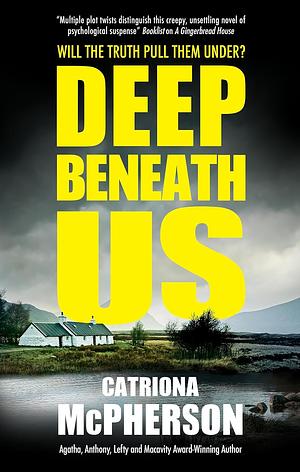
Review 2460: Deep Beneath Us

As a teenager, Tabitha had a mental breakdown and had to be hospitalized. Now her husband has left her for another woman. He has divulged her history of mental illness to her employer, who fired her for not divulging it when she was hired. This loss has resulted in the loss of her home and as a result, the custody of her son. She has returned to her family home on a remote moor because she has nowhere else to go, and at the beginning of the novel, she has decided to recede into madness. She feels a rumble and thinks she imagined it, but it is someone trying to blow up the dam.

Gordo hears the explosion and goes to the police to report it. That’s why the police are nearby when Tabitha realizes she can’t get her cousin Davey to answer his door. They find Davey inside, an apparent suicide, having taken the insulin left over after his mother’s death. At the cottage, Tabitha meets Davey’s friends Gordo and Barrett, with whom he regularly collected trash on the beach.

Tabitha, Gordo, and Barrett can’t make sense of Davey’s death nor of the police assumption that Davey tried to blow up the reservoir dam. Even though Tabitha finds a note, Davey doesn’t seem to be the type of person to commit suicide. Later, Tabitha is astonished to learn she has inherited Davey’s cottage—and delighted because it means she can offer her son a home, which he immediately agrees to accept. Then she and her new friends are astonished again to find that Davey has been hoarding all the junk the three men have picked up off the moor for the last 15 years.

Barrett is delighted to find his ex-wife wants to leave his two daughters with him, and with Tabitha’s son, the teenagers insist that Davey was murdered. As the adults and teens look into it, they end up digging into the tangled past of Tabitha’s family—the distant mother, the two brothers who were estranged for years and then apparently committed suicide on the same day (or did they?), the two cousins who eloped, one of them Davey’s brother, the other Tabitha’s sister, Tabitha’s near death as part of her father’s suicide—and why Tabitha remembers almost nothing.

This novel isn’t as much of a thriller as an extremely atmospheric and tangled mystery as Tabitha and her friends try to sort out the truth of her family’s past. Although the sequence of events around Davey’s death ended up seeming unlikely to me, my doubts didn’t interfere with my enjoyment of the novel.

Related Posts

A Gingerbread House

In Place of Fear

The Mirror Dance

Review 2438: A Stranger Came Ashore

I don’t often read children’s books, but I’m a sucker for a selkie story. This fun little book is set in the Shetland Islands and based on their folk tales and customs.

There is a terrible storm on the night that the Hendersson family hears a knock on the door. A stranger arrives, Finn Learson, who seems to be a sailor from a wrecked ship in the bay. The Hendersson’s dog Tam growls at him, but the family takes him in.

That night, young Robbie Hendersson hears someone playing his father’s fiddle. It is making strange music that he’s never heard before. He goes to look and sees Finn Learson playing it. Tam is still growling, but Finn stares at him as if doing magic and Tam stops.

Robbie begins to suspect that Finn is a selkie. He remembers his grandfather’s tales of the selkie king, who lures girls away undersea to marry him and how they drown when they try to leave. He is afraid that Finn is after his sister, Elspeth. But no one believes him.

Robbie finally finds someone to help him against the selkie. But he’s almost as afraid of his helper as he is of Finn.

This book is probably meant for children around 8-12, and I think they would enjoy it, especially if they are interested in old stories. I liked how it managed to incorporate other old customs of the Shetlands.

Just as a side note, there was a Scottish singer named Jean Redpath. As a young woman I had several of her albums, and I believe it was a song she sang, “Lassie Wi’ a Yellow Coatie,” that referred to a but and ben. I had no idea what one was until I read this book, some fifty years after encountering the term.

Related Posts

Doll Bones

Sealskin

The Sea House

Review 2338: My Death

The unnamed narrator of My Death is a novelist who has been unable to write since her husband died a year ago. She has been isolated in a house in the west of Scotland. She decides to try biography instead and chooses the figure of Helen Ralston, whose accomplishments as an artist and writer were overshadowed by her tumultuous affair with her mentor, W. E. Logan, another artist.

When she begins to look into the subject, she finds that all of Ralston’s books are out of print but Logan’s are not. However, Ralston is in her 90s and eager to meet her and share her journals and photos. The narrator is struck with unease, however, when she sees a painting by Ralston entitled My Death, a supposed landscape of an island that is really a painting of the artist’s most intimate parts. As she continues her research, she keeps finding odd echoes of her own life.

This novella is described as gothic, but I wouldn’t exactly call it that, although it is unsettling and weird. Important to Tuttle is the theme of, as the Introduction by Amy Gentry puts it, “the erasure of women’s authorship by men.” That is certainly at work here, as she based some of the details of Ralson’s life on that of Laura Riding, an American poet and lover of Robert Graves, who accused Graves of stealing material.

This is an involving story that at first seems straightforward but gets odder and odder. I found it fascinating. Tuttle is in general a science fiction writer, but despite that I may look for more by her.

I received this book from the publishers in exchange for a free and fair review.

Related Posts

The Bloody Chamber

Luckenbooth

Ghostly

Review 2329: The Warrielaw Jewel

I have read a few novels by Winifred Peck, so I was intrigued to learn she had also written some mysteries.

Betty Morrison is the newly married wife of an Edinburgh lawyer, John. She accompanies her husband on a call to the Warrielaws, an old family whose members are constantly feuding. The most recent dispute concerns the fairy jewel, a chunk of amber said to be given to an ancestor by a fairy and subsequently encrusted in jewels. Jessica Warrielaw, the old lady who was left the estate, hadn’t spent a penny on its upkeep but instead has been selling off treasures and giving the money to her nephew Noel. Shis is planning on selling the fairy jewel.

Jessica’s sister Mary as well as the other potential legatees are horrified by this. Mary, who lives with Jessica in shabby rooms divided in half by physical markers, wants the jewel to stay in the family as does niece Cora. Niece Rhoda, on the other hand, would like money to start over in America. She is horribly managing and makes the life of weaker Aunt Mary miserable. Other potential heirs are Neil, of course, and Rhoda’s much younger sister Alison.

First, there is an odd incident at the house that seems like a break-in except nothing is missing. Then Jessica leaves for London, presumably to sell the jewel—and isn’t heard from again. John, as trustee of the estate, finally hires Bob Stuart, an ex-police detective and friend, to find Jessica.

Weeks later Jessica is found dead, not in London but in the estate’s dilapidated stables. The jewel is nowhere to be found. Was Jessica murdered? How did she get back home when Betty herself saw her on the train to London?

As is often the case with mystery novels of the period (1933), this novel is more concerned with the puzzle than characterization. However, several characters do have strong personalities. The plot is rather slow moving, and once or twice just when things were getting exciting, Peck drove me crazy by inserting a several-page description. However, I liked Betty and though the novel was entertaining.

Related Posts

Bewildering Cares

House-Bound

4:50 from Paddington

Review 2286: #DeanStreetDecember! Because of Sam

I could fairly easily guess the main plot of Because of Sam from about page 3, but that didn’t make it any less enjoyable to read.

Mild-mannered Millie Maitland has not had an easy life. Her feckless husband died leaving her badly off when her daughter Amabel was a child, and she has had a financial struggle ever since. When a relative died and left money for the use of Amabel, Millie was only delighted that she could provide for her daughter. Even though her lawyer believed she could fairly spend some of the money for her own benefit, or rather for the benefit of both of them, she refused. She has done everything for Amabel, so that her daughter has no idea of how hard Millie has worked. The result is that Amabel, now in her late twenties, is a little spoiled, plain-spoken, used to being waited on, and inconsiderate.

The farmer Martin Heriot catches sight of Millie looking young and pretty at a wedding and decides he wants to get to know her better. She makes a little money taking care of people’s dogs, so he soon makes arrangements for her to board Sam, a Labrador puppy he says belongs to his cousin. This gives him an excuse to visit Millie. But Millie, with no idea of her own attractions, gets it into her head that he is coming to see Amabel.

On another front, a new arrival to this small post-World War II Scottish village is causing problems. Mrs. Noble is a predatory blond whose husband is stationed abroad. She first goes after Martin and then after a young husband of a new mother.

Although Clavering’s books are similar to those of D. E. Stevenson, her friend and neighbor, I think that without becoming at all heavy reading, they go a little more below the surface. I enjoy them very much.

Related Posts

Mrs. Lorimer’s Quiet Summer

Near Neighbors

Dear Hugo

Review 2267: House-Bound

I read Mrs. Tim Carries On just before reading House-Bound, and they made an interesting contrast. They were written about the same time during World War II and both set in Scotland, House-Bound in a fictional city that stands in for Edinburgh and Mrs. Tim in the town base of her husband’s regiment. Both are social comedies, but whereas Mrs. Tim is busy raising her children and doing war work and remaining as upbeat as possible, Rose Fairlaw has raised her children, tends to the depressive, and fully realizes she is looking at the death of her way of life.

House-Bound begins with Rose at the registry hoping to get two servants to replace the two girls who are leaving to work in munitions. It’s clear to her that there are plenty of employers and no one to be employed. When someone remarks that millions of women do their own housework, she decides to try, even though she is fifty and has never done any housework or cooking.

The Laidlaws live in an ancient stone tower with a larger, comfortable Victorian addition. Aside from not exactly knowing how to do the work, Rose seems to have no idea that you might not clean every room every day or that one woman can’t be expected to do what three women used to. But almost immediately she meets Major Hosmer, an American who intrudes himself upon her to make domestic suggestions such as converting the small pantry on the main floor into a little kitchen so she doesn’t have to go up and down stairs to the basement kitchen.

Rose is struggling ineptly with the cleaning and serving her husband disgusting messes, but it appears to occur to no one else in the family to do any work. The family dynamics are important in this novel. Rose was a young mother and widow during World War I when she married Stuart Laidlaw, a widower with a frail only son, Mickey, whose mother died in childbirth. Rose became consumed with caring for Mickey, especially after he almost died, to the evident neglect of her own difficult daughter, Fiona, who has grown up ready to take offence and ready to blame everything on her mother. Major Hosmer is actually an acquaintance of Fiona, and his mistaken idea of her mother is straightened out almost immediately upon meeting her.

Luckily, the registry office comes up with Mrs. Childe, who is willing to teach Rose and work with her three hours a day, but her standards are so high that Rose is exhausted. She become house bound, with no time to do anything else, but Peck extends that idea to the lives of her class—that they are stuck in their ideas and habits.

At first, being someone who has always had to do my own housework (although admittedly not to their standards), I felt impatient of Rose and the others who seemed to thing she was taking on some momentous task. But later I feel I missed some of the comedy in my sympathy for her general conditions. There are some great comic characters here, who are as irritating as they are funny, although I was a little irked at the idea that an American major would push his way into Rose’s house not only to make home improvement suggestions but to make the dinner and do the dishes. I don’t believe that character at all. But Cousin Mary, who is always right, a single woman who keeps trying to force poor exhausted Rose into doing war work—and then there is Grannie Con-Berwick.

Related Posts

Bewildering Cares

The Land of Green Ginger

Mrs. Tim Carries On

Review 2265: Mrs. Tim Carries On

Mrs. Tim Carries On is the second in the Mrs. Tim series, continued after a long break at the beginning of World War II. The narrator, Hester Christie, begins the novel as diary entries after her husband leaves for the front. Her husband’s Scottish regiment is stationed in a small Scottish town, and at first Hester feels she should leave but decides she is of more use there.

The diary is of everyday life that doesn’t seem to be that different from before the war except for war work and worry about loved ones. One of the young officers in her husband’s regiment asks her to invite Pinkie Bradshaw to stay, and Hester is confused by this because she remembers Pinkie as a girl with braces. But Pinkie turns out to be a tall and beautiful seventeen-year-old, practical, too, as she lets one young man after another know they’re just going to be friends. Pinkie stays, and Hester is happy to have her.

After Dunkirk, Tim’s regiment reappears, but without Tim, which leads to some anxiety. Otherwise, the book is calm, pushing the stiff upper lip approach with a few scares, sometimes funny, and entertaining.

Related Posts

Mrs. Tim of the Regiment

Mrs. Tim Flies Home

Mrs. Tim Gets a Job

Review 2240: Deception

Since I discovered recently that I had missed one of Denise Mina’s books, I looked again and found I had also missed Deception (also published as Sanctum), from 2002.

Lachlan Harriot is on his way to his wife Susie’s trial at the beginning of Deception. She is a psychiatrist accused of having had an affair with a convicted serial killer, Andrew Gow, and then murdering him and his wife after he was released from prison on appeal. Lachlan is sure she is innocent and will get off. He is certain she never had an affair with Gow.

But Susie is convicted after the prosecution spins a lurid story. Lachlan begins spending his insomnia-filled nights in Susie’s office—previously off-limits—looking for evidence that can be used for an appeal. Slowly, he begins turning up indications that nothing is what he thought it was, starting with proof that Susie has lied. Months before the murder, she was fired from her job at the prison after being accused of stealing Gow’s files. She always said she was fired because of sexism and did not take the files. But Lachlan finds them in the office.

This is a slow-building novel that takes a little patience. The facts Lachlan turns up aren’t as shocking as promised by the cover blurbs, but Mina is a superb plotter. The book doesn’t disappoint.

Related Posts

Confidence

Conviction

The End of the Wasp Season

Review 2239: Love Comes Home

Jane Cranstoun is enjoying her stay in London with friends George and Kitty Mariner when she is summoned home by her mother because of the return from finishing school of her sister, Love. Jane is not really looking forward to going home, where she is expected to take charge of numerous commitments made by her mother, but also because she has begun to hope for a proposal of marriage from John Marsh, a young naval officer.

At her farewell party, Jane gets her proposal and accepts it but asks John to keep it a secret until her parents get to know him better. He has recently accepted a post that is nearer to her parents’ house in Scotland, so he agrees.

On the train north Jane meets Peregrine Gilbert, whom she takes to be shy and uninteresting, not realize he has become her neighbor. Then she meets him again the next morning and tries to send him off for trespassing.

When John appears, Love begins monopolizing him and throwing Jane together with Peregrine. In fact, there was a scene before he appears when I was certain Love already knew John. But that turns out not to be the case, even though it’s clear Love means to marry him before she even meets him. Silly misunderstandings lead to a broken engagement, and this situation was clumsily handled, I thought. In fact, although Love explains later that she thinks Jane and John are not well suited, she has decided this before she ever meets John.

I have enjoyed reading Clavering, but this one, I think, is the closest to a standard pattern romance than the others. I didn’t like Love, who takes over the story gradually until it is more about her. I also didn’t like John or later Kitty when she reappears. The only characters I liked were Jane and Peregrine and the girls’ brother, Meggie. Love is supposed to be 19, but she acts more like 14. I was a little disappointed in this one.

Related Posts

Susan Settles Down

Touch Not the Nettle

Yoked with a Lamb