Review 2137: Summerwater

Summerwater is a novel composed from brief vignettes that at first seem so disconnected as to be short stories. However, connections appear slowly.

Staying in a collection of cottages on an island in a large Scottish loch are a group of disparate people. The novel alternates point of view to tell their stories over one very wet day. In between each of these chapters is a shorter vignette about what is happening in the surrounding forest.

Justine has an obsession for running, possibly to get away from her family. But she has a secret about her running. David and Mary, an elderly couple, are navigating Mary’s growing decrepitude and memory loss. Milly and Josh are an engaged couple working on their sex life, but Millie would just like a bacon sandwich. Lola, a young girl, takes out her father’s xenophobia on a little Ukrainian girl. Alex, about fourteen, stays out in his kayak a little too long. Becky, his older sister, is so bored she wants to burn the place down. Claire is so unprepared when her husband gives her a break from the kids that she can’t figure out what to do with it. And so on.

We’re told at the beginning that there will be a death, which adds to the tension. A couple of the vignettes got old—the one about sex, even though it was funny, and the thoughts of indecisive Claire. Despite the activity, I found the work slow moving and contemplative.

Related Posts

Not the End of the World

Heads of the Colored People

The Spinning Heart

Review 2121: Young Mungo

Twice recently I’ve had the same unusual experience with my reading. I was looking forward to reading a second novel by an author who wrote a book that I loved, only to find the second novel seemed to be very much the same as the first, as if the writer was stuck somehow. This happened with Young Mungo.

Mungo is a caring 14-year-old Glaswegian gay boy with an alcoholic mother, a sister planning her escape, and a violent brother. Sound familiar, those of you who have read Shuggie Bain? The novel begins with Mungo being packed off on a camping trip with two men his mother barely knows from her AA meetings. He is poorly clad and equipped, the men are drunk, and a feeling of dread is the immediate effect. In between chapters that continue this story, the novel returns to scenes from Mungo’s past.

Set in the 1990’s, the novel is similar to Shuggie Bain except that Mungo is older and the novel is even more grim and violent at times. Still, it is compelling and becomes less like the other novel as it goes along. I ended up liking it but not so sure I want to visit that world a third time.

Related Posts

Shuggie Bain

A Little Life

Edinburgh

Review 2107: Spring

Spring is the third in Ali Smith’s seasonal quartet. Like with most of Smith’s books, there is a point where I say, “What the f— is she on about?” and a point where I say, “Oh.”

Richard Lease is an older man, a filmmaker who has done good work. He is grieving after his old friend Paddy’s death. Paddy had been his screenwriter, a woman who supported and inspired him and a good friend. He is further upset because the screenwriter assigned for his next film is trying to turn a delicate work about two famous writers who never actually met each other into a story about a hot affair.

Supposed to be at a meeting about this film in London, Richard takes a train in the opposite direction and gets off in Scotland, thinking about throwing himself under the train.

About halfway through the novel, it suddenly focuses to a seemingly unrelated story. Brittany is a security guard in a detention facility for illegal immigrants. She, like many of the other guards, has started to become callous and treat the detainees as if they were criminals.

She has heard a rumor about a little girl who walked into a facility and spoke to the director. The next day the toilets were spotlessly cleaned. Then one day on her way to work, she meets the child she thinks is that girl. The child Florence wants to know how to get to the place in Scotland shown on an old postcard she has. Suddenly, Brittany finds herself going along.

The novel is obviously about how we treat immigrants, but it makes comments about other things, like social media, on the way. There were times when its digressions got on my nerves and particularly one that I skipped once I had its measure. But somehow even when I’m frustrated by her, Smith always manages to pull me into her story and impress me with her intelligence.

Related Posts

Autumn

Winter

There but for the

Review 2098: Yoked with a Lamb

After reading several Clavering books, I’ve decided that one of her strengths is in depicting a warm family and village life. It comes slowly in Yoked with a Lamb.

The village of Haystown in Southern Scotland is shocked and excited to learn that the Lockharts are returning to the area—all of them, including Andrew, who ran off with another woman several years ago. Andrew and Lucy are trying again and moving back to his beloved home. Lucy Lockhart has asked Andrew’s cousin, Kate Heron, to oversee preparations to open the house.

Although Lucy and the children are supposed to arrive there before Andrew, one day he stops by on his way north. Kate spends some time with him and his good friend Robin Anstruther. She begins to be attracted to Robin when she learns that he also was madly in love with the woman Andrew ran off with.

Kate thinks Andrew has treated Lucy abominably, but as the family gathers, she sees that Lucy constantly finds fault with him and throws his past in his face. She also tends to boss her children around and deprive them of small pleasures for no apparent reason. As Andrew and Lucy try to work out their problems, Kate tries to deal with her feelings for Robin.

I am enjoying the Furrowed Middlebrow reprints of Molly Clavering’s work very much. She was a neighbor and friend of the better-known D. E. Stevenson, but I have found Clavering’s books slightly more substantial.

Related Posts

Mrs. Lorimer’s Quiet Summer

Dear Hugo

Touch Not the Nettle

Review 2082: Mrs. Lorimer’s Quiet Summer

Liz of Adventures in Reading announced Dean Street Press in December long after I read this book, and the press is trying to get some new books to me in time, but since this one came up in my regular review schedule, I’ll take credit for it!

Because she has been trying to talk her husband Jack into buying it, Mrs. Lorimer is disappointed to learn that a nearby home, Harperslea, has been sold. Now that all their children except Guy are married, and some of them have children, their home, Woodside, is not big enough when they all come to visit, which they are doing this summer. With all the income from her writing, they can afford to move, but Jack refuses to consider it. So, her good friend Gray Douglas, also a writer, will help her out by putting some of the guests up.

Mrs. Lorimer, who tends to be a worrier, is also worried about her son Guy. He has been mentioning a girl quite often in his letters, but Mrs. Lorimer is worried that she won’t be good enough for Guy.

At any rate, when the family shows up, Phillie seems to be the one with the problem. She begins behaving temperamentally, being rude to her husband, dashing off to Harperslea because she’s seen Miss Smellie, one of the new occupants, playing tennis and she wants a game. Then bringing Miss Smellie home to dinner and just abandoning her to her mother and Guy.

Miss Smellie is young and not very prepossessing, and they find out she hates her name, which is Nesta Rowena. So, the family dubs her Rona.

These and other family concerns enliven this charming novel. The novel cover claims the book is autobiographical, and it certainly has some likable and entertaining characters. So far, I have very much enjoyed the novels I’ve read by Clavering.

Related Posts

Dear Hugo

Susan Settles Down

Touch Not the Nettle

Review 2046: Dear Hugo

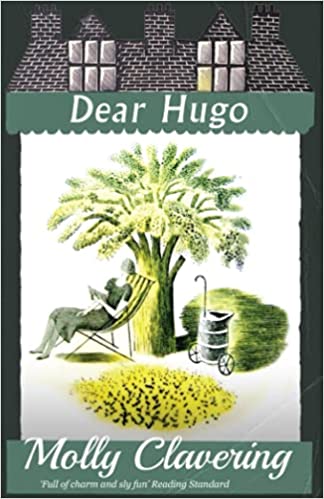
Sara Montieth has purchased a cottage in a small Scottish border village because she wants a quiet life. She has chosen the village because it was the boyhood home of her young man Ivo, who was killed in the war, and his brother Hugo.

Dear Hugo is an epistemological novel, consisting of Sara’s letters to Hugo, whom she has never met and who lives in Nairobi. It is about her daily life, the people she likes and dislikes, the events in the village. Although she wanted a quiet life, hers becomes eventful, especially after her cousin, who is newly remarried, asks her to take his 13-year-old son Arthur during his school holidays. It’s even more so after Hugo sends them a puppy.

The letters are written with gentle humor and describe all the village characters, including Miss Bonaly, a disapproving spinster who urges Sara not to hire Madge Marchbanks, an unwed mother, to help with the housework, and kindly, perceptive Mrs. Keith, who knew Ivo and Hugo as boys.

This is a nice, gentle novel of village life. It didn’t end quite the way I was hoping for, but I enjoyed it very much.

Related Posts

Touch Not the Nettle

Susan Settles Down

Music in the Hills

Review 2032: The Edinburgh Mystery and Other Tales of Scottish Crime

The Edinburgh Mystery and Other Tales of Scottish Crime is the latest British Library collection of crime short stories, edited by Martin Edwards. These stories are either set in Scotland or written by Scottish writers, like the first, “Markheim,” by Robert Louis Stevenson. They are arranged in chronological order by publication date, ranging from 1885 to 1974.

Some of the stories, like “The Field Bazaar” by Sir Arthur Conan Doyle, are simple puzzles. In this one, Sherlock Holmes explains to Watson how he knows what is in the letter he just received. Others, like “The Running of the Deer” by P. M. Hubbard, are about the supposition of crime. “Madame Ville d’Aubier” by Josephine Tey tells the story of the heavy atmosphere emanating from a woman at a bakery and how later this woman murdered her sons and husband. In “Footsteps” by Anthony Wynne, a man figures out the connection between apparently ghostly footsteps and an attempted murder.

I liked some of the stories more than others, but they altogether make an enjoyable collection for an escapist evening.

I received this book from the publisher in exchange for a free and fair review.

Related Posts

Murder at the Manor

Deep Waters

The Tuesday Club Murders

Review 2013: Touch Not the Nettle

Touch Not the Nettle is not necessarily a sequel to Molly Clavering’s Susan Settles Down, but it features the same locations and some of the same characters. The Armstrongs get a call from Jed’s cousin asking if her daughter, Amanda Carmichael, can come to stay. Amanda’s husband, Cocky, an explorer, has been lost in Brazil, and Amanda is being driven crazy by her selfish mother, who is demanding that she behave like a widow when they don’t know if he is dead. Although Amanda, rather brittle from her struggles in an unhappy marriage, doesn’t really want to go stay with strangers, she soon finds herself happy to be with Jed and Susan and loving the beauty of the borderlands of Southern Scotland.

Like Susan Settles Down, Touch Not the Nettle contains many descriptions of the lovely landscape and many of the same delightful or irritating characters. It is darker, however, and I’m not sure (spoilers!) how happy I am with the love interest for Amanda, Larry with the angry temperament and drinking problem. The couple’s problems are also too magically cleared up.

Perhaps this is a deeper novel than Susan Settles Down, but it is also more facile, and I didn’t like it quite as much.

Related Posts

Susan Settles Down

Music in the Hills

Winter and Rough Weather

Review 2006: Susan Settles Down

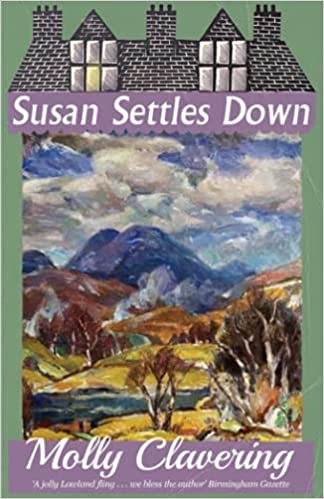
Susan Parsons has been leading a wandering life keeping house for her naval officer brother Oliver, but Oliver was badly injured in a fall months before and has left the Navy, still suffering a limp and not his old self. Then Oliver inherits a small estate in Southern Scotland. It’s not in good condition and the Parsons haven’t much money, but Oliver decides to make it their home.

While Susan struggles to get some help in the kitchen and repair the worst problems of the house, Oliver begins supervising the farm work and almost immediately meets Jed Armstrong, the farmer next door. Although they immediately become friends, Susan finds Jed rude and uncouth.

Soon, the two siblings become involved in village activities. Susan befriends Peggy Cunningham, the parson’s young daughter, who has been receiving unwelcome attentions from the organist. The Parsons become fast friends with the Cunninghams, and all try to avoid the Pringle sisters, three mischievous gossips.

This novel is a lovely tale of village life in pre-World War II rural Scotland, featuring two romances. The descriptions of the landscape are beautiful, the characters are attractive, and I enjoyed it very much. However, I continued to find problems with Furrowed Middlebrow blurbs. Twice now the main character’s name has been misspelled, and this time the blurb places the novel in the Highlands.

Related Posts

Apricot Sky

Music in the Hills

Five Windows

Review 2005: Rose Nicolson

It’s 1575. Mary Queen of Scots has been ousted from the throne of Scotland in favor of her young son James and a series of regents. This revolution has been mostly a religious one, with Queen Mary a Catholic and James (referred to as Jamie Saxe) being raised Protestant. But there is also a struggle between the Calvinists and milder forms of Protestantism.

This struggle is reflected in the home of young William Fowler, whose father is a Calvinist and whose mother, with contacts in Queen Mary’s court, is French and Catholic. However, William’s father is accidentally killed during a siege on Embra. Now William is off on the Sonsie Quine to school at St. Andrews. On the ship, he meets a red-haired boy who asks to borrow his dirk. This meeting proves fateful, as William finds out years later that the boy is Watt Scott of Buccleuch. (For Dorothy Dunnett readers, I believe this is the grandson of the man of the same name in the Lymond chronicles.)

William has an affinity for poetry, and at school he befriends another scholar, Tom Nicolson. He struggles within himself over the religious issue as he feels pressure to commit one way or the other. He also falls in love with Rose Nicolson, Tom’s beautiful sister, a fisher girl with a remarkable mind.

As the King gets older, the Catholics and Protestants compete to control him. The country remains Protestant with the Calvinists gaining power while the Catholic side gains strength at court with the arrival of a favorite from France.

As he approaches graduation, William wants to marry Rose, but she is betrothed to a fisherman with the influence to protect her. She needs this protection because her remarks have been misunderstood as evidence of witchcraft.

William, despite himself, is forced closer to deciding between the two religions and finally decides that Protestantism is the least bad alternative. He also meets Scott again and is drawn into political intrigue.

This is not dry stuff. Greig is great at depicting the realities of living in this difficult time and place. I was fascinated from page one. This novel became part of my Walter Scott prize project by getting on the shortlist, but being a fan of Greig, I had already read it.

Related Posts

Fair Helen

The Ringed Castle

When They Lay Bare