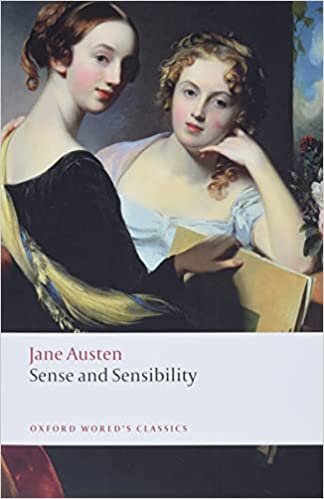
Review 2534: #ReadingAusten25! Sense and Sensibility

My original intention for ReadingAusten25 was to reread only the books I hadn’t reviewed yet. But I can’t resist Austen, so here I am reviewing Sense and Sensibility. I am not going to repeat my review of 2022, though, so you can find it here. Instead, I thought I’d look at whether the book struck me differently this time and a little at Claire Tomalin’s point of view (the wobble), as cited by Brona.

It did strike me differently. Although Elinor is still my favorite of the two sisters, they both struck me more extremely this time. Marianne seemed like a true modern teenager, not as much for her reactions to Willoughby but more in her sulking (call it what it is), her rudeness to various kind characters whom she thinks ill-bred, and so on. But the thing is, 16 in the early 19th century meant she was supposed to be an adult, or almost. (Of course, she is also under the influence of the Romantic movement in art, literature, and music.)

As for Elinor, sometimes I felt she carried her comments a little too far, into preachiness. I got a little tired of her dissections of other people’s behavior.

I also appreciate the wit of the novel more. Although I always find Austen witty, she has drawn us some priceless characters and written quite a few zingers.

I am not so sure about Tomalin’s “wobble.” I looked for it but didn’t find much evidence for it unless you count Elinor’s dash out of the room after she finds out Edward isn’t married. I’d like to hear if anyone was struck differently. I remember not agreeing with some of Tomalin’s interpretations when I read her biography of Austen.

Related Posts

Jane Austen: A Life

Jane Austen at Home

Persuasion

Review 1896: Sense and Sensibility

When I was making up my current Classics Club list, I realized I hadn’t reread any Austen for a while. So, I picked Sense and Sensibility.

When Mr. Dashwood was dying, he made his son John promise to take care of his second wife and daughters, since he was unable to leave them anything due to an entail. John makes this promise with good intentions and tells his wife he will give each of them £1000, but she talks him out of each of his suggestions until he gives them nothing.

On a very small budget, then, Mrs. Dashwood must find a new home for herself and her three daughters, Elinor, Marianne, and Margaret. Just as things are getting unbearable at the shared home, a relative of Mrs. Dashwood, Sir John Middleton, offers the women a cottage in Devonshire at a low rate.

Elinor regrets leaving her home all the more because she has developed what she believes is a shared attachment with her brother-in-law, Edward Ferrars. But Mrs. John Dashwood wants her brother as far away from Elinor as possible. Both she and her mother plan for him to marry well.

Relocated to their new home, the Dashwoods find their neighbors, the Middletons, and Mrs. Jennings, Mrs. Middleton’s mother, to be almost overly friendly.

One day Marianne and Margaret are caught out in a rainstorm and Marianne sprains her ankle skidding down a grassy hill. A gentleman rescues her, and he, Mr. Willoughby, becomes a frequent visitor. It is clear he is attracted to Marianne, and she, having fully adopted the ideals of Romanticism, shows plainly that she’s in love with him. Meanwhile, Elinor wonders why she isn’t hearing from Edward.

This novel is about two sisters who deal with unhappy love affairs in opposite ways and the result. It has vividly believable characters, some funny, and in its own way constitutes a sharp social satire. This novel is one of my favorites by Austen.

Related Posts

Persuasion

Mansfield Park

Sense & Sensibility