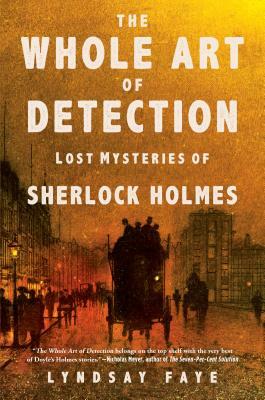
Review 2527: The Whole Art of Detection: Lost Mysteries of Sherlock Holmes

I knew this book might not be a good fit for me, because I usually feel that mystery short stories are too short to do much but pose puzzles, but more importantly, because I usually think it is unsuccessful when an author continues another author’s work. However, I have generally enjoyed Lyndsay Faye’s books, so I tried this one.

Purporting to be lost stories, notes, and diary entries, most by Dr. Watson but some by Holmes, this book’s 15 stories span the time from before the two met until 1902.

I am not going to run through a description of each story. Instead, I’ll comment on how authentic Faye’s stories seemed as stories about Holmes, keeping in mind that I haven’t read a Holmes story in years.

First, how much like the originals are Faye’s Holmes and Watson? Faye clearly is very familiar with the books (this applies to pretty much all the things I’ll look at, not just this one) because she makes lots of references to other cases and certainly has down Holmes’s characteristics. However, it seemed to me that her Holmes is more of a Benedict Cumberbatch Holmes than an Arthur Conan Doyle one. For one thing, he is much more expressive of emotions, more so even than Cumberbatch, especially as the book goes on. Watson seems himself, only even more flowery of description, but smarter. Also, like in the B. C. version mentioned above, his war service is stressed a lot more.

What about the mysteries? Well, you’re reading the words of a person who never once guessed the solution of a Sherlock Holmes story—until now. On the one hand, Faye’s stories are not nearly as ridiculously overcomplicated and unlikely as Doyle’s (spoilers for ACD!)—teach a snake to crawl down a rope? while dying, say “the speckled band” instead of “a snake bit me”? On the other hand, it seemed ridiculously easy to guess at least portions of the solution for most of the stories (unlike in Faye’s other mysteries—this is what I mean by mystery short stories—they’re either totally opaque or too easy). For instance, in “The Case of Colonel Warburton’s Madness,” I guessed immediately that (spoilers) gaslighting was involved and who was doing it. I just didn’t know how. Later in a story about identical twins, I knew immediately that the twins had switched.

Faye writes well and keeps up the interest. I just wish she’d write more of her own stuff.
Related Posts

Seven for a Secret

Back to the Garden

The Edinburgh Mystery and Other Tales of Scottish Crime

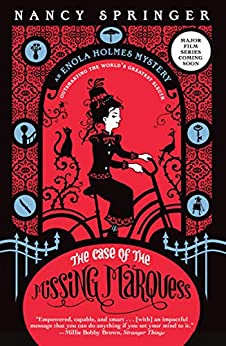
Review 1707: The Case of the Missing Marquess

My husband and I enjoyed watching Enola Holmes over the Christmas holidays, so I decided to give the first book in the series a try. I had assumed it would be YA, but it is actually marked for middle grades.

Enola Holmes, who is the younger sister of Mycroft and Sherlock, finds that her mother has disappeared on Enola’s 14th birthday. When her brothers, who have not come home for 10 years, respond to her telegram, they have some unpleasant surprises in store—Enola that Mycroft is more interested in sending her to boarding school than in finding their mother and Mycroft that the money he’s been sending for the upkeep of the estate has clearly not been spent on the estate. Sherlock is just determined to find their mother.

Enola is offended at some slighting remarks Sherlock makes about her intelligence and is determined not to go to boarding school. Having figured out that her mother has left her some clues and hidden some money, Enola disguises herself as a widow and leaves the house to search for her mother. On the way, she hears that the 12-year-old Marquess of Tewksbury has disappeared and finds the first clues to his disappearance.

I always judge books by how much they entertain me, and I have to say, this one is probably very entertaining for a 12-year-old but was lacking for me. I can’t tell whether this is because I recently saw the movie—which really only borrowed the concept from the book—or not. Certainly, I found the movie sharper in wit, more full of adventure, and more likely, at least in its conclusion. I also couldn’t help comparing this book to the Flavia de Luce series, which has a much more distinctive voice and is much funnier. However, as reading for kids this is good fun.

Related Posts

The Sweetness at the Bottom of the Pie

A Red Herring without Mustard

I Am Half Sick of Shadows

Review 1549: The Strange Case of the Alchemist’s Daughter

Readers Imbibing Peril XV was just announced for books in September and October, and just by coincidence, here is my first entry.

Theodora Goss must really like Victorian and earlier monster stories. In The Strange Case of the Alchemist’s Daughter, she brings together characters inspired from Robert Louis Stevenson, H. G. Wells, Mary Shelley, and Bram Stoker, adding in Sir Arthur Conan Doyle and Nathaniel Hawthorne for good measure.

Mary Jekyll’s mother has just died, and Mary has been left in near poverty. While going through her father’s papers, she finds that her mother was paying monthly sums for the support of Hyde. Thinking that if Mr. Hyde was alive, he might be responsible for the series of grizzly Jack the Ripper murders, she goes to Sherlock Holmes to find out how she might investigate and claim the reward for solving the case.

Dr. Watson comes with her to the address on the invoices to what turns out to be a home for fallen women. There they find, not Mr. Hyde, but a teenage girl named Diana Hyde, who calls her sister.

When Mary and Diana continue to investigate their father’s papers, they take up with Beatrice Rappachini, whose father changed her to breathe poison; Catherine Moreau, half woman, half panther; and Justine Frankenstein. They all begin working with Holmes and Watson to try to solve the killings.

At first, this seemed like a fun book for light reading. It was written in a jaunty style, with characters interrupting as Catherine writes their story, and it seemed entertaining and clever. By 50 pages in, I felt I had figured out everything important, just not the details. By 100 pages in, the story was beginning to flag. The characters didn’t have discernible personalities. It struck me that Holmes, for example, is described as being full of himself when he hasn’t behaved that way.

I finally stopped about halfway through, because I still had 200 pages to read and I wasn’t enjoying myself. What had started out seeming a clever idea got old and was too over the top.

Related Posts

Dust and Shadow

The Bloody Chamber

The New Annotated H. P. Lovecraft: Beyond Arkham

Day 1245: Moriarty

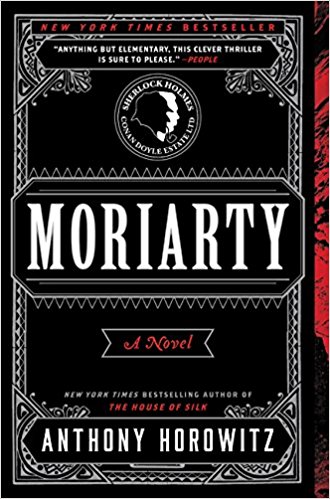
Cover for MoriartyDespite not being a fan of Sherlock Holmes-based contemporary mysteries, I read Moriarty because I recently enjoyed Magpie Murders. In this case, Sherlock Holmes does not appear, and the only link to the older mysteries, aside from a few characters, is Moriarty himself.

The novel begins right after the Reichenbach Falls incident, when both Holmes and his nemesis, Moriarty, are assumed dead. The body of one man, identified as Moriarty, is found.

Shortly after the incident, two detectives arrive on the scene. One is Frederick Chase, an investigator from Pinkerton’s in the United States. The other is Inspector Athelney Jones from Scotland Yard. Chase reports that he has been following Moriarty with information that he was meeting with Clarence Devereaux, a criminal mastermind from New York who purportedly wants to join forces with Moriarty. No one has ever seen Devereaux, but the Pinkertons understand he suffers from extreme agoraphobia. Chase and Jones team up to find him.

This, however, is not an easy quest. Every time the two men get a lead, someone is murdered. Soon, the two investigators must fear for their own lives.

I found this novel clever, but there was something missing from it. I don’t know how else to describe my reaction. I was just a little underwhelmed, even though there were twists and turns.

Related Posts

Magpie Murders

Moriarty

Mr. Timothy

Day 402: Dust and Shadow

Cover for Dust and ShadowIn Dust and Shadow: An Account of the Ripper Killings by Dr. John H. Watson, Lyndsay Faye combines a great deal of research into the Jack the Ripper killings in 1888 with a vast knowledge of Sherlock Holmes literature to offer an entertaining solution to the crimes. The novel begins nearly 50 years after the events, when Dr. Watson places his narrative of the murders into a safety deposit box on the eve of war.

Inspector Lestrade comes to consult Holmes after the second murder, when police begin to realize the two deaths may be linked. Holmes immediately begins pursuing his usual means of detection–inspecting the body and the scenes of the crimes, trying to find out where the victims were last sighted, questioning the victims’ friends–and he very quickly figures out that another murder is related. He even hires an alert young prostitute, Mary Ann Monk, to make her own enquiries and observations after she identifies the body of her friend, Mrs. Nichols. However, he is soon frustrated by his lack of progress. The only lead Holmes has come across is the story of an elusive sailor, being sought by a friend who thinks he may have been involved in the first murder, that of Mrs. Nichols.

Soon Holmes and Watson have something else to worry about, for a member of the press is printing details of the crimes unknown to but a few. He has been alleging that Holmes himself may be the murderer.

Faye’s novel is atmospheric and absorbing. Its greatest accomplishment, though, is in successfully capturing the narrative style of Doctor Watson, making us believe that this could be a Holmes story. Although I was about 100 pages ahead of Holmes in solving the murder (which would never happen in a real Holmes story), I still found the solution ingenious as well as the reason why the crimes are recorded in history as unsolved (when, of course, Holmes solved them). This novel is a very good first effort. I have Faye’s next book awaiting me in my pile.

Day 299: Moriarty

Cover for MoriartyI thought the idea of a novel written from the point of view of Sherlock Holmes’ nemesis, Professor James Moriarty, was an interesting one, but since I always found the Moriarty plot tedious, I now wonder why I thought so. When I opened the book cover to find that John Gardner is the author of many, many series novels and Moriarty is one of them, I was further dismayed, not generally being a fan of series writing (although I have a small number of favorites) and being even more skeptical of someone who writes many different series. Moreover, don’t be mislead into thinking this is a Sherlock Holmes mystery–this novel is missing Sherlock Holmes entirely and it isn’t really a mystery.

The novel opens with two introductions, both putting forward the pretense that the novel  is based on newly discovered diaries of Moriarty, which cannot be reproduced because of their vile content. I suspect the truth is that Gardner found himself unable to sustain a convincing 19th century writing style, this hunch seeming to be confirmed by the modern writing style of the book and the dialogue.

The plot concerns Moriarty’s attempts to re-form his criminal empire after an absence of several years following the Reichenbach Falls incident, in which, if you’ll remember, Conan Doyle attempted to kill off both Holmes and Moriarty. In Moriarty’s absence, other criminals have taken over his various enterprises.

Although not badly written, the novel completely failed to capture me. I was not interested in any of the characters and in fact thought they made unconvincing and boring criminals. One incident early in the book that is artificially spun out by going back and forth in time and place is confusing, and such a device seems totally unnecessary.

All in all, I found the novel tedious and only finished about a third of it before quitting.