Review 2498: Novellas in November! Envy

It wasn’t until I was getting ready to post this review that I realized that at 152 pages it qualifies for Novellas in November!

I read Envy right after Dostoevsky’s The Gambler, and perhaps that was too much for me. The two short Russian novels have a lot in common even though they were written more than 60 years apart. They both feature young male narrators in a frenzy and easily offended. They both have long philosophical speeches that doesn’t seem to mean much. Olesha leans more into Absurdism, but Dostoevsky can be pretty absurdist himself.

Andrei Petrovich Babichev is a model Soviet citizen, a trust director in charge of food. He has literally picked our narrator, Nikolai Kavalerov, up from the gutter and given him a bed on his sofa. Andrei Petrovich is fat and self-satisfied, true, but Nikolai hates everything about him.

Then he meets Andrei’s brother, Ivan, a sort of buffoon who makes up ridiculous stories and also hates Andrei.

Andrei’s claim to fame is a huge communal dining hall he’s building, where food is supposed to be good and cheap. He has also produced a good, inexpensive sausage that he’s proud of. Olesha is clearly making fun of these accomplishments, and I don’t know how he got away with it in 1927 Soviet Union.

There is lots of talk about the New Man that Communism is going to produce but no sign of one. (Coincidentally, I am reading The Possessed by Dostoevsky right now, and there’s lots of talk about the New Man in it, too; only apparently he’s supposed to be produced by Nihilism.)

Thanks to the publisher for sending me this book in exchange for a free and fair review.

Related Posts

Life and Fate

The Gambler

Memories: From Moscow to the Black Sea

Review 2497: Novellas in November! School for Love

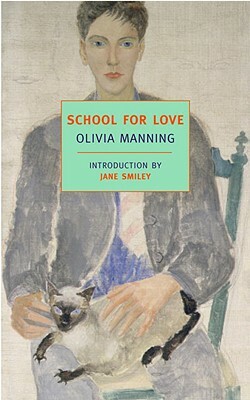
This year, I thought I’d try to pop some novellas into my October reading so that I could participate in Novellas in November, hosted by Bookish Beck and Cathy of 746 Books. I actually read School for Love for my Century of Books project, but was delighted to see that at 191 pages, it qualified for this one, too.

Felix Latimer arrives during a snowstorm in Jerusalem from Baghdad. He is newly orphaned, his father having been killed during the war (WW II) and his mother having recently died from typhoid. So, he is being taken in by a family connection, a woman named Miss Bohun who runs a boarding house, until he can get on a boat to England. The war is winding down, but at this point places are reserved for soldiers and government personnel.

Felix is in his mid-teens, but for a long time I took him for much younger. He has been taught by his mother to look for the good side of people, and he is disposed to be grateful to Miss Bohun, but readers see her another way right from the beginning. Although she runs a fringe religious organization and talks about good works, early on she sits down with Felix to figure his share of expenses and while adding up her household expenses, includes some things twice, then remarks that they should divide the costs in half even though she has another boarder (although admittedly, he is very poor and we don’t know how much he pays). Even so, his half of £36 mysteriously ends up at £21, leaving him pocket money of only a few pounds a month. (Later, she tries to raise the rent to take the full amount.) She also feeds the boarders poor and scant food.

At first, Miss Bohun confides in him and he is confusedly willing to take her part in her concerns. Although we learn that she has stolen Frau Leszno’s house and furnishings from her by putting the house into her own name to “protect” it, and actually uses Frau Leszno as a servant, Felix is ready to take Miss Bohun’s part because Frau Leszno seems so unpleasant. He likes Mr. Jewel, the other tenant who lives in the attic, but he still takes Miss Bohun’s part when she tells him he has to leave the next day, even though he has nowhere to go. (He ends up in the hospital.)

Miss Bohun is scheming, we find, to oust Mr. Jewel and move up into his attic herself so that she can rent her room to Mrs. Ellis, a young widow. Once Mrs. Ellis appears, Felix is smitten, and he begins to see the other side of Miss Bohun after taking in Mrs. Ellis’s sarcastic remarks. We eventually learn that Miss Bohun has promised Mrs. Ellis the whole house in the fall, a promise she has no intention of keeping. In fact, we realize all along that she has been trying to replace her tenants with more wealthy or prestigious ones, with the idea of getting more rent.

Although there is some action, most of the novel is concerned with the interactions among these characters and a few more. Felix begins to wake up to some realities.

The portrayal of Miss Bohun is a masterly one as we note her constant hypocrisies. As for love, although Felix begins with a crush on young Mrs. Ellis, it’s only really between Felix and a little cat, Faro.

Related Posts

The Great Fortune

The Spoilt City

Friends and Heroes

Review 2472: 2024 Dostoevsky Read-A-Thon: The Gambler

The Gambler is known as Dostoevsky’s most autobiographical novel, written in 26 days to foil the claims of an unscrupulous publisher. For Dostoevsky himself was a gambling addict and made a fool of himself over a girl called Polina when he was much older than his fictional alter ego. I read The Gambler for the 2024 Dostoevsky Readathon hosted by Russophile Reads. You can read his much more thorough evaluation of The Gambler here.

Alexey is a tutor for a Russian family returning at the opening of the story from two weeks’ leave to a German spa and gambling town. He works for the General tutoring his young niece and nephew and he is madly in love with Polina, the General’s older niece.

The General is broke, although he is madly pretending not to be. In fact, during his leave, Alexey has been pawning things for Polina. The General is in love with a Frenchwoman named Blanche, who is clearly after the money he expects to get when his aunt dies. Also hanging around are a Frenchman named des Grieux, whom the General has been borrowing money from and who has his eyes on Polina, and a rich Englishman whom Alexey likes named Mr. Astley.

As usual with Dostoevsky’s main characters, Alexey is in a sort of frenzy, this one of love for Polina. In attempts to gain some kind of equality with the other characters, he instead repeatedly shows his immaturity.

I have read most of Dostoevsky’s novels but I didn’t realize he could be funny until this one. The General hears that his aunt is ill and may be dying, so he keeps sending telegrams asking if she is dead in his desperation to seal the deal with Blanche. Suddenly, his aunt, called Grandmother in the novel because she is Polina’s grandmother, appears in town. And does she appear. She takes over the novel until she departs, making Alexey her escort to the casino, where she at first wins a lot of money.

Then loses it, but has the sense to go home. In the meantime, she disinherits the General. She is the most truly Russian character in the novel, with the other Russians trying to pretend they are cosmopolitan.

Eventually, we learn from Alexey’s experience what it’s like to be a gambling addict. For Alexey goes to the casino to try to win enough money to help Polina.

This is a short, sometimes funny, sometimes sad but always lively story about Alexey’s inability to understand what is going on, and about greed in its various forms. Note that the story contains lots of stereotypes in depicting people from countries other than Russia.

Related Posts

The Brothers Karamazov

The Idiot

The Kreutzer Sonata Variations

Review 2304: Midwinter Murder

Even though I don’t always get on with mystery short stories, I’ve observed Midwinter Murder going around and thought it sounded like good winter reading. And so it proved to be.

For one thing, with Christie’s stories I didn’t feel that lack of characterization that I often feel with other mystery short stories, since Christie is so deft at depicting characters with just a few strokes. Not all of these stories involved murders, and some are quite benign. Poirot appears in several, Miss Marple in one, Tommy and Tuppence in one, and in two, a Mr. Satterthwaite and his mysterious friend, Mr. Quin.

“The Clergyman’s Daughter,” about a woman who inherits a house only to find odd things happening in it, was unfortunately already included in Partners in Crime, which I read last year. Similarly, the Miss Marple story, “A Christmas Tragedy,” was included in The Tuesday Club Murders.

Just for a change, I believe I preferred some of the more benign stories. For example, in “The Problem at Pollensa Bay,” Mr. Parker Pine receives a plea from an overprotective mother to find a way to get her poor son Basil away from a girl she deems unsuitable. But Mr. Pine doesn’t see anything wrong with the girl.

I also liked “The World’s End,” in which the mysterious Mr. Quin appears in a desolate location in Corsica to right a wrong.

And in “The Manhood of Edward Robinson,” Edward is a clerk who yearns for romance but his too-practical fianceé Maud thinks he’s a spendthrift and chides him when he tries to make a romantic gesture. Edward wins £500 in a contest and decides to spend it all on a sportscar then take it away for a day before Maud ruins his fun. And he has an unexpected adventure.

There are lots of stories with clever puzzles, for example, “Christmas Adventure,” in which Poirot figures out why there is a jewel in the plum pudding. But I thought I’d point out some of the more unusual stories.

Related Posts

Partners in Crime

The Tuesday Club Murders

The Christmas Card Crime and Other Stories

Review 2300: So Late in the Day

So Late in the Day is a collection of three of Claire Keegan’s short stories. Unfortunately for me, I had already read one of them, “Antarctica,” in her collection Antarctica. All three stories focus on relationships between men and women.

In “So Late in the Day,” we get to know Cathal. We follow him in the course of what was to be an important day for him, as he considers his relationship with his fiancée, referred to only as “she.”

In “The Long and Painful Death,” an unnamed writer starts a residency in the home once owned by a revered Nobel-Prize-winning author. On her first day, however, she has to deal with a visit from a man who claims he has permission to view the house but turns out to have a different agenda.

The story “Antarctica” was a reread for me. It’s about what happens when a married woman decides one time to have a fling.

As always with Keegan, the stories are written in lucid, precise prose. They reflect a good deal of cynicism about relations between the sexes.

Related Posts

Antarctica

Foster

Small Things Like These

Review 2296: Lament for Julia

I tried to read Lament for Julia several times, but I just couldn’t do it. Taubes’s father was a psychoanalyst who believed writing is a disease and her husband disapproved of it for religious reasons, so it’s no wonder it’s quite bizarre.

Lament for Julia is a novella that takes up more than half of the NYRB edition. It is narrated by a disembodied spirit that seems to be part of and not part of a girl named Julia Klopps. Since Taubes believed that each person is a multiplicity of selves, I took it more as another self. Nothing much seemed to be happening in the novella except Julia growing up and the second self obsessing about her, but I didn’t really find any of it interesting. The writing is beautiful, and the second self’s obsessions are akin to those of Humbert Humbert in Lolita. But while I found that novel fascinating, I found the novella too sexualized, too perverse, too Freudian, and too interested in dreams for my taste.

I tried reading some of the short stories, but “The Patient,” about a mental patient who lacks an identity, is told by her psychotherapist that her name is Judy Kopitz, and we seemed to be in for a rehash of Lament for Julia.

The next one was “The Sharks,” about a boy who keeps dreaming he is being eaten by sharks. (Julia also dreams of being eaten.) Nope, couldn’t do it.

I received this book from the publishers in exchange for a free and fair review.

Related Posts

Dangerous Ages

Murmur

Umbrella

Review 2291: Stories for Winter and Nights by the Fire

Here’s an appropriate book for the first day of the new year!

Stories for Winter is British Library Women Writers’ seasonal collection of 14 stories set in winter. They are arranged chronologically (sort of), starting with a story from 1902 by Edith Wharton and ending with one by Angela Carter for which a date is not given but may have been published in 1974. Most of them deal in some way with changes to society that affect women.

In “The Reckoning” (1902) by Edith Wharton, Mrs. Clement Westall has noticed a disturbing change in her husband’s behavior. He has begun lecturing on his radical views of marriage—views the couple agreed on when they married—when before he preferred not to discuss them. The problem is that Jula no longer thinks the same way—that if one of a couple finds they no longer are happy together, they should part.

In “My Fellow Travellers” (1906) by Mary Angela Dickens, Miss Lanyon tells a girl a story about why she believes in spiritual things. This story fits right into the Christmas tradition begun by Dickens’s grandfather, Charles.

In “The Woman Who Was So Tired” (1906) by Elizabeth Banks, “the little reporter” writes an article about a poor woman supporting a large family and then becomes embarrassed when it becomes very popular. Her boss thinks she made the situation up, but that’s not exactly what’s going on.

In “A Cup of Tea” (1923) by Katherine Mansfield, Rosemary Fell thinks she’s doing a charitable act by inviting a poor woman to tea. But she soon decides she’s made a mistake, highlighting the divide between rich and poor.

In “A Motor” (1922) by Elizabeth Bibesco, Eve spots her ex-lover’s car on the street and knows he is visiting his current lover.

In “Ann Lee’s” (1926) by Elizabeth Bowen, two women visit an expensive hat store only to have a slightly disreputable man insistently interrupt their shopping.

I couldn’t really get on the same wavelength with Elizabeth in “The Snowstorm” (1935) by Violet M. McDonald. A stranger talks her into a dubious adventure even though she has only met him once and found him irritating. I couldn’t really understand what he wanted to confide in her or why he wanted to handle it the way he did or why she even agreed to go, much less what happens afterward.

“November Four/Ffair Goeaf” (1937) by Kate Roberts follows a group of Welsh workers to town for the fair, and two women also try to buy a hat, with less success than the women in “Ann Lee’s.”

“My Life with R. H. Macy” (1941) shows a different side of New York than Wharton’s story—a satiric look at Shirley Jackson’s brief employment at Macys, where the workers are so degraded that they’re known by their employee numbers rather than their names.

“The Cold” (1945) by Sylvia Townsend Warner shows how different the staff who are ill are treated from the family.

As Simon Thomas points out in the Introduction, tea is very important to the British, and it is the offer of a cup of tea that begins an acquaintance in “The Prisoner” (1947) by Elizabeth Berridge. Miss Everton offers tea to a German prisoner of war, a young man who is part of a crew digging ditches near her house.

In “The Cut Finger” (1948) by Frances Bellerby, five-year-old Julia makes an upsetting discovery when she seeks help from her mother for her cut finger.

In “The Thames Spread Out” (1959) by Elizabeth Taylor, a mistress has an adventure that leads her to reconsider her relationship with her married lover while her house is flooded by the Thames.

Frankly, I had no idea what was going on with “The Smile of Winter” (1974?) by Angela Carter except someone is depressed.

Except really for one story, I very much enjoyed this collection. I received it from the publishers in exchange for a free and fair review.

Related Posts

Stories for Christmas and the Festive Season

Good Evening, Mrs. Craven: The Wartime Stories of Mollie Panter-Downes

:Let Me Tell You

Review 2243: Antarctica

Looking for more to read by Claire Keegan, I came across this collection of short stories written in the late 1990s.

In the title story, a happily married woman decides to try a one-night stand, with disastrous results.

In “Men and Women” a girl still young enough to believe in Santa gains some insight into her parents’ relationship.

“Where the Water’s Deepest” contrasts the care an au pair has for a boy with her employer’s disdain of her.

“Love in the Tall Grass” tells what happens after Cordelia’s married lover asks her to wait for him for ten years.

“Storms” is about a young girl’s memories of her mother, who has been put away in an asylum.

These are summaries of the first few stories, but there are several others. Many of them are about the mistreatment of women by their partners. Keegan’s writing is always beautifully lucid and her stories contemplative.

Related Posts

Small Things Like These

Not the End of the World

Flights

Review 2212: Crimes of Cymru: Classic Mystery Tales of Wales

This latest British Library Crime Classics collection features mystery and crime short stories written by Welsh authors or located in Wales. The stories were written from 1908 to the mid-1980s, and some of them are quite eerie in nature.

For example, in the 1936 story “Change” by Arthur Macken, holiday makers scoff when Vincent Rimmer tells them lights are on all night in the cottages of Tremant to keep the fairies away. Yet later a child is apparently exchanged by the fairies. Or is he?

In “The Way Up to Heaven,” Roald Dahl (born in Wales) tells the story of Mrs. Foster, whose husband purposefully torments her by being late even on the way to her flight to Paris to see her grandchildren for the first time. She figures out a way to take care of that problem.

In “No More A-Maying” by Christina Stead, the lies of two children with a guilty secret create an injustice in rural Wales.

Although most of the earlier stores are more traditional, “Water Running Out” by Ethel Lina White explains how Harvey deals with his aunt, who has been preventing his marriage to Annie for years by blackmail.

And another attempt to prevent marriage is perpetrated in “The Chosen One” by Rhys Davies. Rufus, whose family has occupied his cottage for hundreds of years, gets a note from his eccentric landlady, Audrey P. Vines, telling him his lease is up and she’s throwing him out.

This was one of the more entertaining and atmospheric of these collections that I have read. I usually like them, but prefer getting into a longer work.

I received this book from the publishers in exchange for a free and fair review.

Related Posts

The Edinburgh Murders and Other Tales of Scottish Crime

Final Acts: Theatrical Mysteries

Murder at the Manor

Review 2179: A Shock

If I hadn’t been reading A Shock for my James Tait Black project, I certainly would not have picked it out based on its description on the back cover: “a rondel of interlocking stories . . . both deracinated and potent with place, druggy but shot through with a terrifying penetration of reality.” How pretentious.

The stories are unusually linked, by characters but also by stories told in a pub. Although I found some of them interesting, I did not find them emotionally engaging, and the explicit sex in some of them is not my thing.

Notice that I haven’t said what they are about. That’s because it’s hard to describe, and a short recap of each story wouldn’t help. Although not exactly magical realism, some of the stories, while apparently set in reality, become a little fantastical.

And that’s what I have to say about that.

Related Posts

In a Strange Room

Sudden Traveler

Thunderstruck and Other Stories