Day 547: Signed Confessions

Cover for Signed ConfessionsI confess to only having read about half of the stories in Signed Confessions, which was not to my taste. The main characters in the first few stories are all unlikable men who have committed acts for which they desire forgiveness.

After his gay son’s suicide, an implacable attorney regrets how he treated his boy. He remembers an earlier time when as a young boy, he was cruel to a bereaved schoolmate and found how that cruelty gave him power. Another man deserts his family and then spends his time making up stories to tell in support groups.

These two stories are written in a virile style that seems like an imitation of writers like Philip Roth and Norman Mailer. The third comes from another genre—that of dark Jewish comedy. A Jewish man who plagiarizes insults ala Don Rickles to be funny is suddenly gripped with remorse and tries to beg forgiveness of some of his victims. I will admit that the results are a bit humorous.

Walker ties the first few stories together by giving a character in one story some characteristic that you can recognize and then bringing him in as an unnamed character in another story. In one case, the attorney of the first story throws legal terms into regular conversation, as does a member of a support group in the second story. My problem was that I couldn’t imagine a lawyer actually talking that way, especially one who was son of a lawyer. It seems more likely the behavior of someone who has taken one or two law courses.

In general, the stories are written in uninspired prose and show no signs of subtlety. The fourth story, “Ode to Billy Jeff,” is a little more thoughtful than the others. Nevertheless, I chose not to finish the collection.

A disclaimer here: I received this book from from the author in exchange for an honest review.
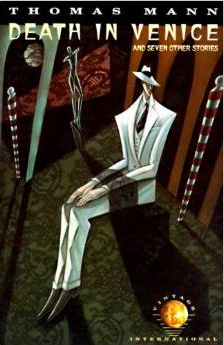
Day 544: Death in Venice

Cover for Death in VeniceGustave Aschenbach is a renowned author who has devoted his life to intellectual pursuits and his art. He leads an orderly life, conscientiously applying himself to his work.

One day when he is feeling over-taxed, he goes out for a walk and spots a red-haired man dressed as a traveler. Although the man appears to view him with disdain, at the sight of him Aschenbach is suddenly possessed with the desire to travel.

After stopping a few days on an island in the Adriatic, he decides to go to Venice. The city is gray and unwelcoming. The air is miasmic, and he wonders if he should have come. Then at the hotel he sees a beautiful boy. At first he simply enjoys looking at him, but eventually he becomes erotically fixated.

In writing this novella, Mann wanted to examine the relationship between art and the mind, a life of the senses and a life of intellect. At first, Aschenbach tries to rationalize his obsession by philosophizing about it. Mann makes many allusions to Greek mythology and calls the boy’s beauty godlike. But Aschenbach is lead inexorably into mental degradation. On the boat to Venice he was repelled by an older man, hair dyed and face rouged, who was traveling with a bunch of students. By the end of the novella, he has become that man.

While respecting the merits of the novella, I found Aschenbach’s obsessions and rationalizations repulsive, but I believe that is what Mann intended. In many ways, the story has similarities to Nabokov’s Lolita. However, while Nabokov’s language was beautiful enough to make me somehow grasp what Humbert Humbert felt, Mann’s was written with a different intent, I think.

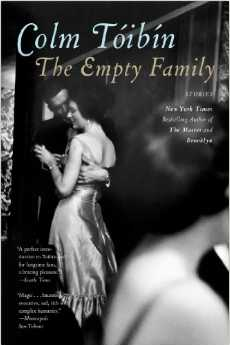
Day 517: The Empty Family

Cover for The Empty FamilyIn this collection of short stories, Colm Toíbín writes empathetically about the human condition. People remember how they have loved, their desire, their loneliness.

In the only historical fiction story, “Silence,” Lady Gregory tells Henry James a tale over dinner. Even though her story is not true, it encapsulates a kind of truth about her relationship with her lover during her marriage to her much older husband.

In “The Empty Family,” a man returns to a seaside village in Ireland after years of absence in California. He meets some old friends and considers his former life in that town and the life he just left.

In my favorite story, “Two Women,” an elderly Irish set dresser remembers her affair with the only man she ever loved. One day on the set where she is working, she meets his widow, the woman who married him after they parted.

In “One Minus One,” a man returns home to be with his dying mother. He is full of regret and longing because she never cared much for him.

These stories are precisely written, sad, and evocative.

Day 481: St. Lucy’s Home for Girls Raised by Wolves

Cover for St. Lucy'sDifficulties of youth and adolescence are the themes of Karen Russell’s unusual collection of short stories. Many of them are set in the Florida Everglades among bizarre and tacky theme parks or tourist destinations, where children sled through the sand on crab shells or visit enormous conches.

The first story, “Ava Wrestles the Alligator,” provides an introduction to the two sisters who are more fully developed in Russell’s later novel Swamplandia! Abandoned momentarily at their Everglades theme park home, Ava has a murky encounter with the Bird Man and tries to rescue her sister Osceola from her ghost lover. That story is expanded in the novel, which I really enjoyed.

Although certainly all are unusual, some of the stories are more bizarre than others. In “from Children’s Reminiscences of the Westward Migration,” a 19th century family makes a difficult crossing west, their wagon pulled by their father, the Minotaur. In the title story, human children of werewolves are sent away to be raised by nuns so that they can have a better life than their parents.

Russell’s stories are at once peculiar and oddly touching, full of young misfits who are even more out of place than all adolescents think they are. At times funny, such as the descriptions of the wolf-girls’ canine behavior when trying to adjust to their new school, the stories all reverberate with longing. Russell’s writing is brilliantly fierce and original, sparked by her own peculiar vision.

A few of the stories felt to me as if the author was just trying to think of the strangest ideas possible, and she almost lost me in “Lady Yeti and the Palace of Artificial Snows.” But ultimately, I enjoyed the stories, although I prefer the more developed characters and plot of Swamplandia!

Day 471: Unaccustomed Earth

Cover for Unaccustomed EarthBest Book of the Week!

Although all of the stories in Unaccustomed Earth feature characters who are immigrants and first-generation Americans of Indian descent, they are about a lot more than that. They are about the common problems of all people.

In the story “Unaccustomed Earth,” Ruma grieves over the loss of her mother while her father fears she is making the same life for herself that embittered his marriage to her mother. In “Hell-Heaven,” a girl observes her traditional mother’s infatuation with a young graduate student in light of her mother’s detached marriage with her father. Amit and his wife Megan try to create a romantic weekend while attending the wedding of a woman Amit once had a crush on in “A Choice of Accommodations.” The best of the stories are the last three, interlinked, about two people who meet each other several times at significant junctures of their lives.

Lahiri’s stories speak to us deeply. With details of life and human behavior so finely observed, they become stories about characters for whom we care.

I am generally a novel reader, because short stories often feel to me as if a lot is missing. But Lahiri’s gift is for saying so much in so few words. You find yourself pondering her stories and characters long after you stop reading. They reveal a profound insight into the human heart.

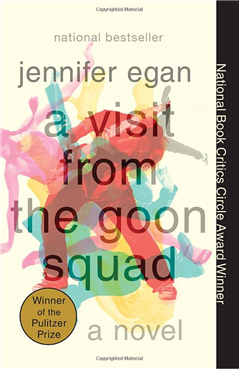
Day 339: A Visit from the Goon Squad

Cover for A Visit from the Goon SquadBest Book of the Week!

Describing this delightful and quirky novel is going to be difficult, so I hope curious readers will try it even if I am unable to convey a sense of it.

First, I call it a novel, but it can be just as accurately described as linked short stories. Each chapter is written from the point of view of a different character who knows one or more of the other characters. The chapters all center around the subjects of music and public relations.

The book begins in New York with Sasha, who is the assistant to Bennie, a music executive, sometime after 9/11. She is on a desultory date with Alex, but she also has a problem with kleptomania. While in the bathroom, she steals a woman’s wallet and then has to watch while Alex gets involved in helping the woman.

Next is a middle-aged Bennie, who torments himself with feelings of shame about past experiences. He takes his son to visit a sister act in order to fire them for not producing an album in the specified amount of time. He realizes he is beginning to see his legendary taste diverge from that of his younger coworkers.

Then we jump back thirty years to Rhea, a teenager in San Francisco who is a member of a punk rock band called the Flaming Dildoes with her friends Bennie (yes, the same Bennie), Scott, Alison, and Jocelyn. Rhea observes Jocelyn’s budding relationship with a middle-aged record executive named Lou, who will become Bennie’s mentor. Rhea is dismayed as Lou gives Jocelyn drugs and gets her to perform sexual acts in public.

These are just the first of the vignettes, which range forward and backward in time over 40 years and extend in structure to a touching PowerPoint presentation and a parody of a celebrity interview. They make stops in Arizona, Italy, and South America but somehow center on New York. Fans of Egan will already be familiar with a certain type of hip, aware New Yorker that appears in her fiction.

By turns funny, touching, and sharp as a razor, Egan’s observations are always entertaining and her intelligence apparent. An obvious theme of this work is the effect of time on characters but another one is how technology seems to have sped time up, the book ending in a futuristic world where public relations is centered on the tastes of babies. The PowerPoint chapter shows us that another theme is pauses, in music and in life.

One of the things I wanted to do when I finished reading A Visit from the Goon Squad was to read it again so that I could know what I was looking for from the beginning and fully understand all the connections. And that is what I plan to do, having inserted the book into my pile of future reading to enjoy again.

Day 338: Raylan

Cover for RaylanMy husband and I recently got hooked on the TV show Justified, which is just as surprising to us as to anyone who knows us, because it is fairly violent. One of the things we like about it is the well written, darkly humorous script. After we watched a couple of episodes, I paid more attention to the credits and discovered that the series is based on stories by Elmore Leonard, which explains a lot. It was with interest, therefore, that I discovered this book, titled after the main character in the series, Raylan Givens.

Marijuana growing has become the cash crop for Harlan County, Kentucky. As a deputy US Marshall, Raylan Givens isn’t concerned with drug enforcement. But Dickie and Coover Crowe have decided to expand their drug business by dealing in body parts. When Raylan tries to serve a federal warrant against Angel Arenas, another marijuana dealer with ties to the Mexican Mafia, he finds him bloody in his motel room with his kidneys removed.

Raylan is on to Dickie and Coover very quickly, as they’re not the brightest of bulbs. He is more interested in catching the doctor who is removing the organs, figuring the Crowe boys aren’t smart enough to cook up this scheme themselves.

This case is solved about midway through the novel, and Raylan gets roped into providing security for Carol Conlan, a representative for a coal company that wants to blast the top off the last remaining mountain in the area. Raylan is not sympathetic, but he is more concerned about the old man who was supposedly shot to death by Boyd Crowder after firing his shotgun at Carol. The old timers who knew Otis claim that if he was shooting at Carol, she’d be dead.

The writing is darkly humorous, with the style of the local dialect skillfully recreated. My problem with this novel is it has no focus except perhaps around the character of Raylan. It reads as if it were quickly put together from several short stories rather than plotted out as a novel. I was a little disappointed.

Day 242: The Tuesday Club Murders

Cover for The Tuesday Club MurdersThe Tuesday Club Murders is a collection of Miss Marple short stories structured around a club in which the members tell each other about crimes or mysteries and the others try to solve them. Of course, Miss Marple is the only member to get the right solution, even though some of the club members are eminent jurists and a Scotland Yard detective. As usual, the other members of the club, except a few most in the know, completely underestimate her.

I’m not that fond of crime short stories because there isn’t really enough room to develop much of a plot. In particular, the format chosen for this book is even more sketchy than usual because the characters involved are only described by the story tellers. You don’t end up with a mystery so much as a puzzle, and one that you probably don’t have enough information about to solve. But then, Christie often withholds information in her novels, too.

That being said, Christie’s biggest talent is her ability to sketch believable characters with just a few words. Of course, her humor is another asset. I may have only solved half the crimes, but I laughed a few times.

Day 36: Collected Stories of Carson McCullers

Cover of Collected Stories of Carson McCullersI sometimes feel frustrated with modern short works because I want them to tell more. Unlike short stories from earlier times, they don’t close any loops but simply capture a moment. This statement explains why I prefer the novel form and may not be very avant garde in my tastes.

Collected Stories of Carson McCullers contains a large number of short stories–some set in New York and some in the south–and two longer works, “The Ballad of the Sad Café” and “A Member of the Wedding,” only the last of which I had read before.

McCullers captures mostly sad moments, many of them autobiographical from what I understand from the introduction. Three of the stories are about her marriage to an alcoholic, although in one it is the wife who drinks.

Although McCullers is known as a “Southern Gothic” writer, the only piece in this collection that truly fits that description is “The Ballad of the Sad Café.” This story illustrates her ideas about love–that people love other people who are unattainable and that even the most unlikely people can be the recipients of adoration or even obsession. Several of the other stories are also about this theme.

“A Member of the Wedding” explores the unhappy adolescent, also one of McCullers’s themes. Frankie, a 12-year-old girl, becomes fixed on the idea that when her brother marries his fianceé they will take her with them on their honeymoon. She is obsessed with this idea and won’t allow herself to admit that they probably won’t. Her obsession is ultimately rooted in the degree to which she hates her town and herself.

Readers familiar with McCullers do not expect cheerful tales, but they are beautifully written and evocative.