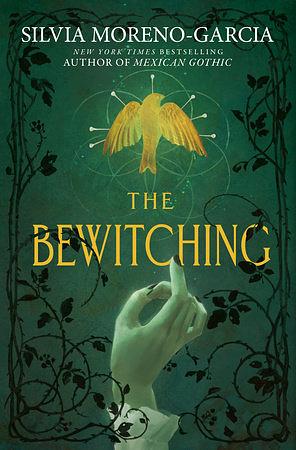
Review 2719: The Bewitching

Maybe this isn’t fair, but I make it a practice to write up every book I read, even if I don’t finish it. In this case, I didn’t get very far in at all.

I liked Moreno-Garcia’s Mexican Gothic well enough to finish it even though it was a slow starter and had a frankly ridiculous concept. (At least it was original.) However, it did maintain a suspenseful atmosphere. So, I picked up The Bewitching by impulse at the library.

This story, set in two time frames and two countries, is really a slow starter.

In 1998, Minerva is a graduate student at a New England university who is having trouble getting access to the information she needs about the life of horror writer Beatrice Tremblay for her Master’s thesis. (As a former graduate student in English, I would like to point out that biography is not a usual focus of literature theses.) Oh well, unexpectedly she gets a chance to talk to the woman who has the source material she needs.

In 1908 Mexico, Minerva’s grandmother Alba lives what she considers a provincial existence and is entranced by her sophisticated but apparently ne’er-do-well uncle.

This was such a slow starter, and I thought I could foresee at least part of silly Alba’s story. Each time the novel went back in time, her story kept slowing down whatever pace the more modern story managed to accumulate. I only made it about 50 pages but decided to quit when the narrative again slowed down to a slog. I generally am patient with slow-moving novels, especially if I’m being entertained in some way, but in this case, I just didn’t feel as if my patience was going to pay off.
Related Posts

Mexican Gothic

The Witching Tide

The Empusium

Review 2025: Mexican Gothic

It’s 1950 Mexico City. Noemí Taboada is a university student, but mostly she’s a socialite from a wealthy family aiming to have as much fun as possible.

Noemí’s father has received a disturbing letter from her cousin Catalina, who recently married a man no one knows very well. It sounds like Catalina is mentally disturbed. So, he asks Noemí to visit Catalina to find out what’s going on.

Catalina has married Virgil Doyle, the son of silver mine owners originally from England. But the silver has run out, and Noemí finds High Place a crumbling Victorian mansion. The family is not welcoming, and they impose a lot of rules, including only infrequent visits to Catalina. Catalina herself seems at first simply ill—she has tuberculosis—but later babbles about something listening, something in the walls.

Although the youngest son of the family, Francis, is friendly and helps her out, the rest of the family remains cold. Noemí herself begins having bizarre dreams.

Some readers may have a problem with how slowly this novel gets going, because the only thing that happens for quite a while is these dreams, but eventually the action picks up. Other readers have complained at the unlikelihood of the secrets revealed. That bothered me at first, but then I thought it was in the spirit of the original gothic novels. I decided it wasn’t any less likely than the notion of vampires or zombies and in these days a lot more original.

The novel is atmospheric, the heroine feisty, the ending quite suspenseful. It delivers what it promises.

Related Posts

Luckenbooth

Dark Enchantment

The Castle of Otranto