
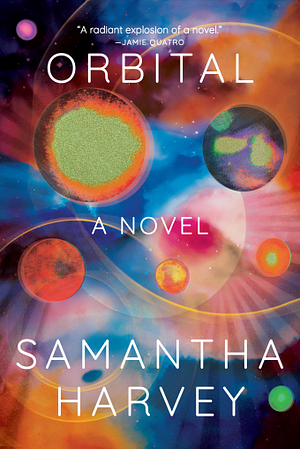
Orbital, the winner of last year’s Booker Prize, is unlike any novel I’ve ever read. I’m not even sure I would call it a novel.
It takes place over 24 hours in the International Space Station. It doesn’t have much of a plot or much characterization. It is mostly contemplative, examining the ideas Harvey imagines the astronauts might consider and making observations of her own.
There are six astronauts onboard—two Russian men, an English woman, a Japanese woman, an American man, and an Italian man. Two significant events are taking place that day outside the space station—a ship is headed to the moon and a super-typhoon is headed for the Philippines.
Pietro, the Italian astronaut, is worried about a Filipino family he and his wife befriended. Chie, the Japanese astronaut, has just heard that her mother died unexpectedly. Nell, the English astronaut, is worried about the growing distance between her own life and her husband’s in Ireland. Anton, one of the Russians, has realized he no longer loves his wife. But being so removed from the Earth simultaneously brings a love for the planet and a remove from it. The novel is about contemplation.
It is almost entirely descriptive, with very little dialogue. It is beautifully written, as it indulges in passages about the beauties of the earth.
For me, not a contemplative person, I could appreciate its qualities without being that engaged in it. That may be because I am interested in people. Miles up may be way too high for me.

 What? Me Read?