
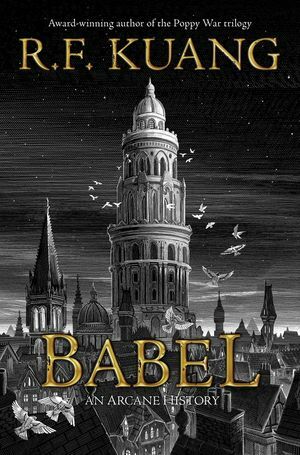
Knowing that this wasn’t my genre, I still decided to read Babel because it sounded interesting. I tried very hard, but it was a DNF for me at about 150 pages. I’ll tell you why in a bit.
A Chinese boy, later called Robin, is dying from cholera when he is mysteriously cured by the application of a silver rod by a stranger named Dr. Lovell. It is too late for Robin’s mother, however.
It is the first half of the 19th century, the height of the British Empire. It seems odd to Robin that once he is well, Dr. Lovell offers to make him his ward and have him educated. The doctor is not warm in his manner, but Robin accepts, suspecting it’s the doctor who has been sending his family books all his life and provided a Scottish nurse. For Robin is now fluent in both Cantonese and English. He also sees a strong physical resemblance between himself and Dr. Lovell.
Robin is educated in Latin and Ancient Greek for the next few years living in Dr. Lovell’s home in Hampshire. The doctor continues to be cold and in one case beats the boy badly for forgetting to go to a lesson.
Finally, Robin is sent to Oxford to study in the translation school, Babel. Besides translating books into English and writing grammar books, Babel’s mission is to handle silver, which can process magic spells through language. Robin makes friends with the other first years—Ramy, Letty, and Victoire, yes, girls at Oxford 100 years before they were let in. I’ll get to that in a minute.
Almost immediately, just as he’s introduced to this new, exciting life, Robin meets a man who looks almost identical to him. This is Griffin Lovell, an early protégé of Dr. Lovell’s, and he belongs to the Hermes Society, a secret group that steals Babel’s silver to give to the more deserving. And Robin helps them.
Before I get into my general problems with the historical angle, I thought it was a shame that Kuang brought the Hermes Society into the novel so soon. I would have liked to see what was going on in Babel without the distraction of the resistance movement. Kuang doesn’t even let Robin go to school for one day before he gets involved with them. That may turn out to be important for the plot. I don’t know, because I quit reading very quickly afterwards.
OK, here’s my problem with some of these genre-bending books. If you’re going to put a magical realism book or speculative fiction in a historical setting, at least get the details right. You can’t cheat by saying this is your alternate reality. Having girls in Oxford might squeak by as part of this invented school if the girls acted even remotely like 19th century women. Having some of the characters with social attitudes closer to 21st century ones I give a reluctant pass to, since some of these characters are from suppressed populations.
However, having the characters use words or think thoughts using words that are anachronistic—no. In one case, for example, Robin thinks about huffing a scent, that is, inhaling it. At that time, though, huffing meant breathing out. The word didn’t start meaning breathing in until the late-ish 20th century, and then it referred to breathing in drugs, although the usage may be more general now.
Another wrong detail is Robin’s casual use of a fountain pen. The problem is that although fountain pens had just barely been invented by then, they were not in general use until much later in the century. In the 1830s, they cost about £2000, although I don’t know whether that’s an amount that is adjusted for 2025 or not.
Historical novels need to get the details right, whether they’re genre bending or not. In my opinion, it’s only fair to change the details that apply directly to the alternate reality. Otherwise, writers are just being lazy.


 What? Me Read?